 Add to Chrome
 Add to Firefox
 Add to Edge
TGV-KV: Text-Grounded KV Eviction for Vision-Language Models
Jun 02, 2026
Vision-Language Models (VLMs) inherit the auto-regressive generation paradigm and cache the keys and values (KV) of all previous tokens to accelerate inference, resulting in memory consumption that scales linearly with context length. This issue is particularly pronounced in VLMs due to substantial redundancy in the visual modality. Although KV cache eviction approaches can effectively reduce inference memory, they often incur significant performance degradation in VLMs, as most are designed for language models and overlook the inherent gap between text and vision. By systematically analyzing the modality gap in VLMs in this work, we argue that the importance of visual information should be grounded in textual guidance and accordingly propose a Text-Grounded KV Eviction method for VLMs (TGV-KV). TGV-KV comprises three submodules: (1) Text-Vision Budgeting (TVB) assigns budget to each layer based on the mutual information interaction. (2) Text-Weighted Ranking (TWR) assesses the priority of text and ranks vision importance based on weighted text-image attention. (3) Text-Prioritised Retention (TPR) policy strategically preserves text KV to avoid acute information loss. We evaluate TGV-KV across five models with different sizes and architectures, showing that TGV-KV preserves 99.2% full-KV accuracy on the VizWiz-VQA task with LLaVA-NeXT and boosts end-to-end throughput by 52.6% with an extreme retention budget of 5%. Code is available at https://github.com/Danielement321/TGV-KV.

ConsisVLA-4D: Advancing Spatiotemporal Consistency in Efficient 3D-Perception and 4D-Reasoning for Robotic Manipulation
May 06, 2026Current Vision-Language-Action (VLA) models primarily focus on mapping 2D observations to actions, but exhibit notable limitations in spatiotemporal perception and reasoning: 1) spatial representations often rely on additional sensors, introducing substantial computational overhead; 2) visual reasoning is typically limited to future-frame prediction, lacking alignment with the instruction-grounded scene and thus compromising spatiotemporal consistency. To address these challenges, we propose ConsisVLA-4D, a unified and efficient framework that enhances spatiotemporal consistency in 3D perception and 4D reasoning. Specifically, we design: 1) CV-Aligner, which ensures cross-view object semantic consistency by filtering instruction-relevant regions and aligning object identities across multiple viewpoints; 2) CO-Fuser, which guarantees cross-object spatial geometric consistency by eliminating spatial relation ambiguities between objects across views using compact latent representations. Building upon these, we introduce 3) CS-Thinker to achieve cross-scene spatiotemporal consistency as actions unfold. It learns implicit knowledge of local dynamics from object-semantic tokens of CV-Aligner and global depth from geometric tokens of CO-Fuser, thereby enhancing efficient visual reasoning under scene variations. Extensive experiments demonstrate that, benefiting from its efficient spatiotemporal consistency design, ConsisVLA-4D achieves 21.6% and 41.5% performance improvements, along with 2.3-fold and 2.4-fold inference speedups compared to OpenVLA on the LIBERO benchmark and real-world platforms, respectively.ConsisVLA-4D is open-sourced and publicly available at
FM2S: Self-Supervised Fluorescence Microscopy Denoising With Single Noisy Image
Dec 13, 2024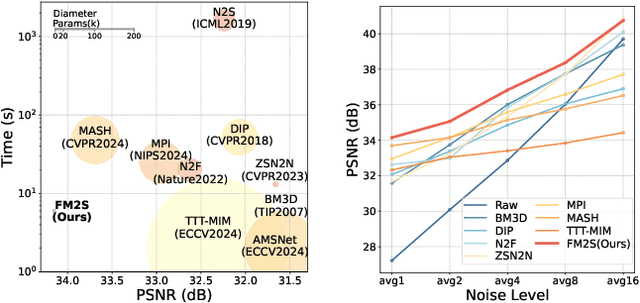
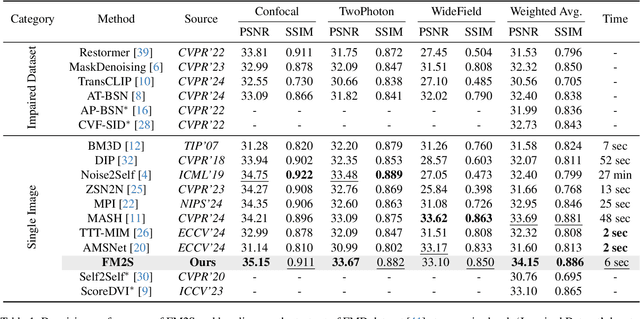
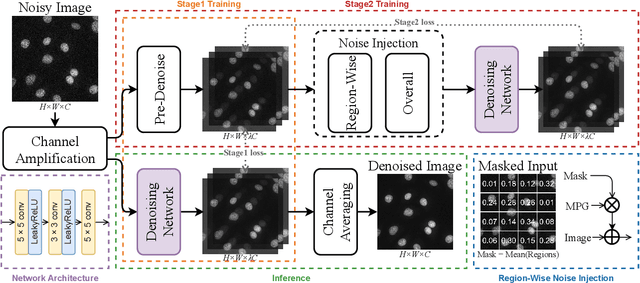

Fluorescence microscopy has significantly advanced biological research by visualizing detailed cellular structures and biological processes. However, such image denoising task often faces challenges due to difficulty in precisely modeling the inherent noise and acquiring clean images for training, which constrains most existing methods. In this paper, we propose an efficient self-supervised denoiser Fluorescence Micrograph to Self (FM2S), enabling a high-quality denoised result with a single noisy image. Our method introduces an adaptive global-local Noise Addition module for data augmentation, addressing generalization problems caused by discrepancies between synthetic and real-world noise. We then train a two-layer neural network to learn the mapping from the noise-added image to the filtered image, achieving a balance between noise removal and computational efficiency. Experimental results demonstrate that FM2S excels in various microscope types and noise levels in terms of denoising effects and time consumption, obtaining an average PSNR improvement of around 6 dB over the original noisy image in a few seconds. The code is available at https://github.com/Danielement321/FM2S.