 Add to Chrome
 Add to Firefox
 Add to Edge
Simple Lines, Big Ideas: Towards Interpretable Assessment of Human Creativity from Drawings
Nov 17, 2025
Assessing human creativity through visual outputs, such as drawings, plays a critical role in fields including psychology, education, and cognitive science. However, current assessment practices still rely heavily on expert-based subjective scoring, which is both labor-intensive and inherently subjective. In this paper, we propose a data-driven framework for automatic and interpretable creativity assessment from drawings. Motivated by the cognitive understanding that creativity can emerge from both what is drawn (content) and how it is drawn (style), we reinterpret the creativity score as a function of these two complementary dimensions.Specifically, we first augment an existing creativity labeled dataset with additional annotations targeting content categories. Based on the enriched dataset, we further propose a multi-modal, multi-task learning framework that simultaneously predicts creativity scores, categorizes content types, and extracts stylistic features. In particular, we introduce a conditional learning mechanism that enables the model to adapt its visual feature extraction by dynamically tuning it to creativity-relevant signals conditioned on the drawing's stylistic and semantic cues.Experimental results demonstrate that our model achieves state-of-the-art performance compared to existing regression-based approaches and offers interpretable visualizations that align well with human judgments. The code and annotations will be made publicly available at https://github.com/WonderOfU9/CSCA_PRCV_2025

ZPD-SCA: Unveiling the Blind Spots of LLMs in Assessing Students' Cognitive Abilities
Aug 20, 2025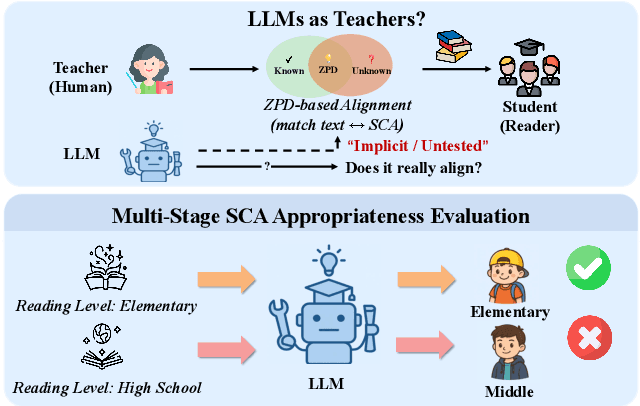

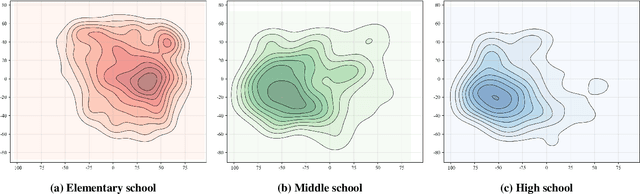
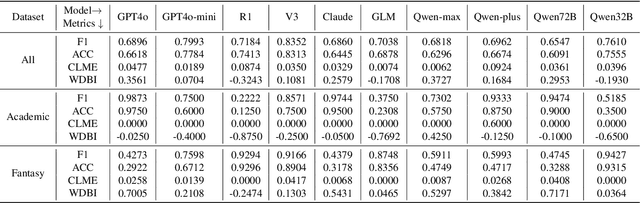
Large language models (LLMs) have demonstrated potential in educational applications, yet their capacity to accurately assess the cognitive alignment of reading materials with students' developmental stages remains insufficiently explored. This gap is particularly critical given the foundational educational principle of the Zone of Proximal Development (ZPD), which emphasizes the need to match learning resources with Students' Cognitive Abilities (SCA). Despite the importance of this alignment, there is a notable absence of comprehensive studies investigating LLMs' ability to evaluate reading comprehension difficulty across different student age groups, especially in the context of Chinese language education. To fill this gap, we introduce ZPD-SCA, a novel benchmark specifically designed to assess stage-level Chinese reading comprehension difficulty. The benchmark is annotated by 60 Special Grade teachers, a group that represents the top 0.15% of all in-service teachers nationwide. Experimental results reveal that LLMs perform poorly in zero-shot learning scenarios, with Qwen-max and GLM even falling below the probability of random guessing. When provided with in-context examples, LLMs performance improves substantially, with some models achieving nearly double the accuracy of their zero-shot baselines. These results reveal that LLMs possess emerging abilities to assess reading difficulty, while also exposing limitations in their current training for educationally aligned judgment. Notably, even the best-performing models display systematic directional biases, suggesting difficulties in accurately aligning material difficulty with SCA. Furthermore, significant variations in model performance across different genres underscore the complexity of task. We envision that ZPD-SCA can provide a foundation for evaluating and improving LLMs in cognitively aligned educational applications.