 Add to Chrome
 Add to Firefox
 Add to Edge
Near-Field Beam Focusing Characterization for 2D Waveguide-Fed Metasurface Antennas
May 05, 2026
Two-dimensional (2D) waveguide-fed metasurfaces enable scalable antenna apertures through guided wave excitation of distributed radiating elements. However, the resulting non-uniform excitation challenges classical interpretations of near-field characteristics. Using a physics-compliant model, this paper analyzes the near-field beam focusing behavior of such architectures. We derive asymptotic scaling laws for the beamforming gain, showcasing that the power-normalized gain scales linearly with the number of radiating elements. Furthermore, we introduce a normalized beam-depth formulation and obtain a compact analytic expression that characterizes the transition to far-field-like behavior. The presented analysis is validated against simulations based on the full electromagnetic model, confirming the accuracy of the derived scaling laws and beam-depth limits.

Robust Beamforming for Cell-Free Systems with Parallel-Plate-Waveguided Dynamic Metasurfaces
May 05, 2026Dynamic Metasurface Antennas (DMAs) constitute a promising solution for extremely large antenna arrays, requiring lower power consumption and reduced hardware cost as compared to conventional phased arrays. In this paper, we consider a cell-free Orthogonal Frequency Division Multiplexing (OFDM) system comprising multiple Base Stations (BSs) equipped with parallel-plate-waveguided DMAs, which aims to serve multiple users in the downlink direction. Focusing on a realistic frequency-selective model for the response-tunable elements of each DMA panel, and targeting to surpass the necessity of centralized designs that rely on a central processing unit with high computational power, we present a distributed optimization framework with minimal control information exchange for the frequency-selective analog and digital beamforming matrices of the multiple BSs, having the system spectral efficiency maximization as the design objective. Considering imperfect Channel State Information (CSI) availability at each BS, we devise a parallel decomposition framework for the configuration of the tunable parameters of each DMA-based BS. Our numerical results showcase the robustness of the proposed distributed beamforming design over different CSI conditions, and quantify the critical role of taking into account mutual coupling during the DMA design process.
A Near-Field Compatible Model for 2D Waveguide-Fed Metasurfaces
May 05, 2026This paper presents a novel physically consistent analytical model for two-dimensional (2D) waveguide-fed metasurface antennas that is based on the discrete dipole approximation. The proposed framework extends previous works deriving power-consistent constraints on the magnetic polarizability tensor, leading to closed-form expressions for the effective polarizabilities. The model is validated through full-wave simulations for multi-feed settings, and is extended to a near-field compatible~formulation enabling accurate predictions in the radiating near-field.
2D Waveguide-Fed Metasurfaces: Physically Consistent Modeling, Validation, and Optimization
May 04, 2026Antenna array architectures based on programmable metasurfaces are emerging as a promising solution for scalable implementations of the eXtremely Large Multiple-Input Multiple-Output (XL-MIMO) systems paradigm, envisioned for 6-th Generation (6G), and beyond, wireless networks. However, their accurate modeling, quantifying the role of key structural features, such as strong mutual coupling and guided-wave excitation, remains challenging, amplifying the need for physically consistent representations of the constituent metamaterial elements. In this paper, capitalizing on the coupled dipole formulation, we develop a comprehensive electromagnetics-compliant framework for 2-Dimensional (2D) waveguide-fed metasurface antennas. The proposed model extends relevant existing modeling approaches by incorporating both electric and magnetic dipoles' responses, accounting for multiple excitation feeds, and enabling accurate characterization in both the near- and far-field regimes. Radiation-reaction corrections based on passivity constraints are derived and shown to ensure the passivity of the overall dipole system. In addition, we present a novel input impedance model for the considered architecture enabling explicit computation of the accepted power, and facilitating efficient beamforming design under realistic power constraints. All modeling components developed in this paper are validated against full-wave electromagnetic simulations. Furthermore, the analytical structure of the proposed model enables the formulation of a differentiable beamforming design optimization problem over both the considered metasurface geometry and its feed excitations. The presented numerical results demonstrate the effectiveness of the proposed modeling framework in achieving both directive beamforming and sector-wide coverage.
2D Waveguide-Fed Metasurface Antenna Arrays: Modeling and Optimization for Bistatic Sensing
Nov 12, 2025This paper presents a physics-consistent framework for bistatic sensing incorporating a 2-Dimensional (2D) waveguide-fed metasurface antenna array capable of realizing eXtremely-Large Multiple-Input Multiple-Output (XL MIMO) apertures. A coupled-dipole model is presented that captures the array's mutual coupling due to both waveguide and free-space interactions, and a novel passivity constraint on the corresponding magnetic polarizabilities is proposed. Focusing on a bistatic sensing setup, we leverage a Neumann-series approximation of the array response model and derive the Cramer-Rao bound for multi-target parameter estimation, which is then incorporated into a sensing optimization formulation with respect to the metasurface's per-element resonance strength configuration. Simulation results on the position error bound in the radiative near field with the proposed design quantify the critical role of metamaterial placement in strongly coupled metasurface-based XL MIMO bistatic sensing systems.
MIMO Communications with 1-bit RIS: Asymptotic Analysis and Over-the-Air Channel Diagonalization
Nov 11, 2025This paper presents an asymptotic analysis of Multiple-Input Multiple-Output (MIMO) systems assisted by a 1-bit Reconfigurable Intelligent Surface (RIS) under Ricean fading conditions. Using random matrix theory, we show that, in the asymptotic regime, the dominant singular values and vectors of the transmitter-RIS and RIS-receiver channels converge to their deterministic Line-of-Sight (LoS) components, almost irrespective of the Ricean factors. This enables RIS phase configuration using only LoS information through a closed-form Sign Alignment (SA) rule that maximizes the channel gain. Furthermore, when the RIS is asymptotically larger than the transceiver arrays, proper RIS configuration can render the end-to-end MIMO channel in the capacity formula asymptotically diagonal, thereby eliminating inter-stream interference and enabling Over-The-Air (OTA) spatial multiplexing without channel knowledge at the transmitter. Building on this result, a waterfilling-inspired SA algorithm that allocates RIS elements to spatial streams, based on the asymptotic singular values and statistical channel parameters, is proposed. Simulation results validate the theoretical analyses, demonstrating that the proposed schemes achieve performance comparable to conventional Riemannian manifold optimization, but with orders of magnitude lower runtime.
Active RISs: Modeling and Optimization
Jul 22, 2025Reconfigurable Intelligent Surfaces (RIS)-empowered communication has emerged as a transformative technology for next generation wireless networks, enabling the programmable shaping of the propagation environment. However, conventional RISs are fundamentally limited by the double path loss effect, which severely attenuates the reflected signals. To overcome this, active RIS architectures, capable of amplifying impinging signals, have been proposed. This chapter investigates the modeling, performance analysis, and optimization of active RISs, focusing on two hardware designs: a dual-RIS structure with a single Power Amplifier (PA), and a reflection amplification structure at the unit cell level using tunnel diodes. For the PA-based design, a comprehensive mathematical model is developed, and closed-form expressions for the received signal-to-noise ratio, bit error probability, and Energy Efficiency (EE) are derived. An optimization framework for configuring the phase shifts and amplifier gain is proposed to maximize system capacity under power constraints. Regarding the second design, the integration of a tunnel diode into the unit cell is carefully studied by analyzing its I-V characteristic, enabling the derivation of the negative resistance range and the power consumption model. Furthermore, the intrinsic phase-amplitude coupling of the reflection coefficient is characterized through compact linear algebra formulations, enabling practical optimization of active RISs. Extensive numerical simulations validate the theoretical analyses, demonstrating that active RISs can effectively overcome the double path loss limitation and achieve favorable EE trade-offs compared to passive RISs. Finally, the trade-off between the available power budget and the number of active elements is examined, revealing that a higher number of active elements does not always lead to optimal performance.
Graph-CNNs for RF Imaging: Learning the Electric Field Integral Equations
Mar 18, 2025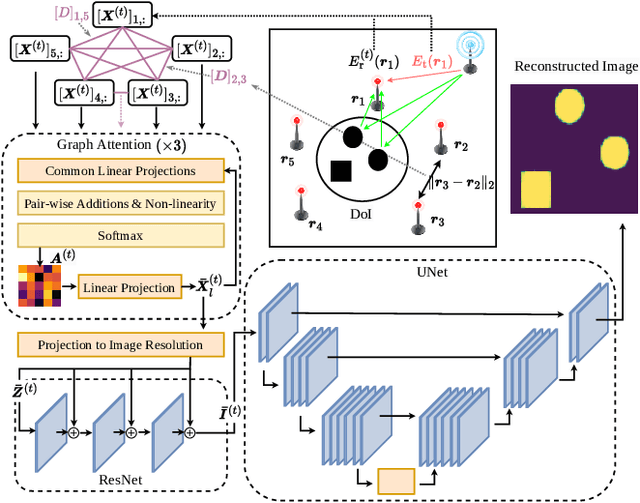
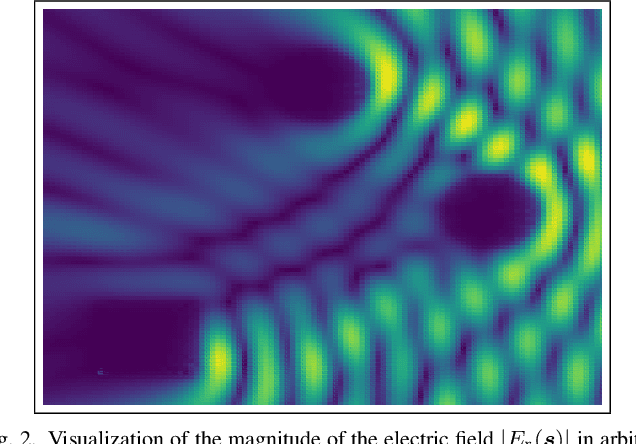
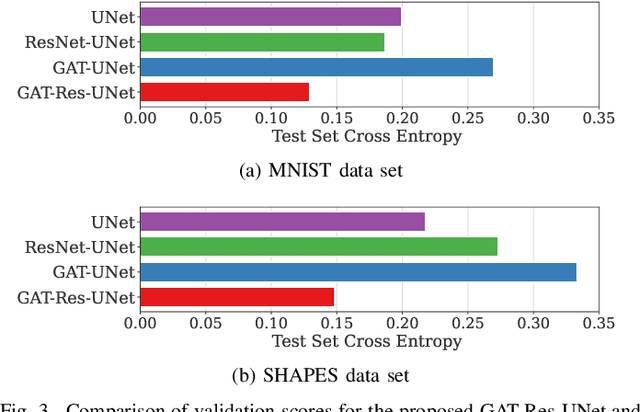
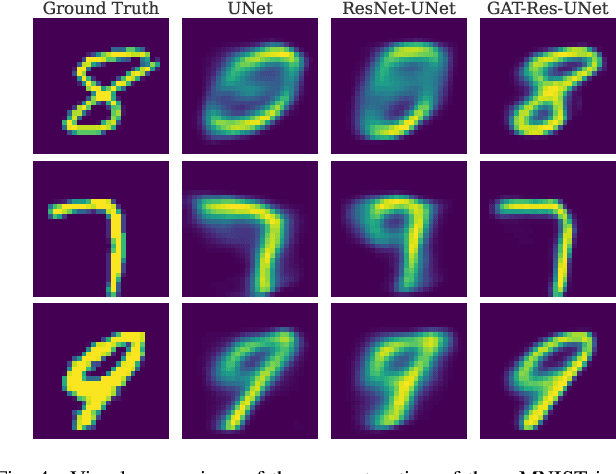
Radio-Frequency (RF) imaging concerns the digital recreation of the surfaces of scene objects based on the scattered field at distributed receivers. To solve this difficult inverse scattering problems, data-driven methods are often employed that extract patterns from similar training examples, while offering minimal latency. In this paper, we first provide an approximate yet fast electromagnetic model, which is based on the electric field integral equations, for data generation, and subsequently propose a Deep Neural Network (DNN) architecture to learn the corresponding inverse model. A graph-attention backbone allows for the system geometry to be passed to the DNN, where residual convolutional layers extract features about the objects, while a UNet head performs the final image reconstruction. Our quantitative and qualitative evaluations on two synthetic data sets of different characteristics showcase the performance gains of thee proposed advanced architecture and its relative resilience to signal noise levels and various reception configurations.
How Do Microstrip Losses Impact Near-Field Beam Depth in Dynamic Metasurface Antennas?
Mar 15, 2025The convergence of eXtremely Large (XL) antenna arrays and high-frequency bands in future wireless networks will inevitably give rise to near-field communications, localization, and sensing. Dynamic Metasurface Antennas (DMAs) have emerged as a key enabler of the XL Multiple-Input Multiple-Output (MIMO) paradigm, leveraging reconfigurable metamaterials to support large antenna arrays. However, DMAs are inherently lossy due to propagation losses in the microstrip lines and radiative losses from the metamaterial elements, which reduce their gain and alter their beamforming characteristics compared to a lossless aperture. In this paper, we address the gap in understanding how DMA losses affect near-field beamforming performance, by deriving novel analytical expressions for the beamforming gain of DMAs under misalignments between the focusing position and the intended user's position in 3D space. Additionally, we derive beam depth limits for varying attenuation conditions, from lossless to extreme attenuation, offering insights into the impact of losses on DMA near-field performance.
On the Detection of Non-Cooperative RISs: Scan B-Testing via Deep Support Vector Data Description
Nov 05, 2024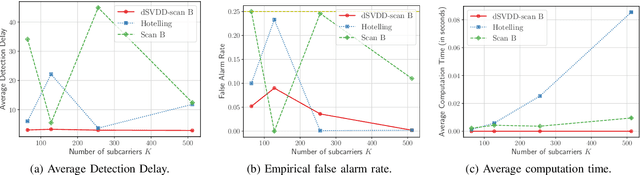
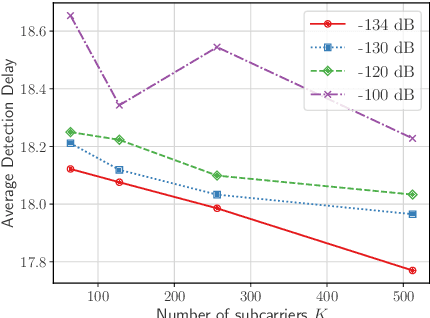
In this paper, we study the problem of promptly detecting the presence of non-cooperative activity from one or more Reconfigurable Intelligent Surfaces (RISs) with unknown characteristics lying in the vicinity of a Multiple-Input Multiple-Output (MIMO) communication system using Orthogonal Frequency-Division Multiplexing (OFDM) transmissions. We first present a novel wideband channel model incorporating RISs as well as non-reconfigurable stationary surfaces, which captures both the effect of the RIS actuation time on the channel in the frequency domain as well as the difference between changing phase configurations during or among transmissions. Considering that RISs may operate under the coordination of a third-party system, and thus, may negatively impact the communication of the intended MIMO OFDM system, we present a novel RIS activity detection framework that is unaware of the distribution of the phase configuration of any of the non-cooperative RISs. In particular, capitalizing on the knowledge of the data distribution at the multi-antenna receiver, we design a novel online change point detection statistic that combines a deep support vector data description model with the scan $B$-test. The presented numerical investigations demonstrate the improved detection accuracy as well as decreased computational complexity of the proposed RIS detection approach over existing change point detection schemes.