 Add to Chrome
 Add to Firefox
 Add to Edge
Compositional Semantic Communication for Physical AI: Category Theory Meets Game Theory
Jul 20, 2026
Physical artificial intelligence (AI) systems involve distributed sensing agents with embedded AI models that must coordinate to perceive, reason, and act in networked environments. Transmitting raw sensor data incurs significant communication overhead, latency, and redundancy. While semantic communication (SC) mitigates these challenges by transmitting task-relevant information, existing deep learning-based joint source-channel coding approaches exhibit limited adaptability, poor out-of-distribution generalization, and scalability challenges. To address these limitations, this paper proposes a framework for compositional semantic communication (CSC), enabling heterogeneous physical AI sources to transmit semantic representations (SRs) that compose meaningfully at a base station (BS) or edge server for remote inference. First, a category-theoretic measure of compositional semantics is developed to quantify each device's contribution to inference tasks beyond mutual information. Second, Grothendieck topologies and presheaves formalize semantic composition across devices, ensuring consistency and task relevance. Building on these foundations, multi-device coordination is formulated as a Stackelberg game in which devices commit to encoding strategies and the BS optimally composes received SRs. An ADMM-based algorithm computes equilibrium signaling strategies. Equilibrium existence is established under mild conditions and is Pareto optimal when compositional information yields increasing collective benefit. Simulation results demonstrate that the proposed approach achieves up to 17% bandwidth reduction and 53% lower end-to-end latency than cooperative multi-agent, distributed gradient descent, and uniform-selection CSC baselines while maintaining 85% inference accuracy across diverse autonomous driving scenarios.

Federated Latent Space Alignment for Multi-user Semantic Communications
Feb 19, 2026Semantic communication aims to convey meaning for effective task execution, but differing latent representations in AI-native devices can cause semantic mismatches that hinder mutual understanding. This paper introduces a novel approach to mitigating latent space misalignment in multi-agent AI- native semantic communications. In a downlink scenario, we consider an access point (AP) communicating with multiple users to accomplish a specific AI-driven task. Our method implements a protocol that shares a semantic pre-equalizer at the AP and local semantic equalizers at user devices, fostering mutual understanding and task-oriented communication while considering power and complexity constraints. To achieve this, we employ a federated optimization for the decentralized training of the semantic equalizers at the AP and user sides. Numerical results validate the proposed approach in goal-oriented semantic communication, revealing key trade-offs among accuracy, com- munication overhead, complexity, and the semantic proximity of AI-native communication devices.
Semantic Waveforms for AI-Native 6G Networks
Feb 10, 2026In this paper, we propose a semantic-aware waveform design framework for AI-native 6G networks that jointly optimizes physical layer resource usage and semantic communication efficiency and robustness, while explicitly accounting for the hardware constraints of RF chains. Our approach, called Orthogonal Semantic Sequency Division Multiplexing (OSSDM), introduces a parametrizable, orthogonal-base waveform design that enables controlled degradation of the wireless transmitted signal to preserve semantically significant content while minimizing resource consumption. We demonstrate that OSSDM not only reinforces semantic robustness against channel impairments but also improves semantic spectral efficiency by encoding meaningful information directly at the waveform level. Extensive numerical evaluations show that OSSDM outperforms conventional OFDM waveforms in spectral efficiency and semantic fidelity. The proposed semantic waveform co-design opens new research frontiers for AI-native, intelligent communication systems by enabling meaning-aware physical signal construction through the direct encoding of semantics at the waveform level.
Semantic Channel Equalization Strategies for Deep Joint Source-Channel Coding
Oct 06, 2025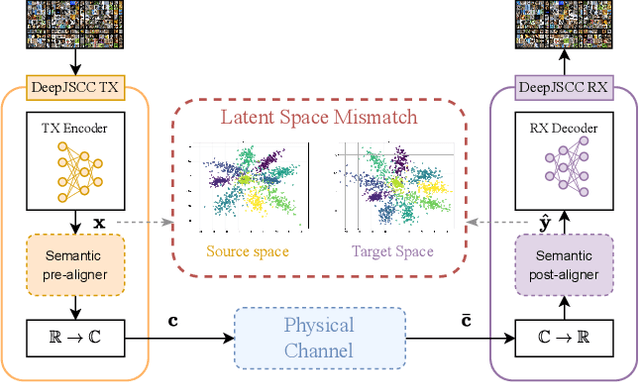
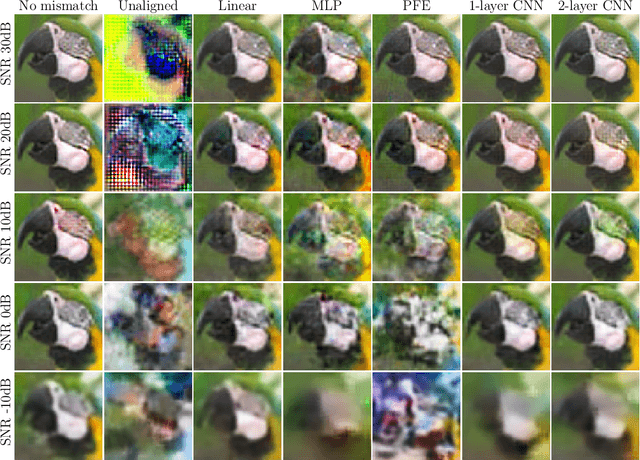
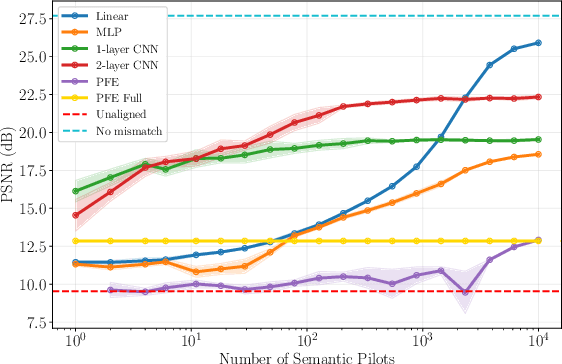
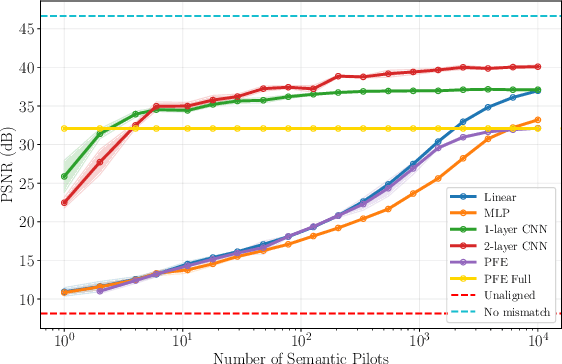
Deep joint source-channel coding (DeepJSCC) has emerged as a powerful paradigm for end-to-end semantic communications, jointly learning to compress and protect task-relevant features over noisy channels. However, existing DeepJSCC schemes assume a shared latent space at transmitter (TX) and receiver (RX) - an assumption that fails in multi-vendor deployments where encoders and decoders cannot be co-trained. This mismatch introduces "semantic noise", degrading reconstruction quality and downstream task performance. In this paper, we systematize and evaluate methods for semantic channel equalization for DeepJSCC, introducing an additional processing stage that aligns heterogeneous latent spaces under both physical and semantic impairments. We investigate three classes of aligners: (i) linear maps, which admit closed-form solutions; (ii) lightweight neural networks, offering greater expressiveness; and (iii) a Parseval-frame equalizer, which operates in zero-shot mode without the need for training. Through extensive experiments on image reconstruction over AWGN and fading channels, we quantify trade-offs among complexity, data efficiency, and fidelity, providing guidelines for deploying DeepJSCC in heterogeneous AI-native wireless networks.
Joint Channel and Semantic-aware Grouping for Effective Collaborative Edge Inference
Oct 02, 2025We focus on collaborative edge inference over wireless, which enables multiple devices to cooperate to improve inference performance in the presence of corrupted data. Exploiting a key-query mechanism for selective information exchange (or, group formation for collaboration), we recall the effect of wireless channel impairments in feature communication. We argue and show that a disjoint approach, which only considers either the semantic relevance or channel state between devices, performs poorly, especially in harsh propagation conditions. Based on these findings, we propose a joint approach that takes into account semantic information relevance and channel states when grouping devices for collaboration, by making the general attention weights dependent of the channel information. Numerical simulations show the superiority of the joint approach against local inference on corrupted data, as well as compared to collaborative inference with disjoint decisions that either consider application or physical layer parameters when forming groups.
Collaborative Edge Inference via Semantic Grouping under Wireless Channel Constraints
Oct 02, 2025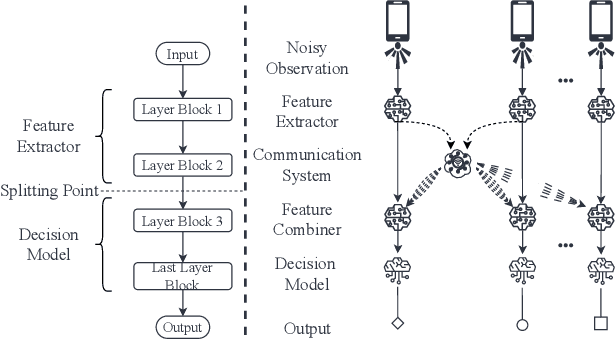
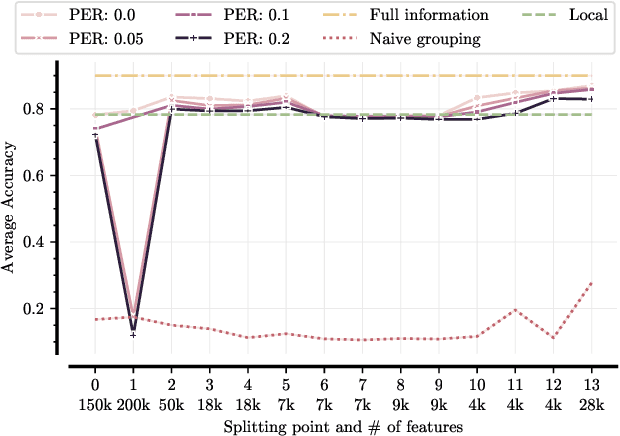
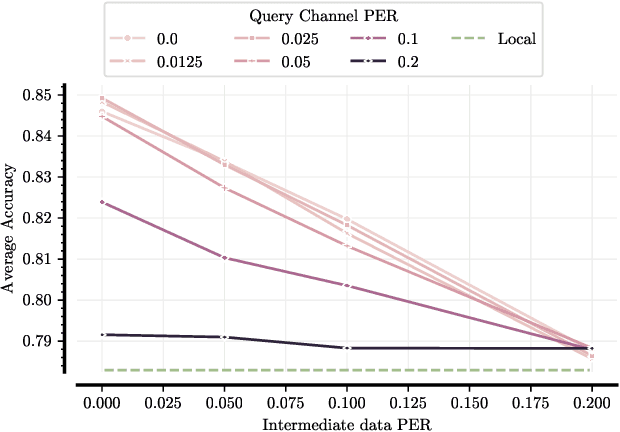
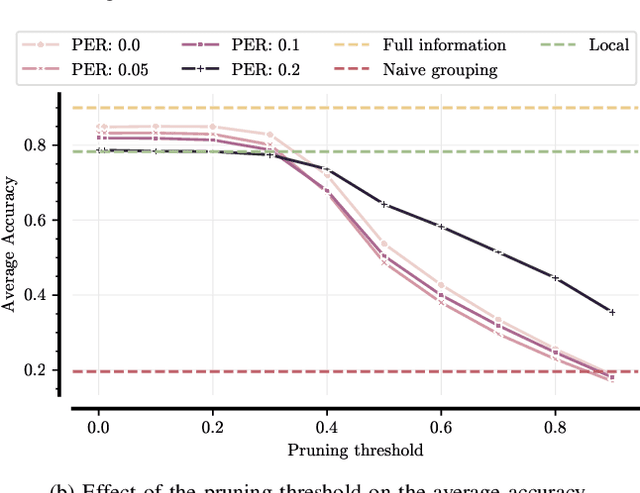
In this paper, we study the framework of collaborative inference, or edge ensembles. This framework enables multiple edge devices to improve classification accuracy by exchanging intermediate features rather than raw observations. However, efficient communication strategies are essential to balance accuracy and bandwidth limitations. Building upon a key-query mechanism for selective information exchange, this work extends collaborative inference by studying the impact of channel noise in feature communication, the choice of intermediate collaboration points, and the communication-accuracy trade-off across tasks. By analyzing how different collaboration points affect performance and exploring communication pruning, we show that it is possible to optimize accuracy while minimizing resource usage. We show that the intermediate collaboration approach is robust to channel errors and that the query transmission needs a higher degree of reliability than the data transmission itself.
Latent Space Alignment for AI-Native MIMO Semantic Communications
Jul 24, 2025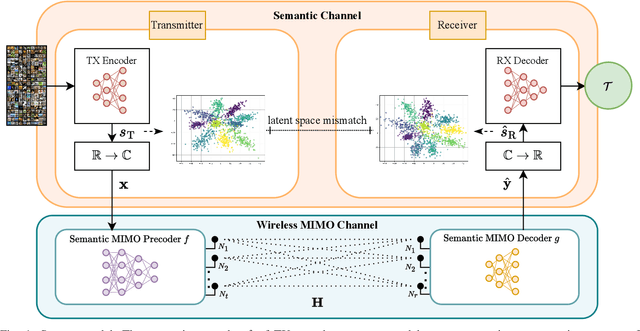

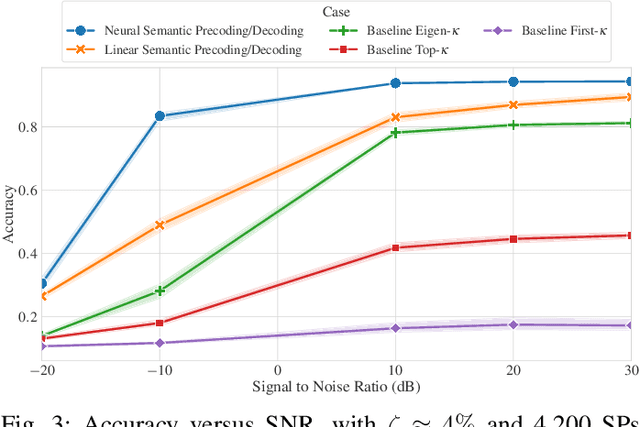
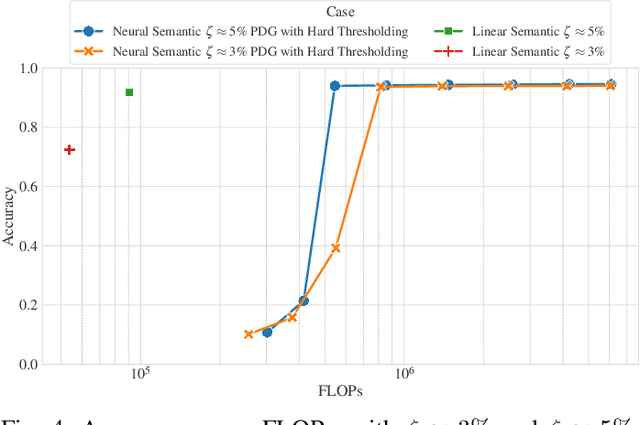
Semantic communications focus on prioritizing the understanding of the meaning behind transmitted data and ensuring the successful completion of tasks that motivate the exchange of information. However, when devices rely on different languages, logic, or internal representations, semantic mismatches may occur, potentially hindering mutual understanding. This paper introduces a novel approach to addressing latent space misalignment in semantic communications, exploiting multiple-input multiple-output (MIMO) communications. Specifically, our method learns a MIMO precoder/decoder pair that jointly performs latent space compression and semantic channel equalization, mitigating both semantic mismatches and physical channel impairments. We explore two solutions: (i) a linear model, optimized by solving a biconvex optimization problem via the alternating direction method of multipliers (ADMM); (ii) a neural network-based model, which learns semantic MIMO precoder/decoder under transmission power budget and complexity constraints. Numerical results demonstrate the effectiveness of the proposed approach in a goal-oriented semantic communication scenario, illustrating the main trade-offs between accuracy, communication burden, and complexity of the solutions.
RIS-aided Latent Space Alignment for Semantic Channel Equalization
Jul 23, 2025Semantic communication systems introduce a new paradigm in wireless communications, focusing on transmitting the intended meaning rather than ensuring strict bit-level accuracy. These systems often rely on Deep Neural Networks (DNNs) to learn and encode meaning directly from data, enabling more efficient communication. However, in multi-user settings where interacting agents are trained independently-without shared context or joint optimization-divergent latent representations across AI-native devices can lead to semantic mismatches, impeding mutual understanding even in the absence of traditional transmission errors. In this work, we address semantic mismatch in Multiple-Input Multiple-Output (MIMO) channels by proposing a joint physical and semantic channel equalization framework that leverages the presence of Reconfigurable Intelligent Surfaces (RIS). The semantic equalization is implemented as a sequence of transformations: (i) a pre-equalization stage at the transmitter; (ii) propagation through the RIS-aided channel; and (iii) a post-equalization stage at the receiver. We formulate the problem as a constrained Minimum Mean Squared Error (MMSE) optimization and propose two solutions: (i) a linear semantic equalization chain, and (ii) a non-linear DNN-based semantic equalizer. Both methods are designed to operate under semantic compression in the latent space and adhere to transmit power constraints. Through extensive evaluations, we show that the proposed joint equalization strategies consistently outperform conventional, disjoint approaches to physical and semantic channel equalization across a broad range of scenarios and wireless channel conditions.
Distributed Intelligent Sensing and Communications for 6G: Architecture and Use Cases
Apr 17, 2025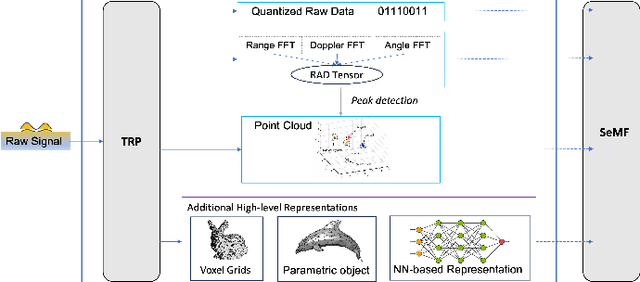
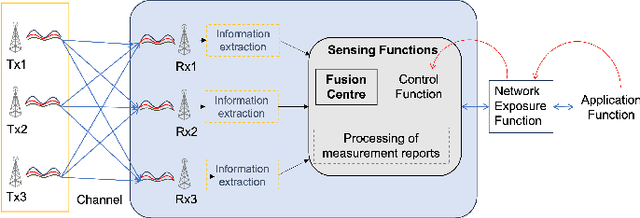
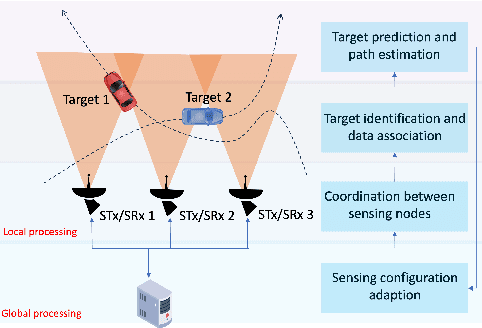

The Distributed Intelligent Sensing and Communication (DISAC) framework redefines Integrated Sensing and Communication (ISAC) for 6G by leveraging distributed architectures to enhance scalability, adaptability, and resource efficiency. This paper presents key architectural enablers, including advanced data representation, seamless target handover, support for heterogeneous devices, and semantic integration. Two use cases illustrate the transformative potential of DISAC: smart factory shop floors and Vulnerable Road User (VRU) protection at smart intersections. These scenarios demonstrate significant improvements in precision, safety, and operational efficiency compared to traditional ISAC systems. The preliminary DISAC architecture incorporates intelligent data processing, distributed coordination, and emerging technologies such as Reconfigurable Intelligent Surfaces (RIS) to meet 6G's stringent requirements. By addressing critical challenges in sensing accuracy, latency, and real-time decision-making, DISAC positions itself as a cornerstone for next-generation wireless networks, advancing innovation in dynamic and complex environments.
Large-Scale AI in Telecom: Charting the Roadmap for Innovation, Scalability, and Enhanced Digital Experiences
Mar 06, 2025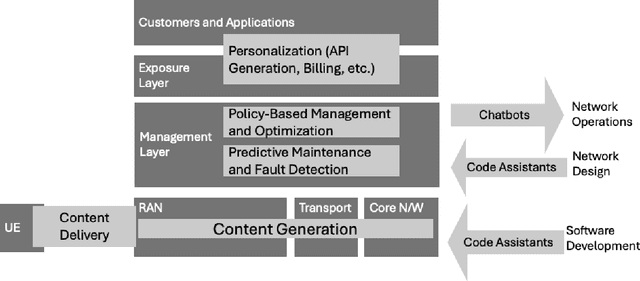
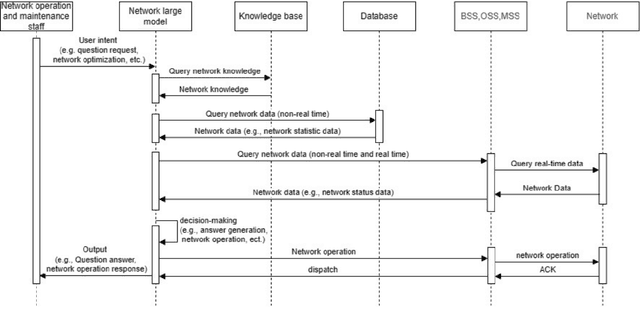
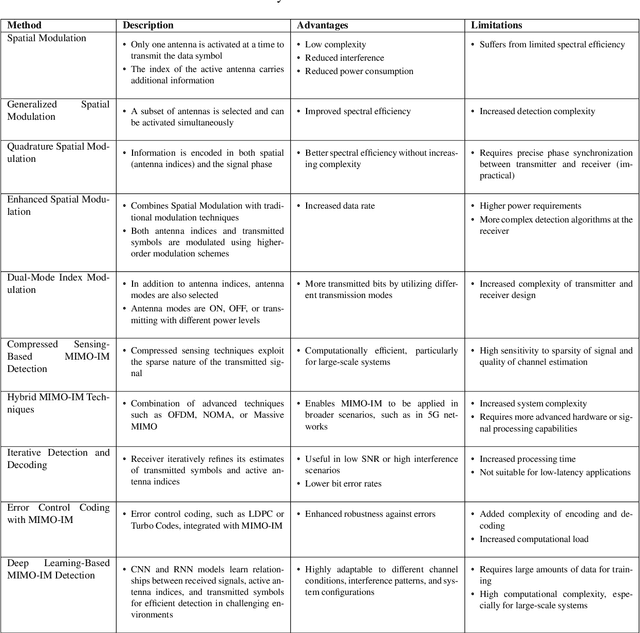
This white paper discusses the role of large-scale AI in the telecommunications industry, with a specific focus on the potential of generative AI to revolutionize network functions and user experiences, especially in the context of 6G systems. It highlights the development and deployment of Large Telecom Models (LTMs), which are tailored AI models designed to address the complex challenges faced by modern telecom networks. The paper covers a wide range of topics, from the architecture and deployment strategies of LTMs to their applications in network management, resource allocation, and optimization. It also explores the regulatory, ethical, and standardization considerations for LTMs, offering insights into their future integration into telecom infrastructure. The goal is to provide a comprehensive roadmap for the adoption of LTMs to enhance scalability, performance, and user-centric innovation in telecom networks.