 Add to Chrome
 Add to Firefox
 Add to Edge
DALSA: Domain Adaptation for Supervised Learning From Sparsely Annotated MR Images
Mar 12, 2024

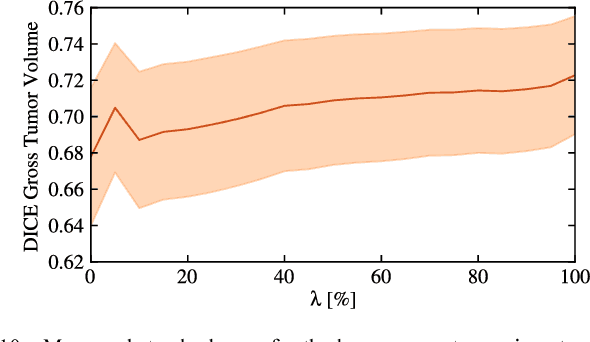
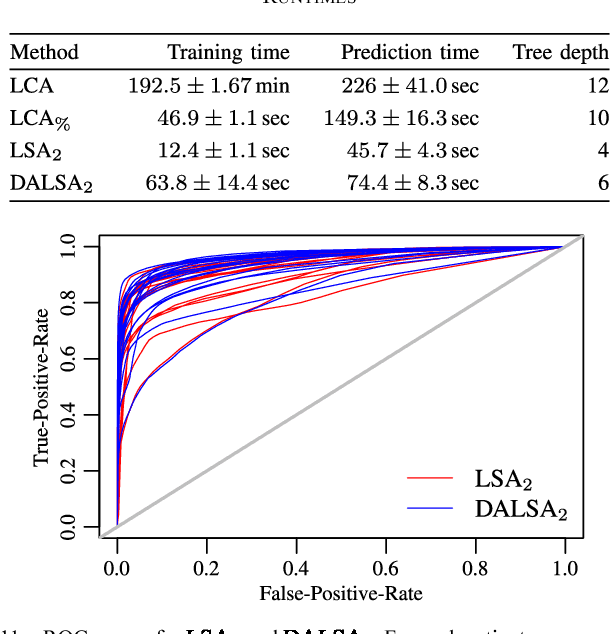
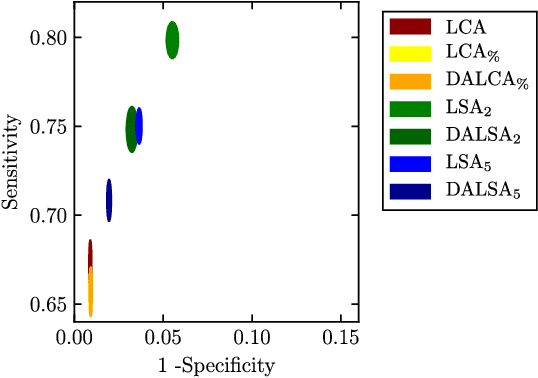
We propose a new method that employs transfer learning techniques to effectively correct sampling selection errors introduced by sparse annotations during supervised learning for automated tumor segmentation. The practicality of current learning-based automated tissue classification approaches is severely impeded by their dependency on manually segmented training databases that need to be recreated for each scenario of application, site, or acquisition setup. The comprehensive annotation of reference datasets can be highly labor-intensive, complex, and error-prone. The proposed method derives high-quality classifiers for the different tissue classes from sparse and unambiguous annotations and employs domain adaptation techniques for effectively correcting sampling selection errors introduced by the sparse sampling. The new approach is validated on labeled, multi-modal MR images of 19 patients with malignant gliomas and by comparative analysis on the BraTS 2013 challenge data sets. Compared to training on fully labeled data, we reduced the time for labeling and training by a factor greater than 70 and 180 respectively without sacrificing accuracy. This dramatically eases the establishment and constant extension of large annotated databases in various scenarios and imaging setups and thus represents an important step towards practical applicability of learning-based approaches in tissue classification.

SegRap2023: A Benchmark of Organs-at-Risk and Gross Tumor Volume Segmentation for Radiotherapy Planning of Nasopharyngeal Carcinoma
Dec 15, 2023


Radiation therapy is a primary and effective NasoPharyngeal Carcinoma (NPC) treatment strategy. The precise delineation of Gross Tumor Volumes (GTVs) and Organs-At-Risk (OARs) is crucial in radiation treatment, directly impacting patient prognosis. Previously, the delineation of GTVs and OARs was performed by experienced radiation oncologists. Recently, deep learning has achieved promising results in many medical image segmentation tasks. However, for NPC OARs and GTVs segmentation, few public datasets are available for model development and evaluation. To alleviate this problem, the SegRap2023 challenge was organized in conjunction with MICCAI2023 and presented a large-scale benchmark for OAR and GTV segmentation with 400 Computed Tomography (CT) scans from 200 NPC patients, each with a pair of pre-aligned non-contrast and contrast-enhanced CT scans. The challenge's goal was to segment 45 OARs and 2 GTVs from the paired CT scans. In this paper, we detail the challenge and analyze the solutions of all participants. The average Dice similarity coefficient scores for all submissions ranged from 76.68\% to 86.70\%, and 70.42\% to 73.44\% for OARs and GTVs, respectively. We conclude that the segmentation of large-size OARs is well-addressed, and more efforts are needed for GTVs and small-size or thin-structure OARs. The benchmark will remain publicly available here: https://segrap2023.grand-challenge.org
Look Ma, no code: fine tuning nnU-Net for the AutoPET II challenge by only adjusting its JSON plans
Sep 24, 2023We participate in the AutoPET II challenge by modifying nnU-Net only through its easy to understand and modify 'nnUNetPlans.json' file. By switching to a UNet with residual encoder, increasing the batch size and increasing the patch size we obtain a configuration that substantially outperforms the automatically configured nnU-Net baseline (5-fold cross-validation Dice score of 65.14 vs 33.28) at the expense of increased compute requirements for model training. Our final submission ensembles the two most promising configurations. At the time of submission our method ranks first on the preliminary test set.
RecycleNet: Latent Feature Recycling Leads to Iterative Decision Refinement
Sep 14, 2023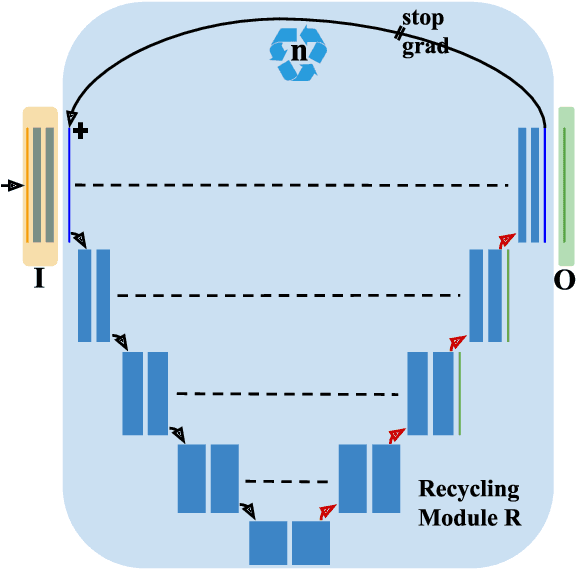

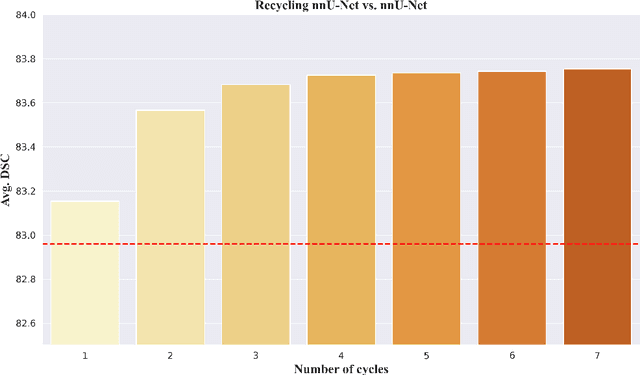

Despite the remarkable success of deep learning systems over the last decade, a key difference still remains between neural network and human decision-making: As humans, we cannot only form a decision on the spot, but also ponder, revisiting an initial guess from different angles, distilling relevant information, arriving at a better decision. Here, we propose RecycleNet, a latent feature recycling method, instilling the pondering capability for neural networks to refine initial decisions over a number of recycling steps, where outputs are fed back into earlier network layers in an iterative fashion. This approach makes minimal assumptions about the neural network architecture and thus can be implemented in a wide variety of contexts. Using medical image segmentation as the evaluation environment, we show that latent feature recycling enables the network to iteratively refine initial predictions even beyond the iterations seen during training, converging towards an improved decision. We evaluate this across a variety of segmentation benchmarks and show consistent improvements even compared with top-performing segmentation methods. This allows trading increased computation time for improved performance, which can be beneficial, especially for safety-critical applications.
Anatomy-informed Data Augmentation for Enhanced Prostate Cancer Detection
Sep 07, 2023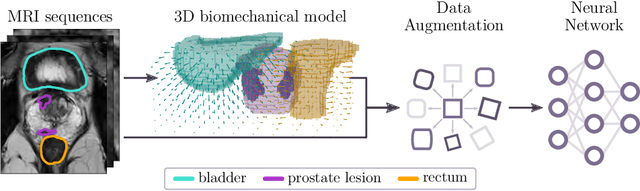

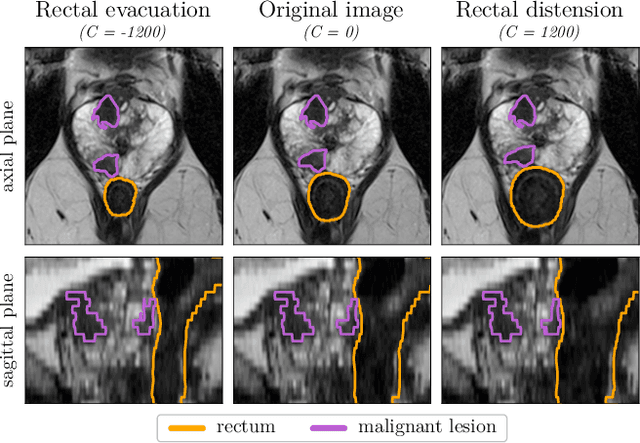
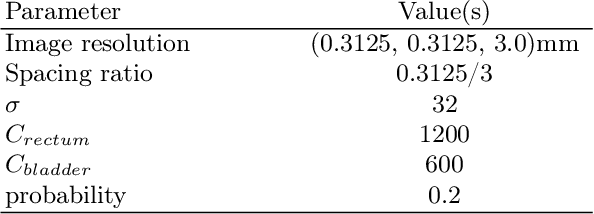
Data augmentation (DA) is a key factor in medical image analysis, such as in prostate cancer (PCa) detection on magnetic resonance images. State-of-the-art computer-aided diagnosis systems still rely on simplistic spatial transformations to preserve the pathological label post transformation. However, such augmentations do not substantially increase the organ as well as tumor shape variability in the training set, limiting the model's ability to generalize to unseen cases with more diverse localized soft-tissue deformations. We propose a new anatomy-informed transformation that leverages information from adjacent organs to simulate typical physiological deformations of the prostate and generates unique lesion shapes without altering their label. Due to its lightweight computational requirements, it can be easily integrated into common DA frameworks. We demonstrate the effectiveness of our augmentation on a dataset of 774 biopsy-confirmed examinations, by evaluating a state-of-the-art method for PCa detection with different augmentation settings.
Exploring new ways: Enforcing representational dissimilarity to learn new features and reduce error consistency
Jul 05, 2023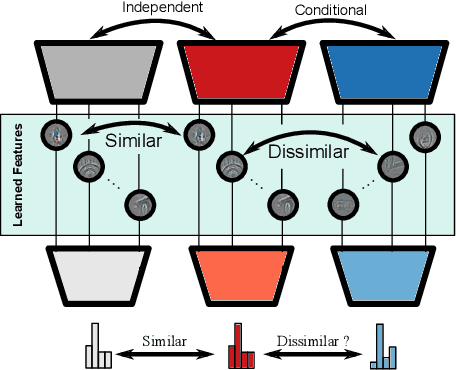
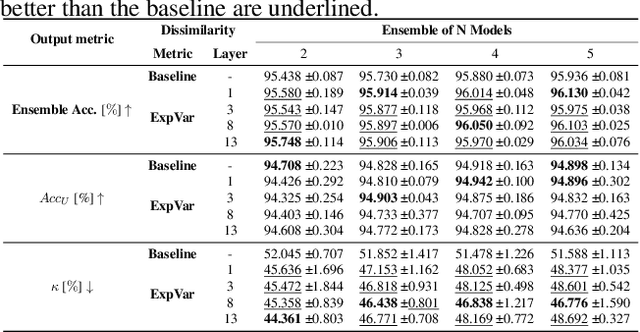
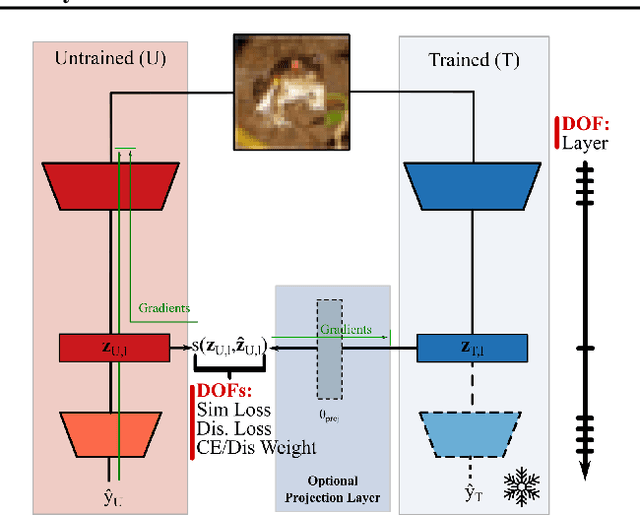
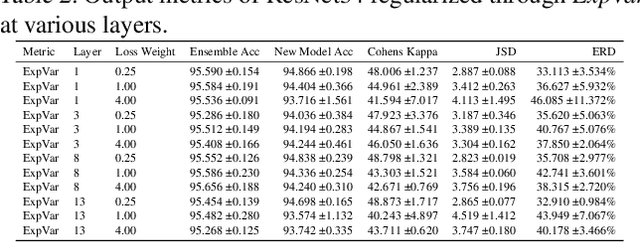
Independently trained machine learning models tend to learn similar features. Given an ensemble of independently trained models, this results in correlated predictions and common failure modes. Previous attempts focusing on decorrelation of output predictions or logits yielded mixed results, particularly due to their reduction in model accuracy caused by conflicting optimization objectives. In this paper, we propose the novel idea of utilizing methods of the representational similarity field to promote dissimilarity during training instead of measuring similarity of trained models. To this end, we promote intermediate representations to be dissimilar at different depths between architectures, with the goal of learning robust ensembles with disjoint failure modes. We show that highly dissimilar intermediate representations result in less correlated output predictions and slightly lower error consistency, resulting in higher ensemble accuracy. With this, we shine first light on the connection between intermediate representations and their impact on the output predictions.
Taming Detection Transformers for Medical Object Detection
Jun 27, 2023The accurate detection of suspicious regions in medical images is an error-prone and time-consuming process required by many routinely performed diagnostic procedures. To support clinicians during this difficult task, several automated solutions were proposed relying on complex methods with many hyperparameters. In this study, we investigate the feasibility of DEtection TRansformer (DETR) models for volumetric medical object detection. In contrast to previous works, these models directly predict a set of objects without relying on the design of anchors or manual heuristics such as non-maximum-suppression to detect objects. We show by conducting extensive experiments with three models, namely DETR, Conditional DETR, and DINO DETR on four data sets (CADA, RibFrac, KiTS19, and LIDC) that these set prediction models can perform on par with or even better than currently existing methods. DINO DETR, the best-performing model in our experiments demonstrates this by outperforming a strong anchor-based one-stage detector, Retina U-Net, on three out of four data sets.
SAM.MD: Zero-shot medical image segmentation capabilities of the Segment Anything Model
Apr 10, 2023
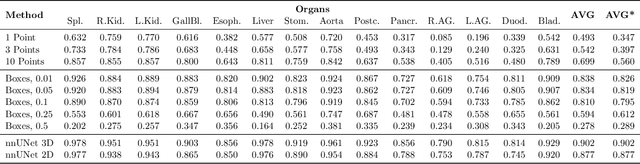
Foundation models have taken over natural language processing and image generation domains due to the flexibility of prompting. With the recent introduction of the Segment Anything Model (SAM), this prompt-driven paradigm has entered image segmentation with a hitherto unexplored abundance of capabilities. The purpose of this paper is to conduct an initial evaluation of the out-of-the-box zero-shot capabilities of SAM for medical image segmentation, by evaluating its performance on an abdominal CT organ segmentation task, via point or bounding box based prompting. We show that SAM generalizes well to CT data, making it a potential catalyst for the advancement of semi-automatic segmentation tools for clinicians. We believe that this foundation model, while not reaching state-of-the-art segmentation performance in our investigations, can serve as a highly potent starting point for further adaptations of such models to the intricacies of the medical domain. Keywords: medical image segmentation, SAM, foundation models, zero-shot learning
MultiTalent: A Multi-Dataset Approach to Medical Image Segmentation
Mar 25, 2023The medical imaging community generates a wealth of datasets, many of which are openly accessible and annotated for specific diseases and tasks such as multi-organ or lesion segmentation. Current practices continue to limit model training and supervised pre-training to one or a few similar datasets, neglecting the synergistic potential of other available annotated data. We propose MultiTalent, a method that leverages multiple CT datasets with diverse and conflicting class definitions to train a single model for a comprehensive structure segmentation. Our results demonstrate improved segmentation performance compared to previous related approaches, systematically, also compared to single dataset training using state-of-the-art methods, especially for lesion segmentation and other challenging structures. We show that MultiTalent also represents a powerful foundation model that offers a superior pre-training for various segmentation tasks compared to commonly used supervised or unsupervised pre-training baselines. Our findings offer a new direction for the medical imaging community to effectively utilize the wealth of available data for improved segmentation performance. The code and model weights will be published here: [tba]
Accurate Detection of Mediastinal Lesions with nnDetection
Mar 20, 2023The accurate detection of mediastinal lesions is one of the rarely explored medical object detection problems. In this work, we applied a modified version of the self-configuring method nnDetection to the Mediastinal Lesion Analysis (MELA) Challenge 2022. By incorporating automatically generated pseudo masks, training high capacity models with large patch sizes in a multi GPU setup and an adapted augmentation scheme to reduce localization errors caused by rotations, our method achieved an excellent FROC score of 0.9922 at IoU 0.10 and 0.9880 at IoU 0.3 in our cross-validation experiments. The submitted ensemble ranked third in the competition with a FROC score of 0.9897 on the MELA challenge leaderboard.