 Add to Chrome
 Add to Firefox
 Add to Edge
Adaptive Texture-aware Masking for Self-Supervised Learning in 3D Dental CBCT Analysis
May 03, 2026
Cone Beam Computed Tomography (CBCT) is pivotal for 3D diagnostic imaging in dentistry. However, the development of robust AI models for volumetric analysis is often constrained by the scarcity of large, annotated datasets. Self-supervised learning (SSL), particularly Masked Image Modeling (MIM), offers a promising pathway to leverage unlabeled data. A limitation of standard MIM is its reliance on random masking, which fails to prioritize diagnostically critical regions in dental CBCT volumes, such as subtle pathological changes and intricate anatomical boundaries. To address this, we propose ATMask, a novel adaptive masking strategy. Instead of applying random masks or employing computationally intensive attention modules, ATMask computes an inter-slice texture variation map to identify regions with high structural or textural complexity. These high-variation areas are then selectively masked during pre-training, compelling the model to learn richer contextual representations essential for inferring complex 3D morphological transitions. Furthermore, we contribute the first large-scale CBCT dataset, curated from both public and private sources, comprising 6,314 scans, for the dental AI model pretraining. Extensive experiments on three downstream dental CBCT tasks demonstrate that our ATMask enables more data-efficient and powerful representation learning than standard random masking and other advanced SSL baselines. The dataset and code will be released.

RegFreeNet: A Registration-Free Network for CBCT-based 3D Dental Implant Planning
Jan 21, 2026As the commercial surgical guide design software usually does not support the export of implant position for pre-implantation data, existing methods have to scan the post-implantation data and map the implant to pre-implantation space to get the label of implant position for training. Such a process is time-consuming and heavily relies on the accuracy of registration algorithm. Moreover, not all hospitals have paired CBCT data, limitting the construction of multi-center dataset. Inspired by the way dentists determine the implant position based on the neighboring tooth texture, we found that even if the implant area is masked, it will not affect the determination of the implant position. Therefore, we propose to mask the implants in the post-implantation data so that any CBCT containing the implants can be used as training data. This paradigm enables us to discard the registration process and makes it possible to construct a large-scale multi-center implant dataset. On this basis, we proposes ImplantFairy, a comprehensive, publicly accessible dental implant dataset with voxel-level 3D annotations of 1622 CBCT data. Furthermore, according to the area variation characteristics of the tooth's spatial structure and the slope information of the implant, we designed a slope-aware implant position prediction network. Specifically, a neighboring distance perception (NDP) module is designed to adaptively extract tooth area variation features, and an implant slope prediction branch assists the network in learning more robust features through additional implant supervision information. Extensive experiments conducted on ImplantFairy and two public dataset demonstrate that the proposed RegFreeNet achieves the state-of-the-art performance.
VLMT: Vision-Language Multimodal Transformer for Multimodal Multi-hop Question Answering
Apr 11, 2025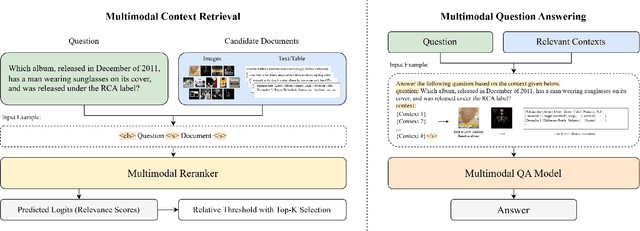
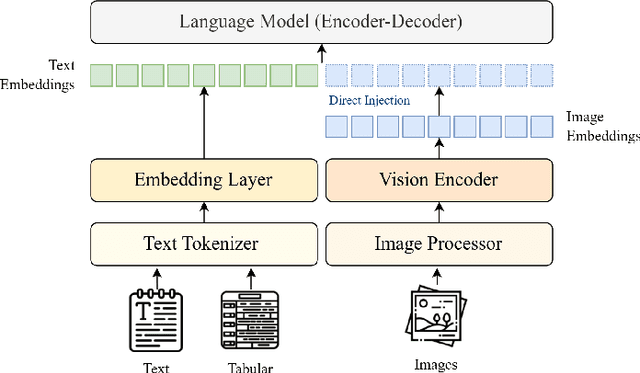
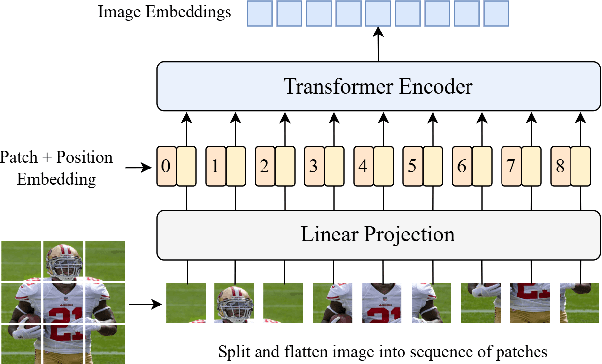
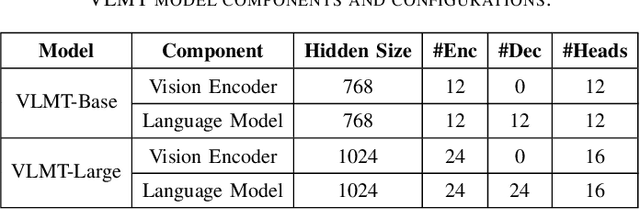
The increasing availability of multimodal data across text, tables, and images presents new challenges for developing models capable of complex cross-modal reasoning. Existing methods for Multimodal Multi-hop Question Answering (MMQA) often suffer from limited reasoning capabilities, reliance on modality conversion, and inadequate alignment between visual and textual representations. To address these limitations, this paper introduces Vision-Language Multimodal Transformer (VLMT), a unified architecture that integrates a transformer-based vision encoder with a sequence-to-sequence language model. VLMT employs a direct token-level injection mechanism to fuse visual and textual inputs within a shared embedding space, eliminating the need for intermediate projection layers. To enhance cross-modal alignment and reasoning, a three-stage pretraining strategy is proposed to progressively align vision-language representations and improve the model's capacity for multimodal understanding. Based on the pretrained backbone, two task-specific modules are instantiated to form a two-stage MMQA framework: a multimodal reranker that predicts document relevance scores and utilizes a relative threshold with top-k strategy for context retrieval, and a multimodal question answering model that generates contextually grounded answers based on the retrieved evidence. Comprehensive experiments on two benchmark datasets demonstrate the effectiveness of the proposed approach. On MultimodalQA validation set, VLMT-Large achieves 76.5% Exact Match and 80.1% F1, outperforming the previous state-of-the-art by +9.1% in Exact Match and +8.8% in F1. On WebQA, it attains a QA score of 47.6, surpassing prior models such as PERQA by +3.2. These results highlight VLMT's strong capabilities in multimodal reasoning and its potential to advance real-world information retrieval and question answering systems.
PAtt-Lite: Lightweight Patch and Attention MobileNet for Challenging Facial Expression Recognition
Jun 16, 2023


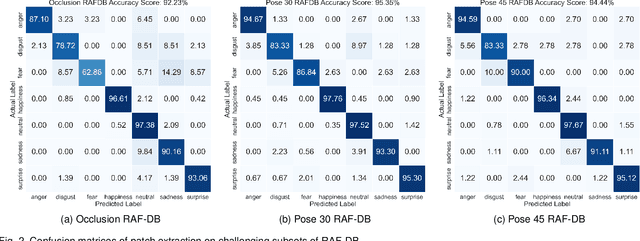
Facial Expression Recognition (FER) is a machine learning problem that deals with recognizing human facial expressions. While existing work has achieved performance improvements in recent years, FER in the wild and under challenging conditions remains a challenge. In this paper, a lightweight patch and attention network based on MobileNetV1, referred to as PAtt-Lite, is proposed to improve FER performance under challenging conditions. A truncated ImageNet-pre-trained MobileNetV1 is utilized as the backbone feature extractor of the proposed method. In place of the truncated layers is a patch extraction block that is proposed for extracting significant local facial features to enhance the representation from MobileNetV1, especially under challenging conditions. An attention classifier is also proposed to improve the learning of these patched feature maps from the extremely lightweight feature extractor. The experimental results on public benchmark databases proved the effectiveness of the proposed method. PAtt-Lite achieved state-of-the-art results on CK+, RAF-DB, FER2013, FERPlus, and the challenging conditions subsets for RAF-DB and FERPlus. The source code for the proposed method will be available at https://github.com/JLREx/PAtt-Lite.
Self-taught learning of a deep invariant representation for visual tracking via temporal slowness principle
Apr 14, 2016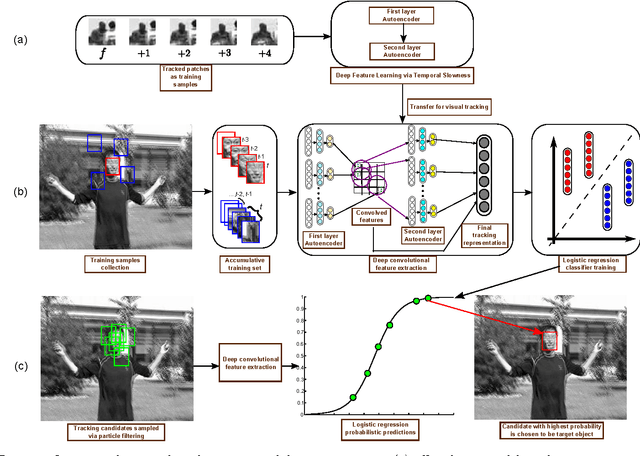
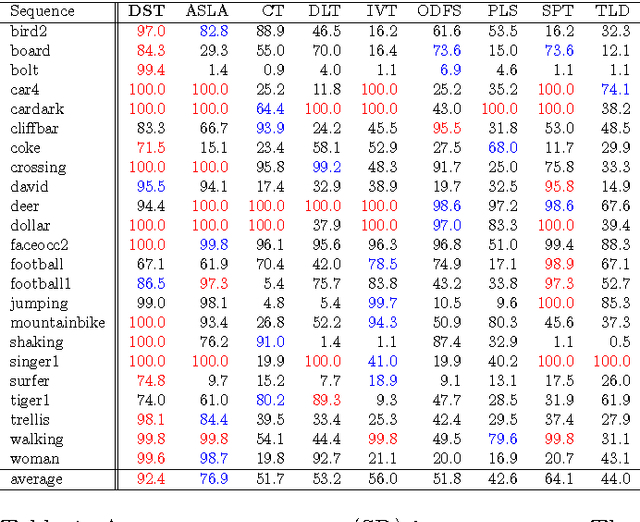
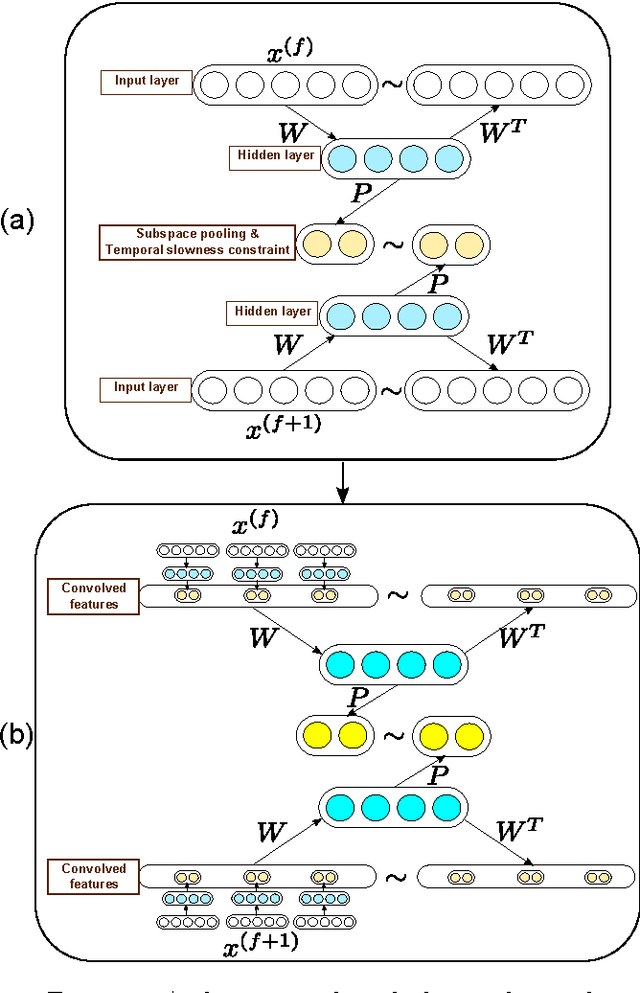
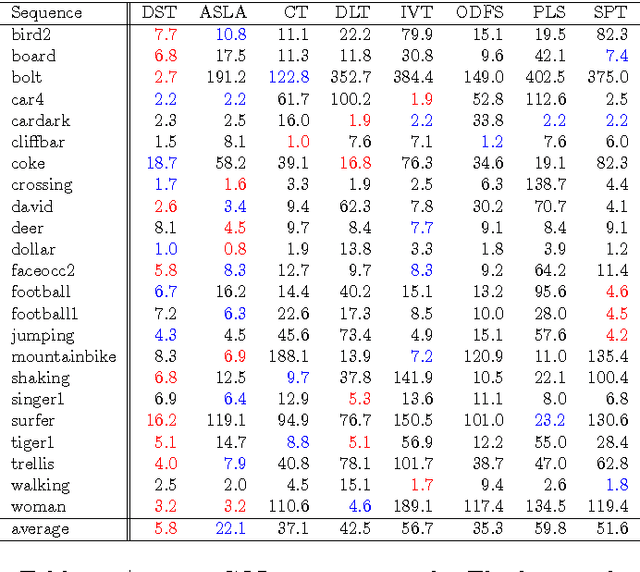
Visual representation is crucial for a visual tracking method's performances. Conventionally, visual representations adopted in visual tracking rely on hand-crafted computer vision descriptors. These descriptors were developed generically without considering tracking-specific information. In this paper, we propose to learn complex-valued invariant representations from tracked sequential image patches, via strong temporal slowness constraint and stacked convolutional autoencoders. The deep slow local representations are learned offline on unlabeled data and transferred to the observational model of our proposed tracker. The proposed observational model retains old training samples to alleviate drift, and collect negative samples which are coherent with target's motion pattern for better discriminative tracking. With the learned representation and online training samples, a logistic regression classifier is adopted to distinguish target from background, and retrained online to adapt to appearance changes. Subsequently, the observational model is integrated into a particle filter framework to peform visual tracking. Experimental results on various challenging benchmark sequences demonstrate that the proposed tracker performs favourably against several state-of-the-art trackers.