 Add to Chrome
 Add to Firefox
 Add to Edge
SemComp-Bench: Benchmarking Semantic Task Completion in Video Generation
Aug 18, 2026
We introduce Semantic Task Completion Video Generation, an outcome-oriented video generation task. Under this formulation, success requires both achievement of the intended outcome and semantic grounding. Semantic grounding characterizes the correspondence between the reference image and the generated outcome in terms of high-level semantics relevant to the task. Evaluation focuses on the generated outcome and requires neither the presentation of a complete sequence of intermediate task steps nor conventional appearance consistency with the reference image. To support systematic evaluation, we construct SemComp-Data, an evaluation dataset covering six domains. Each instance comprises a reference image, a detailed instruction, a brief instruction, and an outcome-centric video clip. A scalable four-stage curation pipeline converts raw videos into standardized SemComp-Data instances. We further introduce SemComp-Bench, an evaluation protocol that uses a vision-language model (VLM) to answer structured binary questions. SemComp-Bench reports the OA Score and the GR Score for Outcome Achievement and Generation Reliability, respectively. Experiments on representative video generation models show that achieving intended outcomes while maintaining task-relevant semantic grounding in reference images remains challenging.

Probability Contrastive Learning for Domain Adaptation
Nov 29, 2021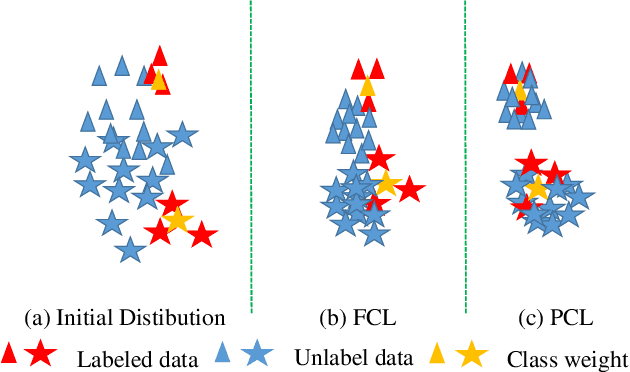
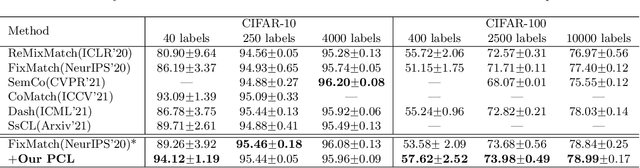
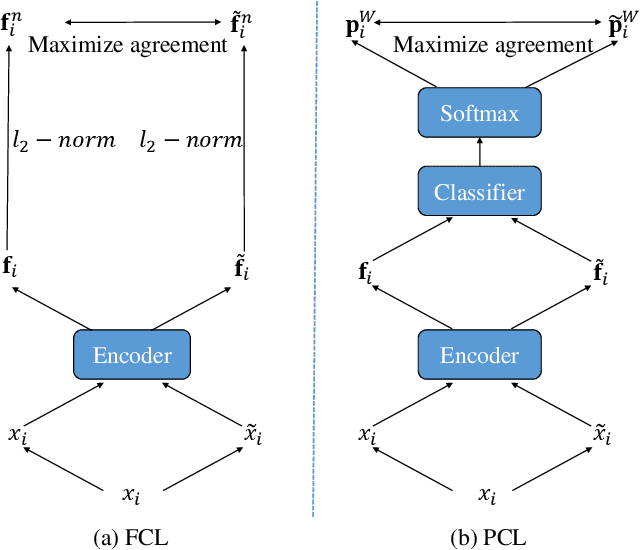
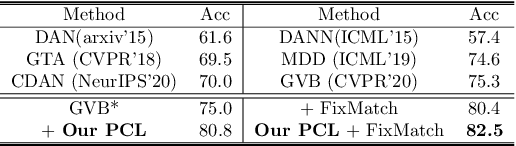
Recent feature contrastive learning (FCL) has shown promising performance in self-supervised representation learning. For domain adaptation, however, FCL cannot show overwhelming gains since the class weights are not involved during optimization, which does not guarantee the produced features to be clustered around the class weights learned from source data. To tackle this issue, we propose a novel probability contrastive learning (PCL) in this paper, which not only produces compact features but also enforces them to be distributed around the class weights. Specifically, we propose to use the output probabilities after softmax to perform contrastive learning instead of the extracted features and remove the $\ell_{2}$ normalization in the traditional FCL. In this way, the probability will approximate the one-hot form, thereby narrowing the distance between the features and the class weights. Our proposed PCL is simple and effective. We conduct extensive experiments on two domain adaptation tasks, i.e., unsupervised domain adaptation and semi-supervised domain adaptation. The results on multiple datasets demonstrate that our PCL can consistently get considerable gains and achieves the state-of-the-art performance. In addition, our method also obtains considerable gains on semi-supervised tasks when labeled data is scarce.