 Add to Chrome
 Add to Firefox
 Add to Edge
SA-GEM: Scale-Adaptive and Geospatial Evidence-Modulated Token Pruning for Efficient Remote Sensing Large Vision-Language Models
Aug 15, 2026
RS-LVLMs have advanced multimodal understanding of Earth observation imagery, yet their performance is fundamentally constrained by high-resolution processing, as visual token counts grow quadratically with linear input resolution while important visual evidence is inherently sparse and increasingly diluted across the expanded sequence. Existing token pruning methods largely rely on scale-agnostic resolution policies and isolated importance cues, limiting task-aligned granularity adaptation and holistic evidence preservation. To address this, we present Scale-Adaptive and Geospatial Evidence-Modulated Token Pruning (SA-GEM), a plug-and-play framework that unifies task-adaptive token granularity allocation with holistic geospatial token importance modulation. Specifically, a lightweight router selects the resolution based on query-dependent token granularity, while a token importance modulator jointly models task relevance, spatial structure, and local redundancy to preserve holistic geospatial evidence. We show that higher resolution is not universally beneficial and, once sufficient granularity is reached, token quality matters more than token quantity. Experiments across various benchmarks demonstrate that SA-GEM achieves consistent gains in both accuracy and efficiency over existing pruning methods. On XLRS-Bench, it surpasses GeoLLaVA-8K by 2.3% in accuracy with a 2.4 times total inference speedup.

Observe Less, Understand More: Cost-aware Cross-scale Observation for Remote Sensing Understanding
Apr 13, 2026Remote sensing understanding inherently requires multi-resolution observation, since different targets and application tasks demand different levels of spatial detail. While low-resolution (LR) imagery enables efficient global observation, high-resolution (HR) imagery provides critical local details at much higher acquisition cost and limited coverage. This motivates a cross-scale sensing strategy that selectively acquires HR imagery from LR-based global perception to improve task performance under constrained cost. Existing methods for HR sampling methods typically make selection decisions from isolated LR patches, which ignore fine-grained intra-patch importance and cross-patch contextual interactions, leading to fragmented feature representation and suboptimal scene reasoning under sparse HR observations. To address this issue, we formulate cross-scale remote sensing understanding as a unified cost-aware problem that couples fine-grained HR sampling with cross-patch representation prediction, enabling more effective task reasoning with fewer HR observations. Furthermore, we present GL-10M, a large-scale benchmark of 10 million spatially aligned multi-resolution images, enabling systematic evaluation of budget-constrained cross-scale reasoning in remote sensing. Extensive experiments on recognition and retrieval tasks show that our method consistently achieves a superior performance-cost trade-off.
Decoupled Similarity for Task-Aware Token Pruning in Large Vision-Language Models
Apr 13, 2026Token pruning has emerged as an effective approach to reduce the substantial computational overhead of Large Vision-Language Models (LVLMs) by discarding less informative visual tokens while preserving performance. However, existing methods typically rely on individual attention sources from different LVLM components, resulting in incomplete and suboptimal pruning decisions due to biased attention distributions. To address this problem, we propose DeSAP, a novel Decoupled Similarity-Aware Pruning method for precise, task-aware token pruning within the visual encoder. Specifically, DeSAP introduces a decoupled similarity to capture fine-grained cross-modal relevance between visual features and text tokens, providing explicit task-related guidance for pruning. By integrating decoupled similarity with visual saliency signals derived from visual attention, DeSAP performs token pruning under the guidance of both task-related and visual cues, enabling robust pruning even under aggressive pruning ratios. Extensive experiments across diverse benchmarks and architectures show that DeSAP consistently outperforms SOTA methods in both accuracy and efficiency. On LLaVA-1.5-7B, DeSAP achieves a 10 times FLOPs reduction and a 2.3 times prefill speedup by retaining only 11.1% of visual tokens, while maintaining 98.1% of the original performance.
Context-Driven Index Trimming: A Data Quality Perspective to Enhancing Precision of RALMs
Aug 10, 2024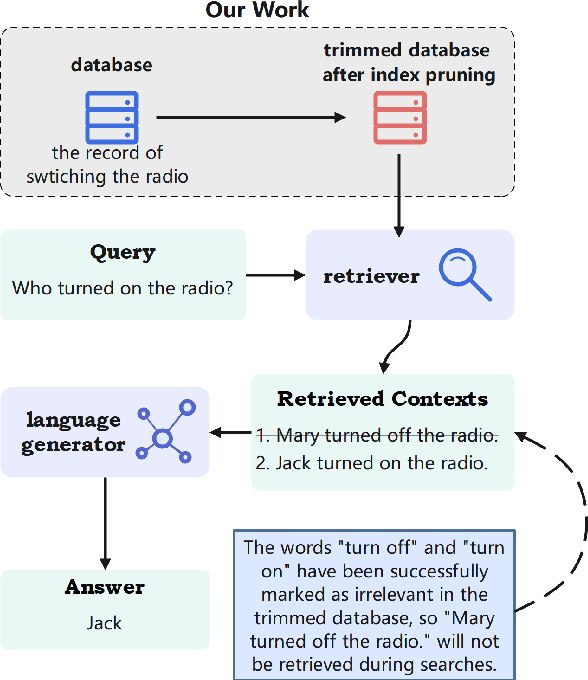
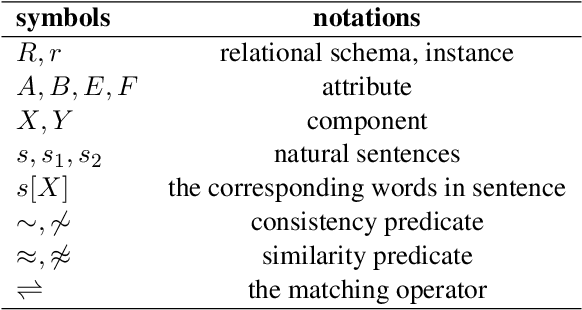
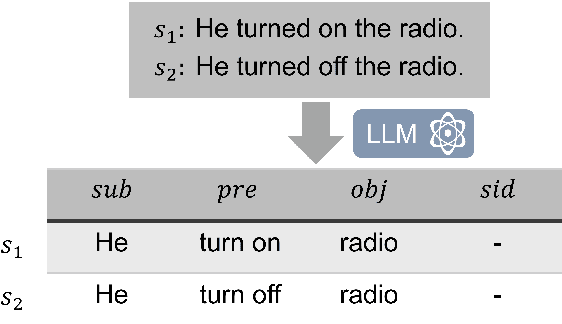
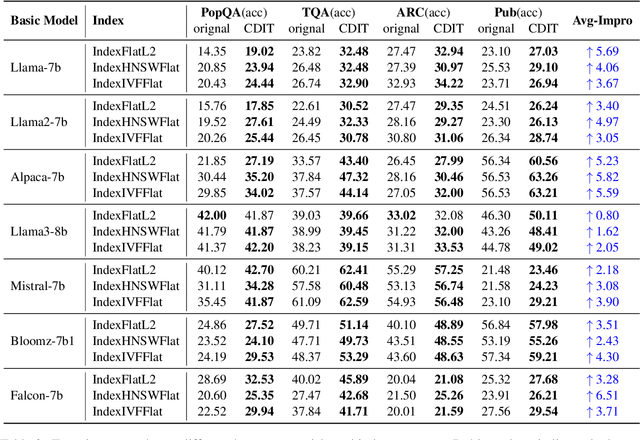
Retrieval-Augmented Large Language Models (RALMs) have made significant strides in enhancing the accuracy of generated responses.However, existing research often overlooks the data quality issues within retrieval results, often caused by inaccurate existing vector-distance-based retrieval methods.We propose to boost the precision of RALMs' answers from a data quality perspective through the Context-Driven Index Trimming (CDIT) framework, where Context Matching Dependencies (CMDs) are employed as logical data quality rules to capture and regulate the consistency between retrieved contexts.Based on the semantic comprehension capabilities of Large Language Models (LLMs), CDIT can effectively identify and discard retrieval results that are inconsistent with the query context and further modify indexes in the database, thereby improving answer quality.Experiments demonstrate on challenging question-answering tasks.Also, the flexibility of CDIT is verified through its compatibility with various language models and indexing methods, which offers a promising approach to bolster RALMs' data quality and retrieval precision jointly.