 Add to Chrome
 Add to Firefox
 Add to Edge
DAGE: Dual-Stream Architecture for Efficient and Fine-Grained Geometry Estimation
Mar 04, 2026
Estimating accurate, view-consistent geometry and camera poses from uncalibrated multi-view/video inputs remains challenging - especially at high spatial resolutions and over long sequences. We present DAGE, a dual-stream transformer whose main novelty is to disentangle global coherence from fine detail. A low-resolution stream operates on aggressively downsampled frames with alternating frame/global attention to build a view-consistent representation and estimate cameras efficiently, while a high-resolution stream processes the original images per-frame to preserve sharp boundaries and small structures. A lightweight adapter fuses these streams via cross-attention, injecting global context without disturbing the pretrained single-frame pathway. This design scales resolution and clip length independently, supports inputs up to 2K, and maintains practical inference cost. DAGE delivers sharp depth/pointmaps, strong cross-view consistency, and accurate poses, establishing new state-of-the-art results for video geometry estimation and multi-view reconstruction.

3D Space as a Scratchpad for Editable Text-to-Image Generation
Jan 21, 2026Recent progress in large language models (LLMs) has shown that reasoning improves when intermediate thoughts are externalized into explicit workspaces, such as chain-of-thought traces or tool-augmented reasoning. Yet, visual language models (VLMs) lack an analogous mechanism for spatial reasoning, limiting their ability to generate images that accurately reflect geometric relations, object identities, and compositional intent. We introduce the concept of a spatial scratchpad -- a 3D reasoning substrate that bridges linguistic intent and image synthesis. Given a text prompt, our framework parses subjects and background elements, instantiates them as editable 3D meshes, and employs agentic scene planning for placement, orientation, and viewpoint selection. The resulting 3D arrangement is rendered back into the image domain with identity-preserving cues, enabling the VLM to generate spatially consistent and visually coherent outputs. Unlike prior 2D layout-based methods, our approach supports intuitive 3D edits that propagate reliably into final images. Empirically, it achieves a 32% improvement in text alignment on GenAI-Bench, demonstrating the benefit of explicit 3D reasoning for precise, controllable image generation. Our results highlight a new paradigm for vision-language models that deliberate not only in language, but also in space. Code and visualizations at https://oindrilasaha.github.io/3DScratchpad/
Fast View Synthesis of Casual Videos
Dec 04, 2023Novel view synthesis from an in-the-wild video is difficult due to challenges like scene dynamics and lack of parallax. While existing methods have shown promising results with implicit neural radiance fields, they are slow to train and render. This paper revisits explicit video representations to synthesize high-quality novel views from a monocular video efficiently. We treat static and dynamic video content separately. Specifically, we build a global static scene model using an extended plane-based scene representation to synthesize temporally coherent novel video. Our plane-based scene representation is augmented with spherical harmonics and displacement maps to capture view-dependent effects and model non-planar complex surface geometry. We opt to represent the dynamic content as per-frame point clouds for efficiency. While such representations are inconsistency-prone, minor temporal inconsistencies are perceptually masked due to motion. We develop a method to quickly estimate such a hybrid video representation and render novel views in real time. Our experiments show that our method can render high-quality novel views from an in-the-wild video with comparable quality to state-of-the-art methods while being 100x faster in training and enabling real-time rendering.
A Practical Stereo Depth System for Smart Glasses
Nov 19, 2022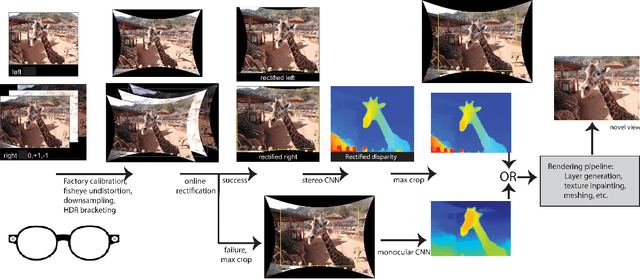
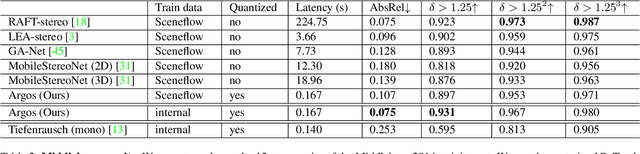
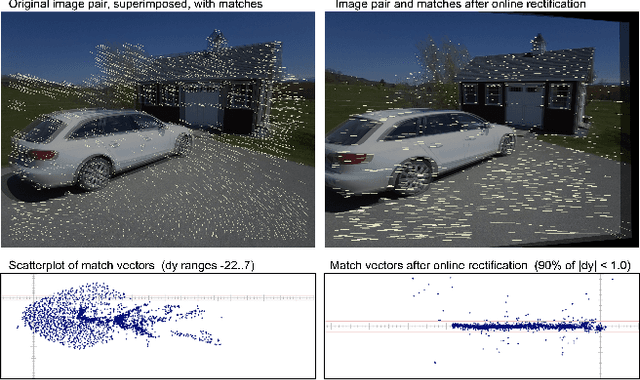
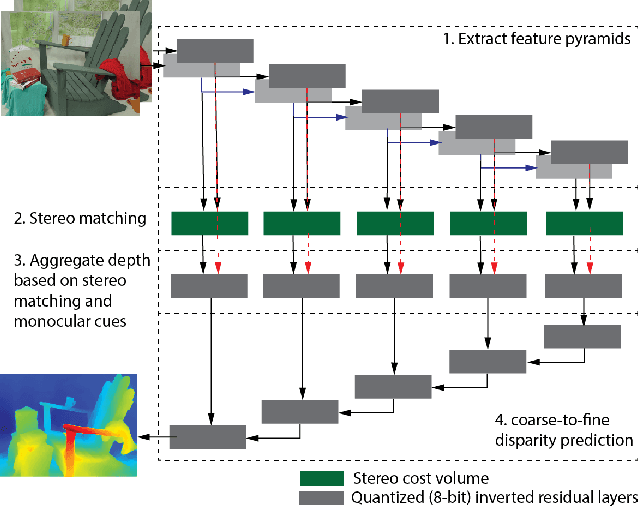
We present the design of a productionized end-to-end stereo depth sensing system that does pre-processing, online stereo rectification, and stereo depth estimation with a fallback to monocular depth estimation when rectification is unreliable. The output of our depth sensing system is then used in a novel view generation pipeline to create 3D computational photography effect using point-of-view images captured by smart glasses. All these steps are executed on-device on the stringent compute budget of a mobile phone, and because we expect the users can use a wide range of smartphones, our design needs to be general and cannot be dependent on a particular hardware or ML accelerator such as a smartphone GPU. Although each of these steps is well-studied, a description of a practical system is still lacking. For such a system, each of these steps need to work in tandem with one another and fallback gracefully on failures within the system or less than ideal input data. We show how we handle unforeseen changes to calibration, e.g. due to heat, robustly support depth estimation in the wild, and still abide by the memory and latency constraints required for a smooth user experience. We show that our trained models are fast, that run in less than 1s on a six-year-old Samsung Galaxy S8 phone's CPU. Our models generalize well to unseen data and achieve good results on Middlebury and in-the-wild images captured from the smart glasses.