 Add to Chrome
 Add to Firefox
 Add to Edge
XPolicyLab: A Unified Standard and Open Ecosystem for Robot Policy Evaluation and Deployment
Aug 11, 2026
Robot policy evaluation and deployment remain fragmented by model-specific software dependencies, data representations, and runtime interfaces, so that connecting N policies to M evaluation environments requires O(NM) separate integrations. We present XPolicyLab, a unified standard and open ecosystem that reduces this cost to O(N+M). XPolicyLab specifies common observation, action, and trajectory schemas together with a minimal adapter interface for observation updates, action prediction, batched execution, and episode reset, while a dependency-isolated client/server architecture separates policy inference from environment execution, so that each side retains its native software stack and may run locally or remotely. The ecosystem integrates 42 robot policies and standardizes their installation, debugging, serving, and evaluation workflows. Across these adapters, model-specific code varies by an order of magnitude while the environment-facing loop stays within a few lines of a fixed reference, confirming that the contract confines heterogeneity to the policy side. In a controlled study, conforming to the standard reduces the integration effort of a representative policy from over five hours to two hours, and packaged agent skills reduce it further to thirty minutes. The same adapters serve RoboTwin, RoboDojo simulation, and standardized real-robot evaluation through one interface. XPolicyLab is released as shared infrastructure for reproducible policy comparison and standardized deployment across simulation and physical platforms. Project website: https://xpolicylab.github.io/.

FieldGen: From Teleoperated Pre-Manipulation Trajectories to Field-Guided Data Generation
Oct 23, 2025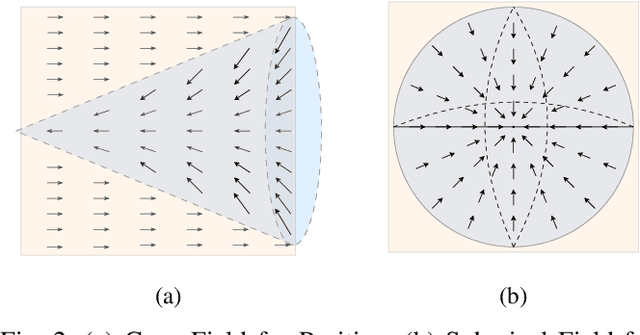
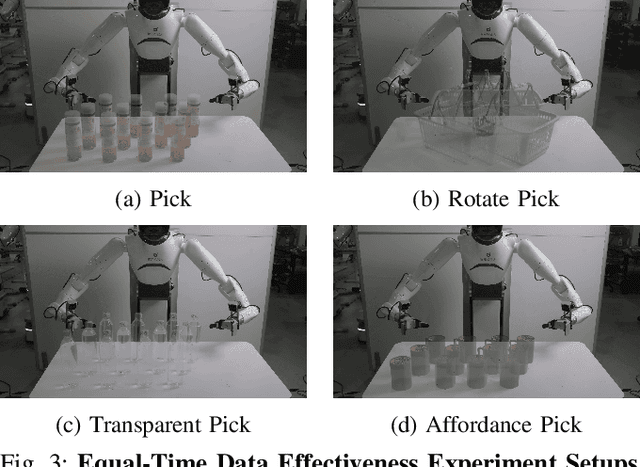
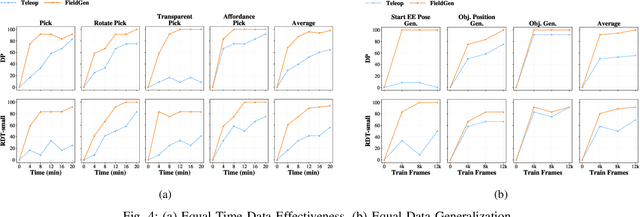
Large-scale and diverse datasets are vital for training robust robotic manipulation policies, yet existing data collection methods struggle to balance scale, diversity, and quality. Simulation offers scalability but suffers from sim-to-real gaps, while teleoperation yields high-quality demonstrations with limited diversity and high labor cost. We introduce FieldGen, a field-guided data generation framework that enables scalable, diverse, and high-quality real-world data collection with minimal human supervision. FieldGen decomposes manipulation into two stages: a pre-manipulation phase, allowing trajectory diversity, and a fine manipulation phase requiring expert precision. Human demonstrations capture key contact and pose information, after which an attraction field automatically generates diverse trajectories converging to successful configurations. This decoupled design combines scalable trajectory diversity with precise supervision. Moreover, FieldGen-Reward augments generated data with reward annotations to further enhance policy learning. Experiments demonstrate that policies trained with FieldGen achieve higher success rates and improved stability compared to teleoperation-based baselines, while significantly reducing human effort in long-term real-world data collection. Webpage is available at https://fieldgen.github.io/.