 Add to Chrome
 Add to Firefox
 Add to Edge
Renormalising Generative Models for Active Inference: Foundations, Derivations, and Verification
Aug 10, 2026
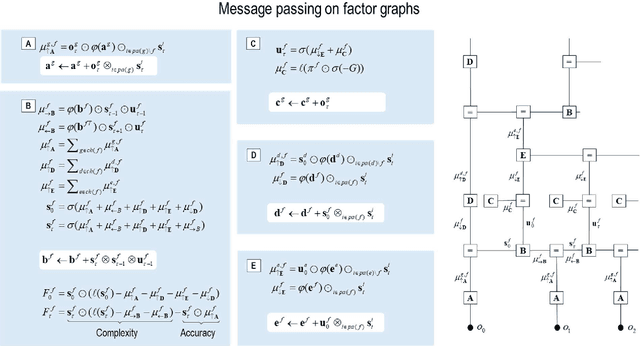
Active inference offers a unified framework for perception, learning, and action, but scaling discrete active-inference models to rich spatial and temporal domains remains difficult. Renormalising generative models (RGMs) address this challenge by composing discrete generative models across spatial and temporal scales, coarse-graining lower-level states and paths into higher-level causes for objects, events, and action. However, fully reproducing and adapting the framework remains difficult: the mathematical exposition is compact, and the reference implementations are deeply integrated within specialized software environments, leaving many algorithmic details implicit. This paper addresses these challenges by providing a self-contained, derivation-oriented account of RGMs together with an open, verified implementation. We explain how the hierarchy is built, how beliefs and actions are updated within it, and how information is passed between levels. Where the published equations and implementation differ in emphasis, we make those choices explicit and explain their modelling consequences. By clarifying the theory and separating it from its original implementation context, this work lowers practical barriers to entry and makes RGMs more transparent, auditable, and reproducible, providing a foundation for future quantitative evaluation and development on machine-learning benchmarks.

Active Inference as the Test-Time Scaling Law for Physical AI Agents
Jun 22, 2026In this paper, a novel test-time scaling law for physical artificial intelligence (AI) agents is introduced. This scaling law enables physical AI agents to reason with their world models to generalize in unforeseen scenarios at test time. The derived scaling law is grounded in the first principle of active inference, which equips agents with the general objective to survive in the real world, under which their specific task objectives are subsumed. Active inference achieves this by providing the reasoning to resolve prediction errors that arise when the agent encounters unforeseen situations outside its training distribution, enabling generalization in non-stationary environments. The proposed scaling law captures this by dynamically updating the agent's policy with this reasoning at test time. This policy update is modeled as a soft Bayesian inference process in which beliefs about the policy are updated using the reasoning that reduces expected prediction errors under allowable policies as a likelihood. The resulting posterior policy admits a biological interpretation, recovering the scaling mechanism that engages the brain's basal ganglia and prefrontal cortex at test time. To solve this analytically intractable problem, a variational inference solution minimizing free energy bounds is developed. This solution extends to enable learning beyond training by reinforcing new instances, resolved at test time, in both the policy and world model. Unlike existing scaling laws constrained by model size and training data, the derived solution scales with the continuous real-world experience of a physical AI agent. Simulation results on an autonomous driving task demonstrate that the proposed solution outperforms model-free Q-learning and model-based Bayesian reinforcement learning, achieving robust generalization to unforeseen scenarios while improving inference efficiency by over 36%.
Online Generalised Predictive Coding
May 04, 2026This paper introduces an extension of generalised filtering for online applications. Generalised filtering refers to data assimilation schemes that jointly infer latent states, learn unknown model parameters, and estimate uncertainty in an integrated framework -- e.g., estimate state and observation noise -- at the same time (i.e., triple estimation). This framework appears across disciplines under different names, including variational Kalman-Bucy filtering in engineering, generalised predictive coding in neuroscience, and Dynamic Expectation Maximisation (DEM) in time-series analysis. Here, we specialise DEM for ``online'' data assimilation, through a separation of temporal scales. We describe the variational principles and procedures that allow one to assimilate data in a way that allows for a slow updating of parameters and precisions, which contextualise fast Bayesian belief updating about the dynamic hidden states. Using numerical studies, we demonstrate the validity of online DEM (ODEM) using a non-linear -- and potentially chaotic -- generative model, to show that the ODEM scheme can track the latent states of the generative process, even when its functional form differs fundamentally from the dynamics of the generative model. Framed from a neuro-mimetic predictive coding perspective, ODEM offers a biologically inspired solution to online inference, learning, and uncertainty estimation in dynamic environments.
Active Inference: A method for Phenotyping Agency in AI systems?
Apr 25, 2026The proliferation of agentic artificial intelligence has outpaced the conceptual tools needed to characterize agency in computational systems. Prevailing definitions mainly rely on autonomy and goal-directedness. Here, we argue for a minimal notion open to principled inspection given three criteria: intentionality as action grounded in beliefs and desires, rationality as normatively coherent action entailed by a world model, and explainability as action causally traceable to internal states; we subsequently instantiate these as a partially observable Markov decision process under a variational framework wherein posterior beliefs, prior preferences, and the minimization of expected free energy jointly constitute an agentic action chain. Using a canonical T-maze paradigm, we evidence how empowerment, formulated as the channel capacity between actions and anticipated observations, serves as an operational metric that distinguishes zero-, intermediate-, and high-agency phenotypes through structural manipulations of the generative model. We conclude by arguing that as agents engage in epistemic foraging to resolve ambiguity, the governance controls that remain effective must shift systematically from external constraints to the internal modulation of prior preferences, offering a principled, variational bridge from computational phenotyping to AI governance strategy
Active inference and artificial reasoning
Dec 24, 2025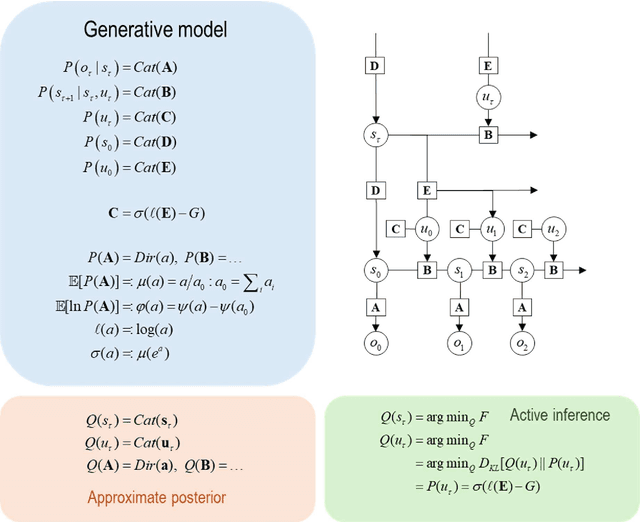
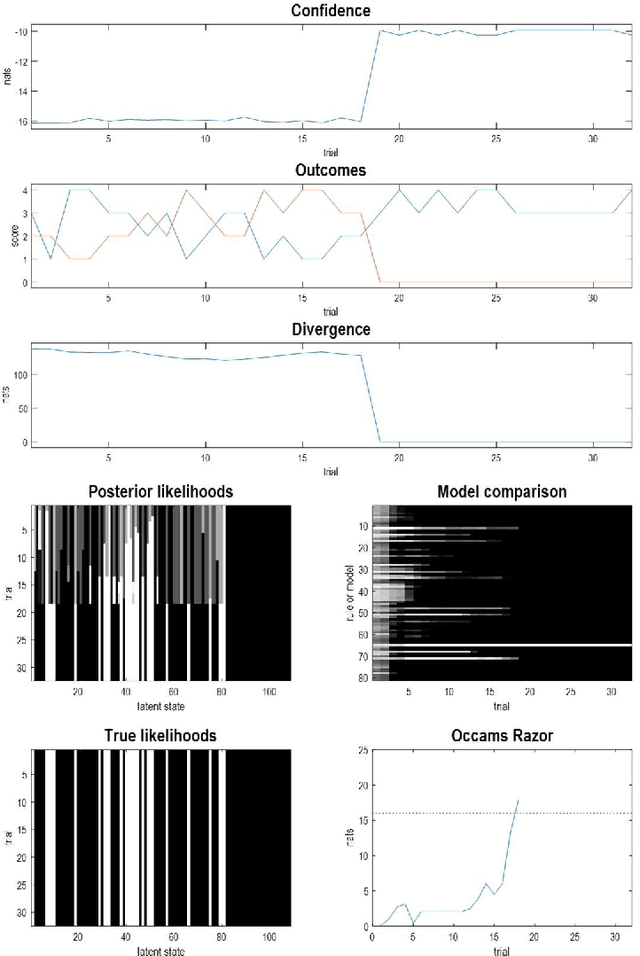
This technical note considers the sampling of outcomes that provide the greatest amount of information about the structure of underlying world models. This generalisation furnishes a principled approach to structure learning under a plausible set of generative models or hypotheses. In active inference, policies - i.e., combinations of actions - are selected based on their expected free energy, which comprises expected information gain and value. Information gain corresponds to the KL divergence between predictive posteriors with, and without, the consequences of action. Posteriors over models can be evaluated quickly and efficiently using Bayesian Model Reduction, based upon accumulated posterior beliefs about model parameters. The ensuing information gain can then be used to select actions that disambiguate among alternative models, in the spirit of optimal experimental design. We illustrate this kind of active selection or reasoning using partially observed discrete models; namely, a 'three-ball' paradigm used previously to describe artificial insight and 'aha moments' via (synthetic) introspection or sleep. We focus on the sample efficiency afforded by seeking outcomes that resolve the greatest uncertainty about the world model, under which outcomes are generated.
EcoNet: Multiagent Planning and Control Of Household Energy Resources Using Active Inference
Dec 14, 2025Advances in automated systems afford new opportunities for intelligent management of energy at household, local area, and utility scales. Home Energy Management Systems (HEMS) can play a role by optimizing the schedule and use of household energy devices and resources. One challenge is that the goals of a household can be complex and conflicting. For example, a household might wish to reduce energy costs and grid-associated greenhouse gas emissions, yet keep room temperatures comfortable. Another challenge is that an intelligent HEMS agent must make decisions under uncertainty. An agent must plan actions into the future, but weather and solar generation forecasts, for example, provide inherently uncertain estimates of future conditions. This paper introduces EcoNet, a Bayesian approach to household and neighborhood energy management that is based on active inference. The aim is to improve energy management and coordination, while accommodating uncertainties and taking into account potentially conditional and conflicting goals and preferences. Simulation results are presented and discussed.
AXIOM: Learning to Play Games in Minutes with Expanding Object-Centric Models
May 30, 2025Current deep reinforcement learning (DRL) approaches achieve state-of-the-art performance in various domains, but struggle with data efficiency compared to human learning, which leverages core priors about objects and their interactions. Active inference offers a principled framework for integrating sensory information with prior knowledge to learn a world model and quantify the uncertainty of its own beliefs and predictions. However, active inference models are usually crafted for a single task with bespoke knowledge, so they lack the domain flexibility typical of DRL approaches. To bridge this gap, we propose a novel architecture that integrates a minimal yet expressive set of core priors about object-centric dynamics and interactions to accelerate learning in low-data regimes. The resulting approach, which we call AXIOM, combines the usual data efficiency and interpretability of Bayesian approaches with the across-task generalization usually associated with DRL. AXIOM represents scenes as compositions of objects, whose dynamics are modeled as piecewise linear trajectories that capture sparse object-object interactions. The structure of the generative model is expanded online by growing and learning mixture models from single events and periodically refined through Bayesian model reduction to induce generalization. AXIOM masters various games within only 10,000 interaction steps, with both a small number of parameters compared to DRL, and without the computational expense of gradient-based optimization.
Self-orthogonalizing attractor neural networks emerging from the free energy principle
May 28, 2025Attractor dynamics are a hallmark of many complex systems, including the brain. Understanding how such self-organizing dynamics emerge from first principles is crucial for advancing our understanding of neuronal computations and the design of artificial intelligence systems. Here we formalize how attractor networks emerge from the free energy principle applied to a universal partitioning of random dynamical systems. Our approach obviates the need for explicitly imposed learning and inference rules and identifies emergent, but efficient and biologically plausible inference and learning dynamics for such self-organizing systems. These result in a collective, multi-level Bayesian active inference process. Attractors on the free energy landscape encode prior beliefs; inference integrates sensory data into posterior beliefs; and learning fine-tunes couplings to minimize long-term surprise. Analytically and via simulations, we establish that the proposed networks favor approximately orthogonalized attractor representations, a consequence of simultaneously optimizing predictive accuracy and model complexity. These attractors efficiently span the input subspace, enhancing generalization and the mutual information between hidden causes and observable effects. Furthermore, while random data presentation leads to symmetric and sparse couplings, sequential data fosters asymmetric couplings and non-equilibrium steady-state dynamics, offering a natural extension to conventional Boltzmann Machines. Our findings offer a unifying theory of self-organizing attractor networks, providing novel insights for AI and neuroscience.
Robust Decision-Making Via Free Energy Minimization
Mar 17, 2025Despite their groundbreaking performance, state-of-the-art autonomous agents can misbehave when training and environmental conditions become inconsistent, with minor mismatches leading to undesirable behaviors or even catastrophic failures. Robustness towards these training/environment ambiguities is a core requirement for intelligent agents and its fulfillment is a long-standing challenge when deploying agents in the real world. Here, departing from mainstream views seeking robustness through training, we introduce DR-FREE, a free energy model that installs this core property by design. It directly wires robustness into the agent decision-making mechanisms via free energy minimization. By combining a robust extension of the free energy principle with a novel resolution engine, DR-FREE returns a policy that is optimal-yet-robust against ambiguity. Moreover, for the first time, it reveals the mechanistic role of ambiguity on optimal decisions and requisite Bayesian belief updating. We evaluate DR-FREE on an experimental testbed involving real rovers navigating an ambiguous environment filled with obstacles. Across all the experiments, DR-FREE enables robots to successfully navigate towards their goal even when, in contrast, standard free energy minimizing agents that do not use DR-FREE fail. In short, DR-FREE can tackle scenarios that elude previous methods: this milestone may inspire both deployment in multi-agent settings and, at a perhaps deeper level, the quest for a biologically plausible explanation of how natural agents - with little or no training - survive in capricious environments.
Brain in the Dark: Design Principles for Neuromimetic Inference under the Free Energy Principle
Feb 13, 2025Deep learning has revolutionised artificial intelligence (AI) by enabling automatic feature extraction and function approximation from raw data. However, it faces challenges such as a lack of out-of-distribution generalisation, catastrophic forgetting and poor interpretability. In contrast, biological neural networks, such as those in the human brain, do not suffer from these issues, inspiring AI researchers to explore neuromimetic deep learning, which aims to replicate brain mechanisms within AI models. A foundational theory for this approach is the Free Energy Principle (FEP), which despite its potential, is often considered too complex to understand and implement in AI as it requires an interdisciplinary understanding across a variety of fields. This paper seeks to demystify the FEP and provide a comprehensive framework for designing neuromimetic models with human-like perception capabilities. We present a roadmap for implementing these models and a Pytorch code repository for applying FEP in a predictive coding network.