 Add to Chrome
 Add to Firefox
 Add to Edge
Online Generalised Predictive Coding
May 04, 2026
This paper introduces an extension of generalised filtering for online applications. Generalised filtering refers to data assimilation schemes that jointly infer latent states, learn unknown model parameters, and estimate uncertainty in an integrated framework -- e.g., estimate state and observation noise -- at the same time (i.e., triple estimation). This framework appears across disciplines under different names, including variational Kalman-Bucy filtering in engineering, generalised predictive coding in neuroscience, and Dynamic Expectation Maximisation (DEM) in time-series analysis. Here, we specialise DEM for ``online'' data assimilation, through a separation of temporal scales. We describe the variational principles and procedures that allow one to assimilate data in a way that allows for a slow updating of parameters and precisions, which contextualise fast Bayesian belief updating about the dynamic hidden states. Using numerical studies, we demonstrate the validity of online DEM (ODEM) using a non-linear -- and potentially chaotic -- generative model, to show that the ODEM scheme can track the latent states of the generative process, even when its functional form differs fundamentally from the dynamics of the generative model. Framed from a neuro-mimetic predictive coding perspective, ODEM offers a biologically inspired solution to online inference, learning, and uncertainty estimation in dynamic environments.

The Deep Radial Basis Function Data Descriptor (D-RBFDD) Network: A One-Class Neural Network for Anomaly Detection
Jan 29, 2021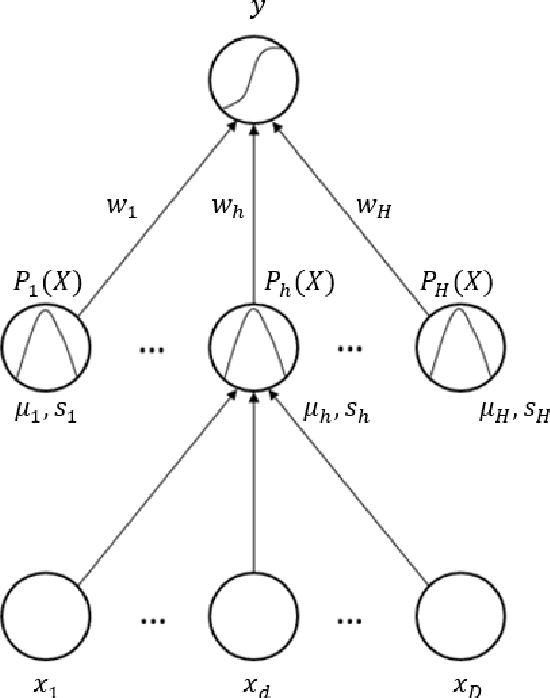
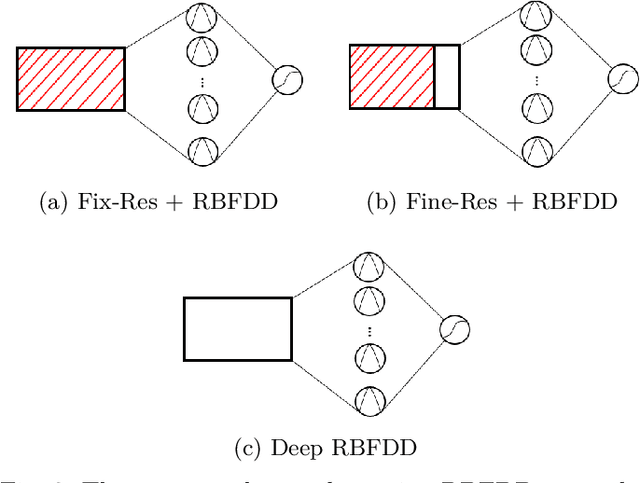
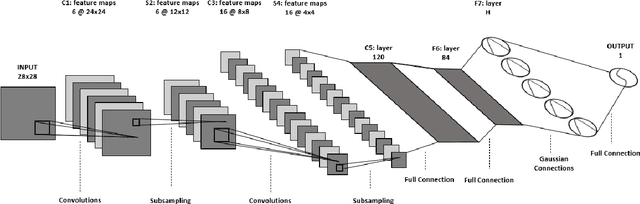
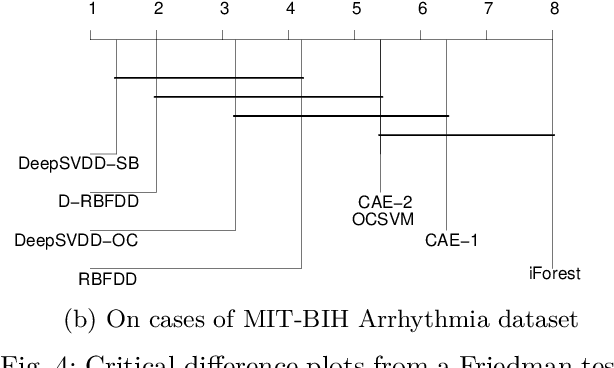
Anomaly detection is a challenging problem in machine learning, and is even more so when dealing with instances that are captured in low-level, raw data representations without a well-behaved set of engineered features. The Radial Basis Function Data Descriptor (RBFDD) network is an effective solution for anomaly detection, however, it is a shallow model that does not deal effectively with raw data representations. This paper investigates approaches to modifying the RBFDD network to transform it into a deep one-class classifier suitable for anomaly detection problems with low-level raw data representations. We show that approaches based on transfer learning are not effective and our results suggest that this is because the latent representations learned by generic classification models are not suitable for anomaly detection. Instead we show that an approach that adds multiple convolutional layers before the RBF layer, to form a Deep Radial Basis Function Data Descriptor (D-RBFDD) network, is very effective. This is shown in a set of evaluation experiments using multiple anomaly detection scenarios created from publicly available image classification datasets, and a real-world anomaly detection dataset in which different types of arrhythmia are detected in electrocardiogram (ECG) data. Our experiments show that the D-RBFDD network out-performs state-of-the-art anomaly detection methods including the Deep Support Vector Data Descriptor (Deep SVDD), One-Class SVM, and Isolation Forest on the image datasets, and produces competitive results for the ECG dataset.