 Add to Chrome
 Add to Firefox
 Add to Edge
Active Inference: A method for Phenotyping Agency in AI systems?
Apr 25, 2026
The proliferation of agentic artificial intelligence has outpaced the conceptual tools needed to characterize agency in computational systems. Prevailing definitions mainly rely on autonomy and goal-directedness. Here, we argue for a minimal notion open to principled inspection given three criteria: intentionality as action grounded in beliefs and desires, rationality as normatively coherent action entailed by a world model, and explainability as action causally traceable to internal states; we subsequently instantiate these as a partially observable Markov decision process under a variational framework wherein posterior beliefs, prior preferences, and the minimization of expected free energy jointly constitute an agentic action chain. Using a canonical T-maze paradigm, we evidence how empowerment, formulated as the channel capacity between actions and anticipated observations, serves as an operational metric that distinguishes zero-, intermediate-, and high-agency phenotypes through structural manipulations of the generative model. We conclude by arguing that as agents engage in epistemic foraging to resolve ambiguity, the governance controls that remain effective must shift systematically from external constraints to the internal modulation of prior preferences, offering a principled, variational bridge from computational phenotyping to AI governance strategy

FutureVision: A methodology for the investigation of future cognition
Feb 03, 2025
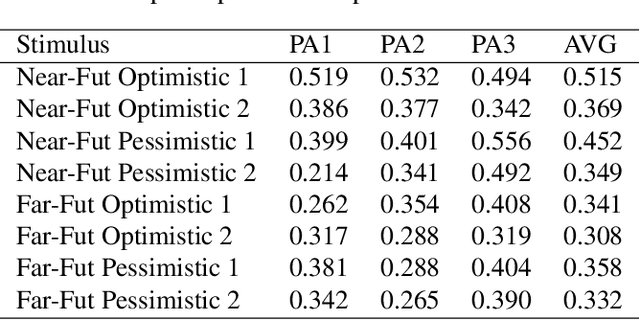
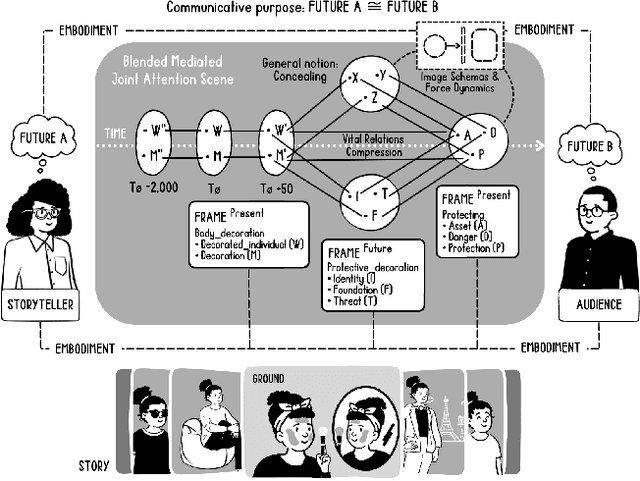
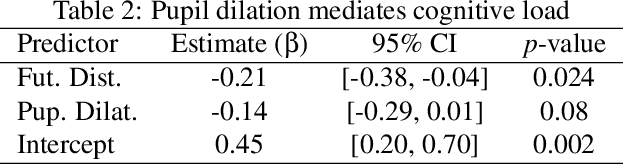
This paper presents a methodology combining multimodal semantic analysis with an eye-tracking experimental protocol to investigate the cognitive effort involved in understanding the communication of future scenarios. To demonstrate the methodology, we conduct a pilot study examining how visual fixation patterns vary during the evaluation of valence and counterfactuality in fictional ad pieces describing futuristic scenarios, using a portable eye tracker. Participants eye movements are recorded while evaluating the stimuli and describing them to a conversation partner. Gaze patterns are analyzed alongside semantic representations of the stimuli and participants descriptions, constructed from a frame semantic annotation of both linguistic and visual modalities. Preliminary results show that far-future and pessimistic scenarios are associated with longer fixations and more erratic saccades, supporting the hypothesis that fractures in the base spaces underlying the interpretation of future scenarios increase cognitive load for comprehenders.