 Add to Chrome
 Add to Firefox
 Add to Edge
Multi-Agent Intelligence for Multidisciplinary Decision-Making in Gastrointestinal Oncology
Dec 23, 2025
Multimodal clinical reasoning in the field of gastrointestinal (GI) oncology necessitates the integrated interpretation of endoscopic imagery, radiological data, and biochemical markers. Despite the evident potential exhibited by Multimodal Large Language Models (MLLMs), they frequently encounter challenges such as context dilution and hallucination when confronted with intricate, heterogeneous medical histories. In order to address these limitations, a hierarchical Multi-Agent Framework is proposed, which emulates the collaborative workflow of a human Multidisciplinary Team (MDT). The system attained a composite expert evaluation score of 4.60/5.00, thereby demonstrating a substantial improvement over the monolithic baseline. It is noteworthy that the agent-based architecture yielded the most substantial enhancements in reasoning logic and medical accuracy. The findings indicate that mimetic, agent-based collaboration provides a scalable, interpretable, and clinically robust paradigm for automated decision support in oncology.

EpiPlanAgent: Agentic Automated Epidemic Response Planning
Dec 12, 2025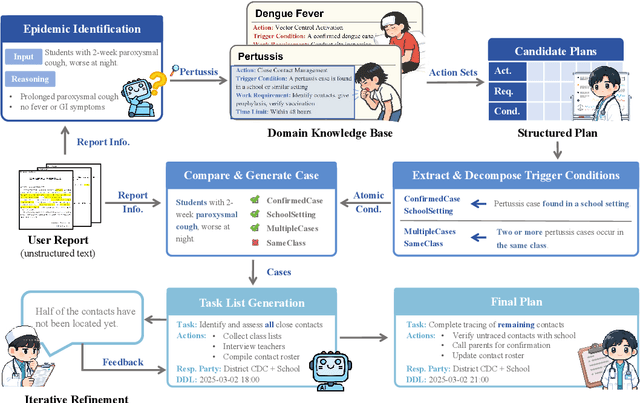

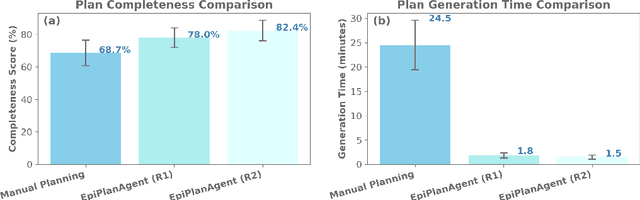
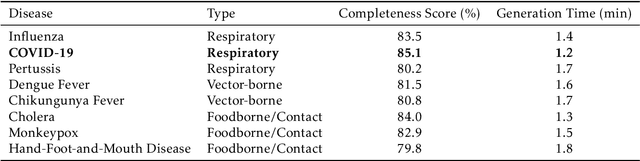
Epidemic response planning is essential yet traditionally reliant on labor-intensive manual methods. This study aimed to design and evaluate EpiPlanAgent, an agent-based system using large language models (LLMs) to automate the generation and validation of digital emergency response plans. The multi-agent framework integrated task decomposition, knowledge grounding, and simulation modules. Public health professionals tested the system using real-world outbreak scenarios in a controlled evaluation. Results demonstrated that EpiPlanAgent significantly improved the completeness and guideline alignment of plans while drastically reducing development time compared to manual workflows. Expert evaluation confirmed high consistency between AI-generated and human-authored content. User feedback indicated strong perceived utility. In conclusion, EpiPlanAgent provides an effective, scalable solution for intelligent epidemic response planning, demonstrating the potential of agentic AI to transform public health preparedness.
MedCalc-Eval and MedCalc-Env: Advancing Medical Calculation Capabilities of Large Language Models
Oct 31, 2025As large language models (LLMs) enter the medical domain, most benchmarks evaluate them on question answering or descriptive reasoning, overlooking quantitative reasoning critical to clinical decision-making. Existing datasets like MedCalc-Bench cover few calculation tasks and fail to reflect real-world computational scenarios. We introduce MedCalc-Eval, the largest benchmark for assessing LLMs' medical calculation abilities, comprising 700+ tasks across two types: equation-based (e.g., Cockcroft-Gault, BMI, BSA) and rule-based scoring systems (e.g., Apgar, Glasgow Coma Scale). These tasks span diverse specialties including internal medicine, surgery, pediatrics, and cardiology, offering a broader and more challenging evaluation setting. To improve performance, we further develop MedCalc-Env, a reinforcement learning environment built on the InternBootcamp framework, enabling multi-step clinical reasoning and planning. Fine-tuning a Qwen2.5-32B model within this environment achieves state-of-the-art results on MedCalc-Eval, with notable gains in numerical sensitivity, formula selection, and reasoning robustness. Remaining challenges include unit conversion, multi-condition logic, and contextual understanding. Code and datasets are available at https://github.com/maokangkun/MedCalc-Eval.