 Add to Chrome
 Add to Firefox
 Add to Edge
IUP-Pose: Decoupled Iterative Uncertainty Propagation for Real-time Relative Pose Regression via Implicit Dense Alignment v1
Mar 20, 2026
Relative pose estimation is fundamental for SLAM, visual localization, and 3D reconstruction. Existing Relative Pose Regression (RPR) methods face a key trade-off: feature-matching pipelines achieve high accuracy but block gradient flow via non-differentiable RANSAC, while ViT-based regressors are end-to-end trainable but prohibitively expensive for real-time deployment. We identify the core bottlenecks as the coupling between rotation and translation estimation and insufficient cross-view feature alignment. We propose IUP-Pose, a geometry-driven decoupled iterative framework with implicit dense alignment. A lightweight Multi-Head Bi-Cross Attention (MHBC) module aligns cross-view features without explicit matching supervision. The aligned features are processed by a decoupled rotation-translation pipeline: two shared-parameter rotation stages iteratively refine rotation with uncertainty, and feature maps are realigned via rotational homography H_inf before translation prediction. IUP-Pose achieves 73.3% AUC@20deg on MegaDepth1500 with full end-to-end differentiability, 70 FPS throughput, and only 37M parameters, demonstrating a favorable accuracy-efficiency trade-off for real-time edge deployment.

EpiPlanAgent: Agentic Automated Epidemic Response Planning
Dec 12, 2025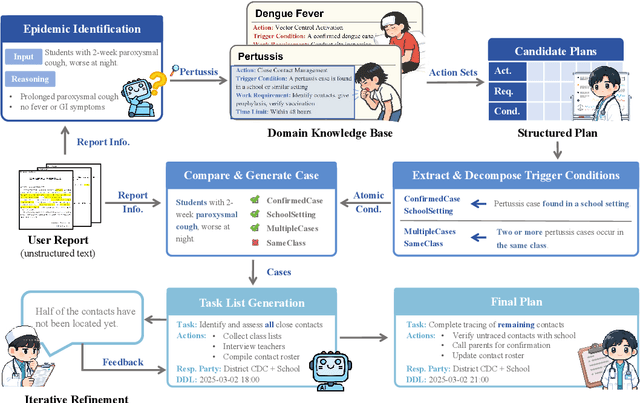

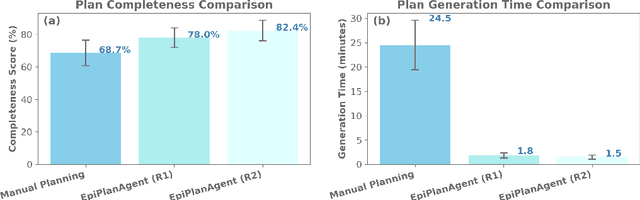
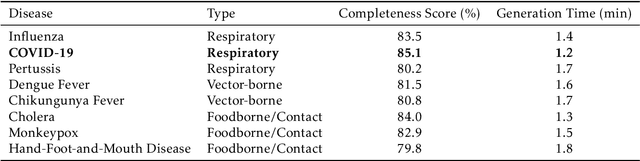
Epidemic response planning is essential yet traditionally reliant on labor-intensive manual methods. This study aimed to design and evaluate EpiPlanAgent, an agent-based system using large language models (LLMs) to automate the generation and validation of digital emergency response plans. The multi-agent framework integrated task decomposition, knowledge grounding, and simulation modules. Public health professionals tested the system using real-world outbreak scenarios in a controlled evaluation. Results demonstrated that EpiPlanAgent significantly improved the completeness and guideline alignment of plans while drastically reducing development time compared to manual workflows. Expert evaluation confirmed high consistency between AI-generated and human-authored content. User feedback indicated strong perceived utility. In conclusion, EpiPlanAgent provides an effective, scalable solution for intelligent epidemic response planning, demonstrating the potential of agentic AI to transform public health preparedness.
Metasurface Smart Glass for Object Recognition
Oct 15, 2022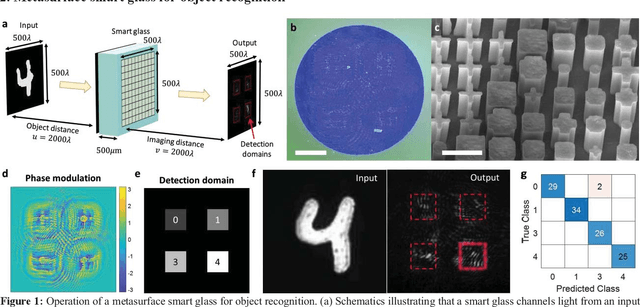
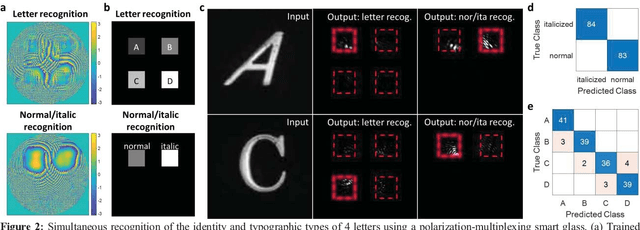
Recent years have seen a considerable surge of research on developing heuristic approaches to realize analog computing using physical waves. Among these, neuromorphic computing using light waves is envisioned to feature performance metrics such as computational speed and energy efficiency exceeding those of conventional digital techniques by many orders of magnitude. Yet, neuromorphic computing based on photonics remains a challenge due to the difficulty of training and manufacturing sophisticated photonic structures to support neural networks with adequate expressive power. Here, we realize a diffractive optical neural network (ONN) based on metasurfaces that can recognize objects by directly processing light waves scattered from the objects. Metasurfaces composed of a two-dimensional array of millions of meta-units can realize precise control of optical wavefront with subwavelength resolution; thus, when used as constitutive layers of an ONN, they can provide exceptionally high expressive power. We experimentally demonstrate ONNs based on single-layered metasurfaces that modulate the phase and polarization over optical wavefront for recognizing optically coherent binary objects, including hand-written digits and English alphabetic letters. We further demonstrate, in simulation, ONNs based on metasurface doublets for human facial verification. The advantageous traits of metasurface-based ONNs, including ultra-compact form factors, zero power consumption, ultra-fast and parallel data processing capabilities, and physics-guaranteed data security, make them suitable as "edge" perception devices that can transform the future of image collection and analysis.