 Add to Chrome
 Add to Firefox
 Add to Edge
DiffCVE: Diffusion-based Compressed Video Enhancement
Jul 08, 2026
Perceptual quality enhancement of severely compressed videos remains challenging due to complex artifact patterns and substantial information loss. Recent diffusion models have demonstrated strong generative capability for visual restoration, but directly applying them to compressed video often ignores compression degradation characteristics and may introduce structure-inconsistent hallucinations. To address this issue, this paper presents a diffusion-based compressed video enhancement method, named DiffCVE. Coding Prior-enhanced Dual Conditioning (CPDC) branches are designed to jointly model compressed video and coding prior conditions, where coding priors including residuals and motion vectors provide complementary structural and motion guidance during the diffusion denoising process. To make the diffusion process aware of compression severity, a Compression Degradation Semantic Prompting (CDSP) mechanism is introduced to leverage QP-conditioned textual prompts together with LoRA fine-tuning. In addition, a Coding Prior-guided Weighted Fusion (CPWF) module is incorporated into the VAE decoder to fuse VAE encoder and coding prior encoder features with QP-predicted weights. Extensive experiments demonstrate the effectiveness of the proposed method in improving perceptual quality, especially under severe compression settings. The project page with enhanced video demonstrations is available at https://wqmaker.github.io/projects/DiffCVE/.

AURA: Adaptive Uncertainty-aware Refinement for LLM-as-a-Judge Auditing
Jun 18, 2026Large language models (LLMs) are increasingly used as judges for open-ended generation, as large-scale human evaluation is often expensive and difficult to scale, yet their preferences remain imperfect proxies for human judgment. Existing auditing pipelines often assume that a reliable subset of examples or clean supervision signals are available beforehand, for example from human annotation, heuristic filtering, or the outputs of strong judges. In LLM evaluation, this assumption is fragile: the initial split may inherit judge bias, while human verification is typically too scarce to define stable groups at scale. We propose AURA, an adaptive uncertainty--aware refinement framework for auditing pairwise LLM--as--a--judge decisions under selected human verification. AURA iteratively learns a human-consistency signal, propagates reliable evidence, and prioritizes uncertain comparisons for human review. The key idea is to treat trust in a judge as a latent quantity that is progressively refined as evidence accumulates. We provide a compact formulation, a stable refinement procedure, and a comprehensive evaluation on both synthetic and real pairwise LLM-answer data.
Managing Temporal Resolution in Continuous Value Estimation: A Fundamental Trade-off
Dec 17, 2022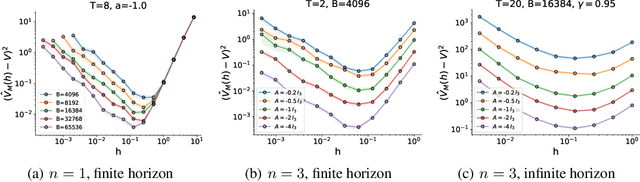

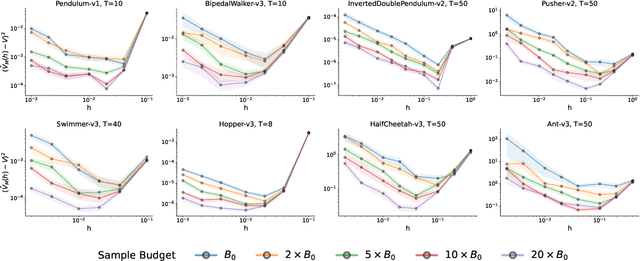

A default assumption in reinforcement learning and optimal control is that experience arrives at discrete time points on a fixed clock cycle. Many applications, however, involve continuous systems where the time discretization is not fixed but instead can be managed by a learning algorithm. By analyzing Monte-Carlo value estimation for LQR systems in both finite-horizon and infinite-horizon settings, we uncover a fundamental trade-off between approximation and statistical error in value estimation. Importantly, these two errors behave differently with respect to time discretization, which implies that there is an optimal choice for the temporal resolution that depends on the data budget. These findings show how adapting the temporal resolution can provably improve value estimation quality in LQR systems from finite data. Empirically, we demonstrate the trade-off in numerical simulations of LQR instances and several non-linear environments.
Efficient and Accurate Quantized Image Super-Resolution on Mobile NPUs, Mobile AI & AIM 2022 challenge: Report
Nov 07, 2022

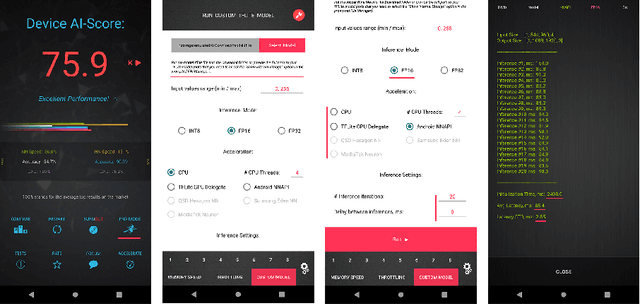
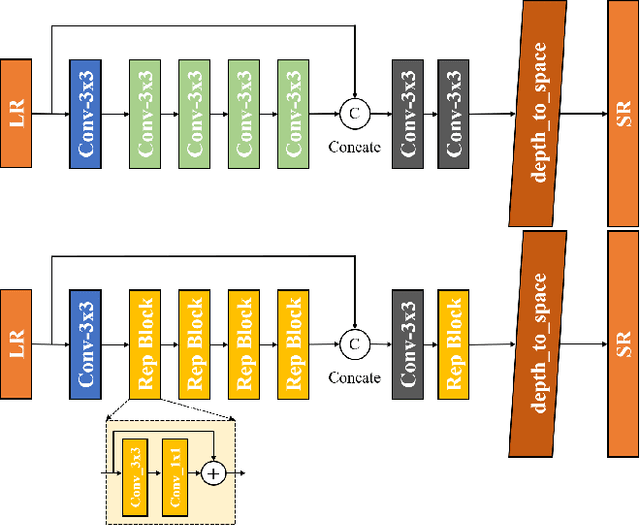
Image super-resolution is a common task on mobile and IoT devices, where one often needs to upscale and enhance low-resolution images and video frames. While numerous solutions have been proposed for this problem in the past, they are usually not compatible with low-power mobile NPUs having many computational and memory constraints. In this Mobile AI challenge, we address this problem and propose the participants to design an efficient quantized image super-resolution solution that can demonstrate a real-time performance on mobile NPUs. The participants were provided with the DIV2K dataset and trained INT8 models to do a high-quality 3X image upscaling. The runtime of all models was evaluated on the Synaptics VS680 Smart Home board with a dedicated edge NPU capable of accelerating quantized neural networks. All proposed solutions are fully compatible with the above NPU, demonstrating an up to 60 FPS rate when reconstructing Full HD resolution images. A detailed description of all models developed in the challenge is provided in this paper.