 Add to Chrome
 Add to Firefox
 Add to Edge
Patients-like-me: A Variational LM--GNN Framework for Explainable Clinical Prediction
Aug 04, 2026
Language models (LMs) offer strong textual representations for electronic health records (EHRs), but they encode patient sequences in isolation and provide limited explainability. Graph neural networks (GNNs) complement LMs by incorporating inter-patient relationships and enabling reference-patient attribution, yet they rely on high-quality patient representations. We propose Patients-like-me (PLM), a unified LM--GNN framework that integrates local patient semantics with global cohort structure. To train PLM efficiently, we introduce a Variational Expectation-Maximization algorithm that alternates LM and GNN updates under a supervised variational objective. Extensive experiments on MIMIC-III and MIMIC-IV show that PLM consistently outperforms state-of-the-art methods, with improvements generalizing across encoder-only and decoder-only LM backbones. These gains are achieved with only modest additional computational overhead. PLM also provides reference-patient explanations by retrieving influential similar patients, while edge-masking experiments confirm that the highest-ranked references have the greatest impact on model predictions.

AURA: Adaptive Uncertainty-aware Refinement for LLM-as-a-Judge Auditing
Jun 18, 2026Large language models (LLMs) are increasingly used as judges for open-ended generation, as large-scale human evaluation is often expensive and difficult to scale, yet their preferences remain imperfect proxies for human judgment. Existing auditing pipelines often assume that a reliable subset of examples or clean supervision signals are available beforehand, for example from human annotation, heuristic filtering, or the outputs of strong judges. In LLM evaluation, this assumption is fragile: the initial split may inherit judge bias, while human verification is typically too scarce to define stable groups at scale. We propose AURA, an adaptive uncertainty--aware refinement framework for auditing pairwise LLM--as--a--judge decisions under selected human verification. AURA iteratively learns a human-consistency signal, propagates reliable evidence, and prioritizes uncertain comparisons for human review. The key idea is to treat trust in a judge as a latent quantity that is progressively refined as evidence accumulates. We provide a compact formulation, a stable refinement procedure, and a comprehensive evaluation on both synthetic and real pairwise LLM-answer data.
Quantifying and Auditing LLM Evaluation via Positive--Unlabeled Learning
Jun 17, 2026Large Language Models (LLMs) are increasingly used as judges for scalable evaluation, yet such LLM--as--a--Judge systems exhibit systematic biases that are decoupled from semantic quality, most notably verbosity bias. Meanwhile, human supervision is costly and typically selective, yielding reliable positive judgments but leaving most outputs unlabelled and potentially mixed in quality. We formulate LLM evaluation under selective human supervision as a positive--unlabelled learning problem and propose a geometric auditing framework based on Partial Optimal Transport. By aligning a small set of human--verified positives with a reliable subset of unlabelled outputs in a fixed embedding space, our method identifies human--consistent preferences and corrects biased judges without retraining. Experiments demonstrate improved alignment with human preferences, increased robustness to presentation biases, and interpretable confidence estimates, offering a scalable and statistically grounded alternative to existing LLM--as--a--judge pipelines.
Positive and Unlabeled Data: Model, Estimation, Inference, and Classification
Jul 13, 2024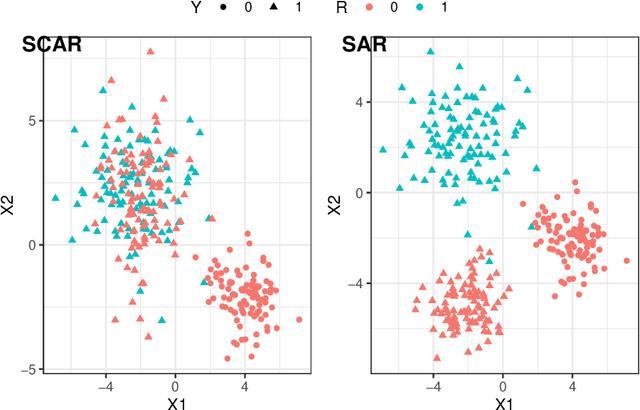
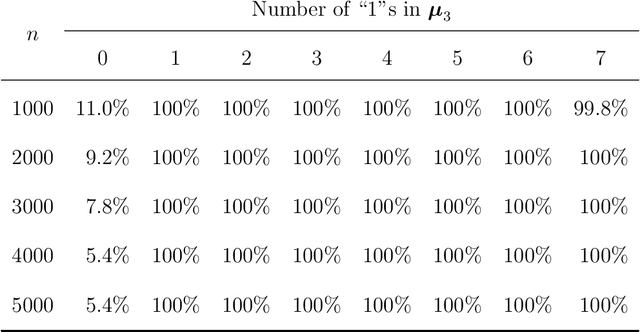
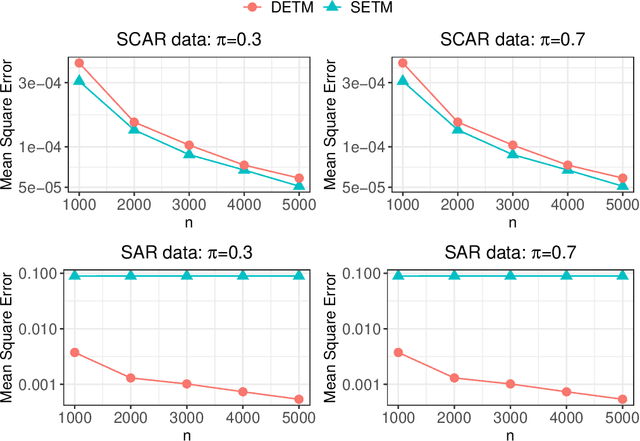
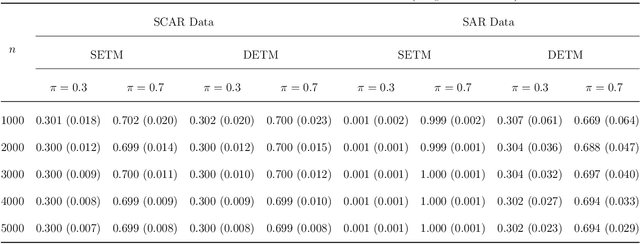
This study introduces a new approach to addressing positive and unlabeled (PU) data through the double exponential tilting model (DETM). Traditional methods often fall short because they only apply to selected completely at random (SCAR) PU data, where the labeled positive and unlabeled positive data are assumed to be from the same distribution. In contrast, our DETM's dual structure effectively accommodates the more complex and underexplored selected at random PU data, where the labeled and unlabeled positive data can be from different distributions. We rigorously establish the theoretical foundations of DETM, including identifiability, parameter estimation, and asymptotic properties. Additionally, we move forward to statistical inference by developing a goodness-of-fit test for the SCAR condition and constructing confidence intervals for the proportion of positive instances in the target domain. We leverage an approximated Bayes classifier for classification tasks, demonstrating DETM's robust performance in prediction. Through theoretical insights and practical applications, this study highlights DETM as a comprehensive framework for addressing the challenges of PU data.