 Add to Chrome
 Add to Firefox
 Add to Edge
FinReporting: An Agentic Workflow for Localized Reporting of Cross-Jurisdiction Financial Disclosures
Apr 07, 2026
Financial reporting systems increasingly use large language models (LLMs) to extract and summarize corporate disclosures. However, most assume a single-market setting and do not address structural differences across jurisdictions. Variations in accounting taxonomies, tagging infrastructures (e.g., XBRL vs. PDF), and aggregation conventions make cross-jurisdiction reporting a semantic alignment and verification challenge. We present FinReporting, an agentic workflow for localized cross-jurisdiction financial reporting. The system builds a unified canonical ontology over Income Statement, Balance Sheet, and Cash Flow, and decomposes reporting into auditable stages including filing acquisition, extraction, canonical mapping, and anomaly logging. Rather than using LLMs as free-form generators, FinReporting deploys them as constrained verifiers under explicit decision rules and evidence grounding. Evaluated on annual filings from the US, Japan, and China, the system improves consistency and reliability under heterogeneous reporting regimes. We release an interactive demo supporting cross-market inspection and structured export of localized financial statements. Our demo is available at https://huggingface.co/spaces/BoomQ/FinReporting-Demo . The video describing our system is available at https://www.youtube.com/watch?v=f65jdEL31Kk

Segregation Before Polarization: How Recommendation Strategies Shape Echo Chamber Pathways
Jan 23, 2026Social media platforms facilitate echo chambers through feedback loops between user preferences and recommendation algorithms. While algorithmic homogeneity is well-documented, the distinct evolutionary pathways driven by content-based versus link-based recommendations remain unclear. Using an extended dynamic Bounded Confidence Model (BCM), we show that content-based algorithms--unlike their link-based counterparts--steer social networks toward a segregation-before-polarization (SbP) pathway. Along this trajectory, structural segregation precedes opinion divergence, accelerating individual isolation while delaying but ultimately intensifying collective polarization. Furthermore, we reveal a paradox in information sharing: Reposting increases the number of connections in the network, yet it simultaneously reinforces echo chambers because it amplifies small, latent opinion differences that would otherwise remain inconsequential. These findings suggest that mitigating polarization requires stage-dependent algorithmic interventions, shifting from content-centric to structure-centric strategies as networks evolve.
OpenAgents: An Open Platform for Language Agents in the Wild
Oct 16, 2023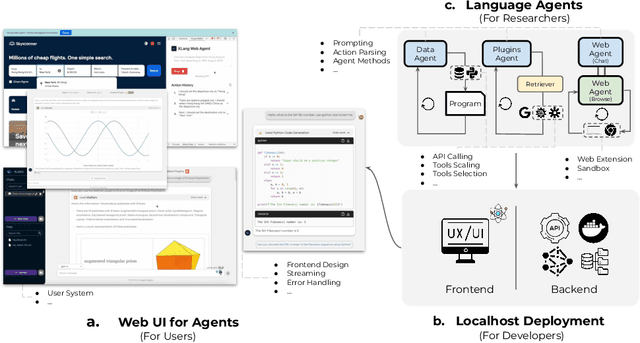
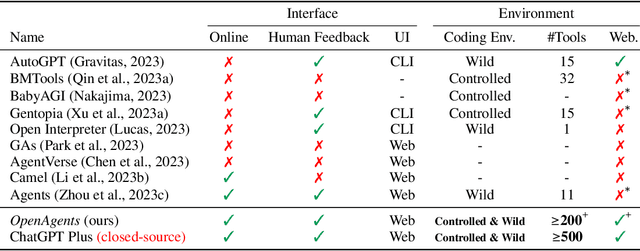
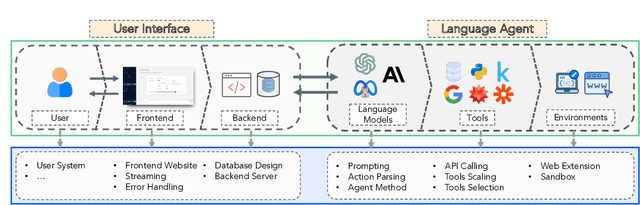

Language agents show potential in being capable of utilizing natural language for varied and intricate tasks in diverse environments, particularly when built upon large language models (LLMs). Current language agent frameworks aim to facilitate the construction of proof-of-concept language agents while neglecting the non-expert user access to agents and paying little attention to application-level designs. We present OpenAgents, an open platform for using and hosting language agents in the wild of everyday life. OpenAgents includes three agents: (1) Data Agent for data analysis with Python/SQL and data tools; (2) Plugins Agent with 200+ daily API tools; (3) Web Agent for autonomous web browsing. OpenAgents enables general users to interact with agent functionalities through a web user interface optimized for swift responses and common failures while offering developers and researchers a seamless deployment experience on local setups, providing a foundation for crafting innovative language agents and facilitating real-world evaluations. We elucidate the challenges and opportunities, aspiring to set a foundation for future research and development of real-world language agents.