 Add to Chrome
 Add to Firefox
 Add to Edge
Step-DeepResearch Technical Report
Dec 24, 2025
As LLMs shift toward autonomous agents, Deep Research has emerged as a pivotal metric. However, existing academic benchmarks like BrowseComp often fail to meet real-world demands for open-ended research, which requires robust skills in intent recognition, long-horizon decision-making, and cross-source verification. To address this, we introduce Step-DeepResearch, a cost-effective, end-to-end agent. We propose a Data Synthesis Strategy Based on Atomic Capabilities to reinforce planning and report writing, combined with a progressive training path from agentic mid-training to SFT and RL. Enhanced by a Checklist-style Judger, this approach significantly improves robustness. Furthermore, to bridge the evaluation gap in the Chinese domain, we establish ADR-Bench for realistic deep research scenarios. Experimental results show that Step-DeepResearch (32B) scores 61.4% on Scale AI Research Rubrics. On ADR-Bench, it significantly outperforms comparable models and rivals SOTA closed-source models like OpenAI and Gemini DeepResearch. These findings prove that refined training enables medium-sized models to achieve expert-level capabilities at industry-leading cost-efficiency.

Constructing accurate machine-learned potentials and performing highly efficient atomistic simulations to predict structural and thermal properties
Nov 16, 2024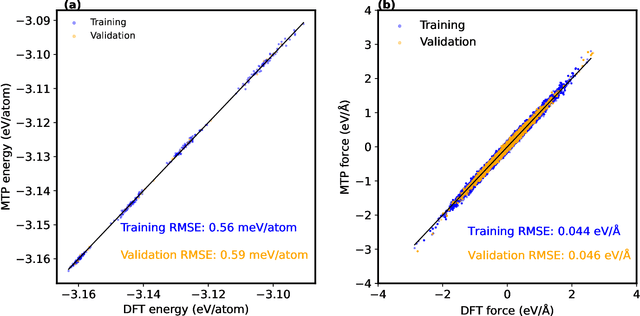
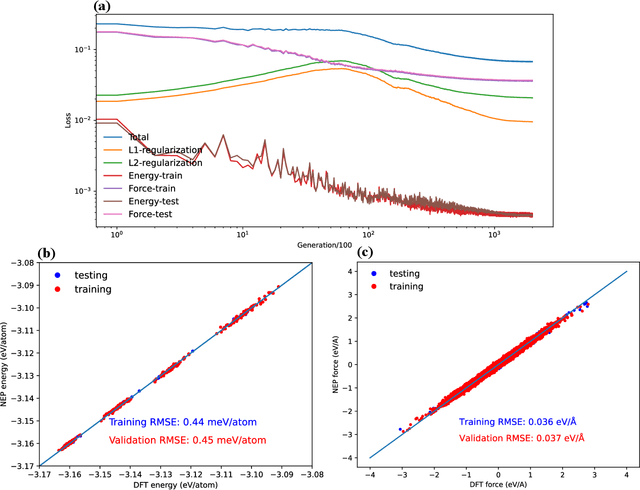
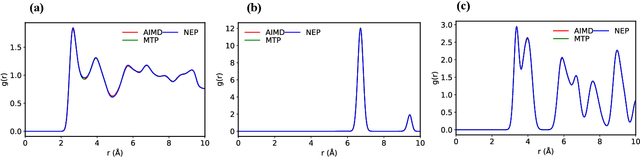
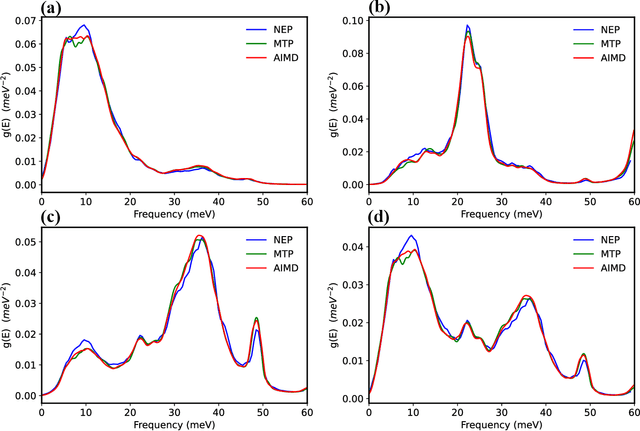
The $\text{Cu}_7\text{P}\text{S}_6$ compound has garnered significant attention due to its potential in thermoelectric applications. In this study, we introduce a neuroevolution potential (NEP), trained on a dataset generated from ab initio molecular dynamics (AIMD) simulations, using the moment tensor potential (MTP) as a reference. The low root mean square errors (RMSEs) for total energy and atomic forces demonstrate the high accuracy and transferability of both the MTP and NEP. We further calculate the phonon density of states (DOS) and radial distribution function (RDF) using both machine learning potentials, comparing the results to density functional theory (DFT) calculations. While the MTP potential offers slightly higher accuracy, the NEP achieves a remarkable 41-fold increase in computational speed. These findings provide detailed microscopic insights into the dynamics and rapid Cu-ion diffusion, paving the way for future studies on Cu-based solid electrolytes and their applications in energy devices.