 Add to Chrome
 Add to Firefox
 Add to Edge
Learning Action Manifold with Multi-view Latent Priors for Robotic Manipulation
May 12, 2026
This paper tackles spatial perception and manipulation challenges in Vision-Language-Action (VLA) models. To address depth ambiguity from monocular input, we leverage a pre-trained multi-view diffusion model to synthesize latent novel views and propose a Geometry-Guided Gated Transformer (G3T) that aligns multi-view features under 3D geometric guidance while adaptively filtering occlusion noise. To improve action learning efficiency, we introduce Action Manifold Learning (AML), which directly predicts actions on the valid action manifold, bypassing inefficient regression of unstructured targets like noise or velocity. Experiments on LIBERO, RoboTwin 2.0, and real-robot tasks show our method achieves superior success rate and robustness over SOTA baselines. Project page: https://junjxiao.github.io/Multi-view-VLA.github.io/.

Learning Explicit Continuous Motion Representation for Dynamic Gaussian Splatting from Monocular Videos
Mar 26, 2026We present an approach for high-quality dynamic Gaussian Splatting from monocular videos. To this end, we in this work go one step further beyond previous methods to explicitly model continuous position and orientation deformation of dynamic Gaussians, using an SE(3) B-spline motion bases with a compact set of control points. To improve computational efficiency while enhancing the ability to model complex motions, an adaptive control mechanism is devised to dynamically adjust the number of motion bases and control points. Besides, we develop a soft segment reconstruction strategy to mitigate long-interval motion interference, and employ a multi-view diffusion model to provide multi-view cues for avoiding overfitting to training views. Extensive experiments demonstrate that our method outperforms state-of-the-art methods in novel view synthesis. Our code is available at https://github.com/hhhddddddd/se3bsplinegs.
ABot-PhysWorld: Interactive World Foundation Model for Robotic Manipulation with Physics Alignment
Mar 24, 2026Video-based world models offer a powerful paradigm for embodied simulation and planning, yet state-of-the-art models often generate physically implausible manipulations - such as object penetration and anti-gravity motion - due to training on generic visual data and likelihood-based objectives that ignore physical laws. We present ABot-PhysWorld, a 14B Diffusion Transformer model that generates visually realistic, physically plausible, and action-controllable videos. Built on a curated dataset of three million manipulation clips with physics-aware annotation, it uses a novel DPO-based post-training framework with decoupled discriminators to suppress unphysical behaviors while preserving visual quality. A parallel context block enables precise spatial action injection for cross-embodiment control. To better evaluate generalization, we introduce EZSbench, the first training-independent embodied zero-shot benchmark combining real and synthetic unseen robot-task-scene combinations. It employs a decoupled protocol to separately assess physical realism and action alignment. ABot-PhysWorld achieves new state-of-the-art performance on PBench and EZSbench, surpassing Veo 3.1 and Sora v2 Pro in physical plausibility and trajectory consistency. We will release EZSbench to promote standardized evaluation in embodied video generation.
ABot-M0: VLA Foundation Model for Robotic Manipulation with Action Manifold Learning
Feb 11, 2026Building general-purpose embodied agents across diverse hardware remains a central challenge in robotics, often framed as the ''one-brain, many-forms'' paradigm. Progress is hindered by fragmented data, inconsistent representations, and misaligned training objectives. We present ABot-M0, a framework that builds a systematic data curation pipeline while jointly optimizing model architecture and training strategies, enabling end-to-end transformation of heterogeneous raw data into unified, efficient representations. From six public datasets, we clean, standardize, and balance samples to construct UniACT-dataset, a large-scale dataset with over 6 million trajectories and 9,500 hours of data, covering diverse robot morphologies and task scenarios. Unified pre-training improves knowledge transfer and generalization across platforms and tasks, supporting general-purpose embodied intelligence. To improve action prediction efficiency and stability, we propose the Action Manifold Hypothesis: effective robot actions lie not in the full high-dimensional space but on a low-dimensional, smooth manifold governed by physical laws and task constraints. Based on this, we introduce Action Manifold Learning (AML), which uses a DiT backbone to predict clean, continuous action sequences directly. This shifts learning from denoising to projection onto feasible manifolds, improving decoding speed and policy stability. ABot-M0 supports modular perception via a dual-stream mechanism that integrates VLM semantics with geometric priors and multi-view inputs from plug-and-play 3D modules such as VGGT and Qwen-Image-Edit, enhancing spatial understanding without modifying the backbone and mitigating standard VLM limitations in 3D reasoning. Experiments show components operate independently with additive benefits. We will release all code and pipelines for reproducibility and future research.
RoGSplat: Learning Robust Generalizable Human Gaussian Splatting from Sparse Multi-View Images
Mar 18, 2025
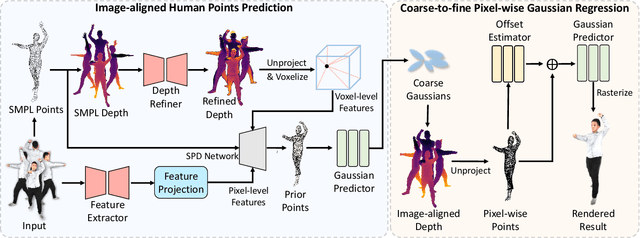

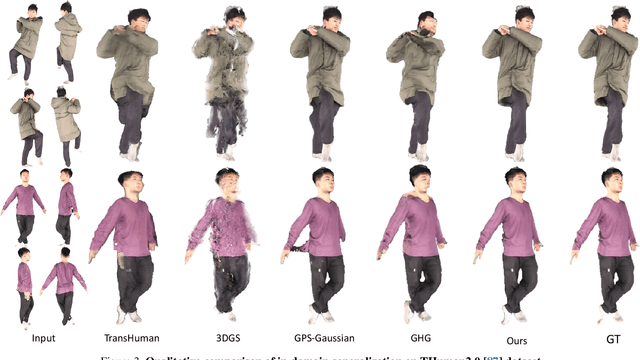
This paper presents RoGSplat, a novel approach for synthesizing high-fidelity novel views of unseen human from sparse multi-view images, while requiring no cumbersome per-subject optimization. Unlike previous methods that typically struggle with sparse views with few overlappings and are less effective in reconstructing complex human geometry, the proposed method enables robust reconstruction in such challenging conditions. Our key idea is to lift SMPL vertices to dense and reliable 3D prior points representing accurate human body geometry, and then regress human Gaussian parameters based on the points. To account for possible misalignment between SMPL model and images, we propose to predict image-aligned 3D prior points by leveraging both pixel-level features and voxel-level features, from which we regress the coarse Gaussians. To enhance the ability to capture high-frequency details, we further render depth maps from the coarse 3D Gaussians to help regress fine-grained pixel-wise Gaussians. Experiments on several benchmark datasets demonstrate that our method outperforms state-of-the-art methods in novel view synthesis and cross-dataset generalization. Our code is available at https://github.com/iSEE-Laboratory/RoGSplat.
NECA: Neural Customizable Human Avatar
Mar 15, 2024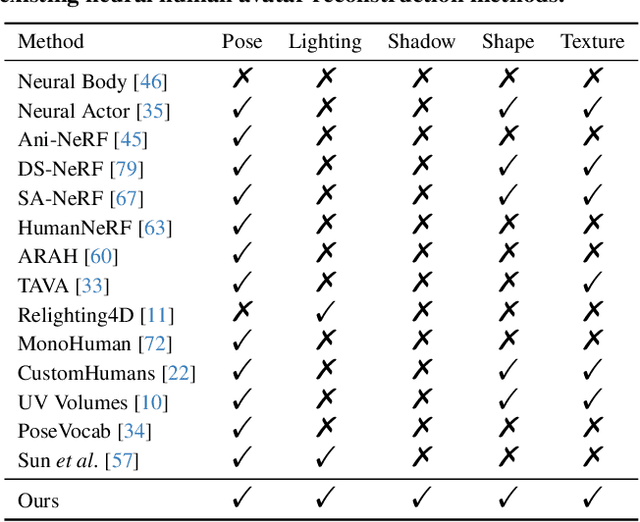
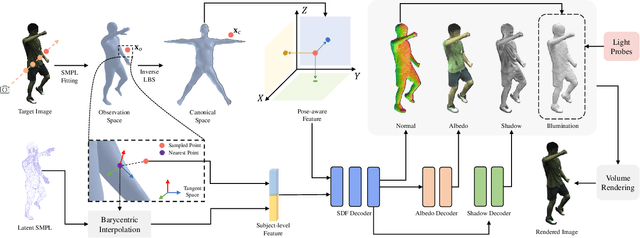
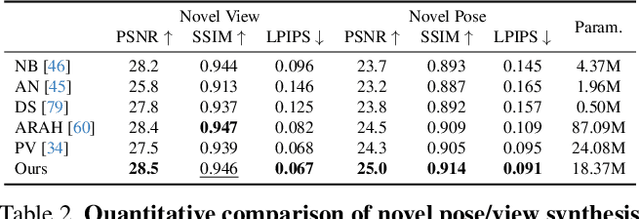
Human avatar has become a novel type of 3D asset with various applications. Ideally, a human avatar should be fully customizable to accommodate different settings and environments. In this work, we introduce NECA, an approach capable of learning versatile human representation from monocular or sparse-view videos, enabling granular customization across aspects such as pose, shadow, shape, lighting and texture. The core of our approach is to represent humans in complementary dual spaces and predict disentangled neural fields of geometry, albedo, shadow, as well as an external lighting, from which we are able to derive realistic rendering with high-frequency details via volumetric rendering. Extensive experiments demonstrate the advantage of our method over the state-of-the-art methods in photorealistic rendering, as well as various editing tasks such as novel pose synthesis and relighting. The code is available at https://github.com/iSEE-Laboratory/NECA.