 Add to Chrome
 Add to Firefox
 Add to Edge
AHEAD: Anticipatory Hand-Driven Teleoperation via Human Intent Prediction
Jul 16, 2026
Direct hand-driven teleoperation maps an operator's hand motion to robot end-effector commands at every frame, enabling precise control, but it requires constant monitoring and correction during approach, grasp, and placement, which can be slow and fatiguing. For repetitive pick-and-place tasks, supervisory (goal-based) teleoperation simplifies this process: the operator specifies goals/waypoints, and the robot executes the motion using planning algorithms. Yet, this introduces latency, as the robot must wait for the next command before it can plan and act. "How can we reduce robot reaction time while lowering operator workload?" To tackle this question, we present AHEAD, a real-time VR teleoperation system that anticipates operator intent to enable proactive, hand-driven control. In a digital twin, the operator performs pick-and-place naturally, using hand motion to convey high-level commands rather than a continuous robot trajectory. AHEAD processes a short window of 3D hand and head signals together with scene context through an attention-based classifier to predict the intended grasp object and placement slot. A state machine converts intent predictions into stable robot goals, enabling early motion while remaining stable under noisy predictions and corrective hand movements. AHEAD's intent prediction module achieves Top1 accuracy: 76% for grasp objects and 76% for target slots. Moreover, our user study shows AHEAD reduces robot reaction latency by 0.6 s (object) and 1.4 s (slot) relative to baselines. Participants also reported lower operator load, indicating faster robot responses while maintaining low operator effort in practice.

Domain Generalization via Text-Anchored Information Bottleneck
Jul 02, 2026Visual recognition models often fail when deployed in new environments. Domain Generalization (DG) addresses this by learning representations that remain invariant to environment-specific variations. Recent approaches increasingly rely on large vision-language models, assuming that preserving their expressive visual representations improves robustness. However, we show that such visual expressiveness can instead propagate spurious cues that tie representations to the training environments, hindering invariant learning. We therefore discard visual guidance and instead treat the language embedding space as the primary source of domain invariance, naturally acting as an information bottleneck that preserves core semantics while suppressing domain-specific variations. Extensive experiments across diverse backbones exhibit state-of-the-art performance and further analyze what makes guidance effective for robust generalization. These findings shift the focus of DG from improving representations to designing supervision that enforces invariance.
HEART: Coordination of Heterogeneous Expert Agents for Physically Grounded Robotic Task Planning
Jun 24, 2026Large Language Models (LLMs) can reason over complex instructions but often fail to satisfy the physical and spatial constraints required for robotic task planning. Recent LLM-based planners directly translate text into action sequences, yet they lack structured reasoning about feasibility, reachability, and logical order, resulting in invalid or incomplete plans. We present a heterogeneous multi-LLM framework that decomposes instructions into atomic reasoning tasks and allocates them to role-specialized expert agents under a token budget for real-world computational and communicational constraints. By combining role-oriented reasoning from heterogeneous agents followed by constraint-driven plan synthesis, HEART validates capability, reachability, and constraint conditions before planning and helps produce physically executable plans while maintaining efficiency. Experiments across different household benchmarks show that HEART consistently improves plan success compared to single-LLM and rule-based planners, demonstrating that heterogeneous LLM collaboration enables robust and scalable robotic task planning under resource constraints.
Geometry-Aware Image Flow Matching
May 24, 2026Recent advances in generative models highlight the power of geometry-aware modeling in manifold-constrained settings. Yet, for natural images, the field remains confined to Euclidean assumptions, failing to exploit the potential of intrinsic geometric structures within the data. In this work, we investigate the geometry of natural images and observe that semantic information is predominantly encoded in directional components, while norm components can be approximated by the global average. This property holds across both RGB and latent spaces, suggesting that natural images can be effectively modeled on a hypersphere. Building on this finding, we introduce Spherical Optimal Transport Flow Matching (SOT-CFM), which utilizes angular distance, and Spherical Flow Matching (SFM), which constrains dynamics directly on the manifold. Our experiments demonstrate that these geometry-aware methods achieve superior performance against Euclidean baselines. Ultimately, this work provides a novel perspective that bridges the gap between Riemannian manifold-based modeling and natural image generation.
Is There a Better Source Distribution than Gaussian? Exploring Source Distributions for Image Flow Matching
Dec 20, 2025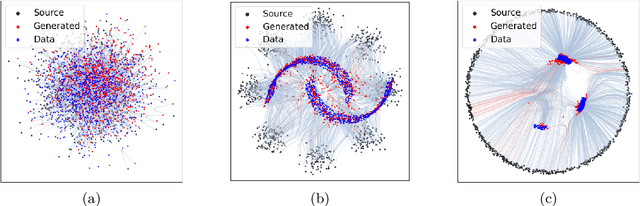
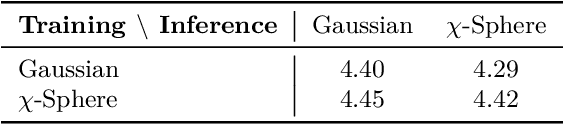
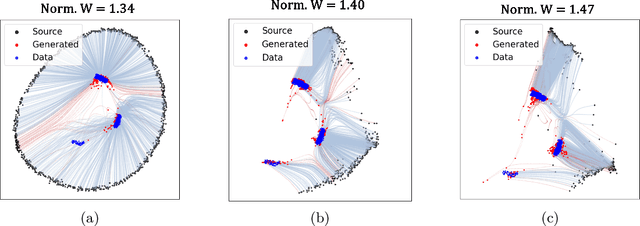

Flow matching has emerged as a powerful generative modeling approach with flexible choices of source distribution. While Gaussian distributions are commonly used, the potential for better alternatives in high-dimensional data generation remains largely unexplored. In this paper, we propose a novel 2D simulation that captures high-dimensional geometric properties in an interpretable 2D setting, enabling us to analyze the learning dynamics of flow matching during training. Based on this analysis, we derive several key insights about flow matching behavior: (1) density approximation can paradoxically degrade performance due to mode discrepancy, (2) directional alignment suffers from path entanglement when overly concentrated, (3) Gaussian's omnidirectional coverage ensures robust learning, and (4) norm misalignment incurs substantial learning costs. Building on these insights, we propose a practical framework that combines norm-aligned training with directionally-pruned sampling. This approach maintains the robust omnidirectional supervision essential for stable flow learning, while eliminating initializations in data-sparse regions during inference. Importantly, our pruning strategy can be applied to any flow matching model trained with a Gaussian source, providing immediate performance gains without the need for retraining. Empirical evaluations demonstrate consistent improvements in both generation quality and sampling efficiency. Our findings provide practical insights and guidelines for source distribution design and introduce a readily applicable technique for improving existing flow matching models. Our code is available at https://github.com/kwanseokk/SourceFM.
Finding NeMo: Negative-mined Mosaic Augmentation for Referring Image Segmentation
Nov 03, 2024

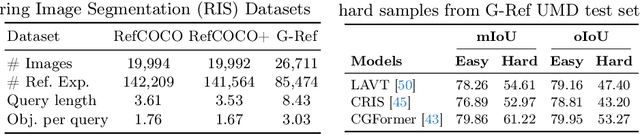

Referring Image Segmentation is a comprehensive task to segment an object referred by a textual query from an image. In nature, the level of difficulty in this task is affected by the existence of similar objects and the complexity of the referring expression. Recent RIS models still show a significant performance gap between easy and hard scenarios. We pose that the bottleneck exists in the data, and propose a simple but powerful data augmentation method, Negative-mined Mosaic Augmentation (NeMo). This method augments a training image into a mosaic with three other negative images carefully curated by a pretrained multimodal alignment model, e.g., CLIP, to make the sample more challenging. We discover that it is critical to properly adjust the difficulty level, neither too ambiguous nor too trivial. The augmented training data encourages the RIS model to recognize subtle differences and relationships between similar visual entities and to concretely understand the whole expression to locate the right target better. Our approach shows consistent improvements on various datasets and models, verified by extensive experiments.
Scalable Frame Sampling for Video Classification: A Semi-Optimal Policy Approach with Reduced Search Space
Sep 09, 2024Given a video with $T$ frames, frame sampling is a task to select $N \ll T$ frames, so as to maximize the performance of a fixed video classifier. Not just brute-force search, but most existing methods suffer from its vast search space of $\binom{T}{N}$, especially when $N$ gets large. To address this challenge, we introduce a novel perspective of reducing the search space from $O(T^N)$ to $O(T)$. Instead of exploring the entire $O(T^N)$ space, our proposed semi-optimal policy selects the top $N$ frames based on the independently estimated value of each frame using per-frame confidence, significantly reducing the computational complexity. We verify that our semi-optimal policy can efficiently approximate the optimal policy, particularly under practical settings. Additionally, through extensive experiments on various datasets and model architectures, we demonstrate that learning our semi-optimal policy ensures stable and high performance regardless of the size of $N$ and $T$.
Isometric Representation Learning for Disentangled Latent Space of Diffusion Models
Jul 16, 2024The latent space of diffusion model mostly still remains unexplored, despite its great success and potential in the field of generative modeling. In fact, the latent space of existing diffusion models are entangled, with a distorted mapping from its latent space to image space. To tackle this problem, we present Isometric Diffusion, equipping a diffusion model with a geometric regularizer to guide the model to learn a geometrically sound latent space of the training data manifold. This approach allows diffusion models to learn a more disentangled latent space, which enables smoother interpolation, more accurate inversion, and more precise control over attributes directly in the latent space. Our extensive experiments consisting of image interpolations, image inversions, and linear editing show the effectiveness of our method.
Semi-Supervised Domain Adaptation Using Target-Oriented Domain Augmentation for 3D Object Detection
Jun 17, 2024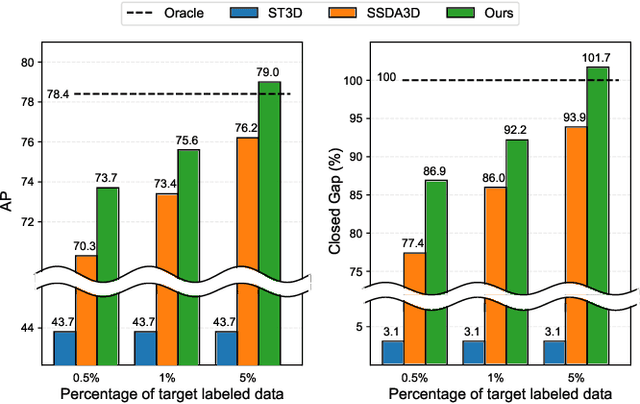
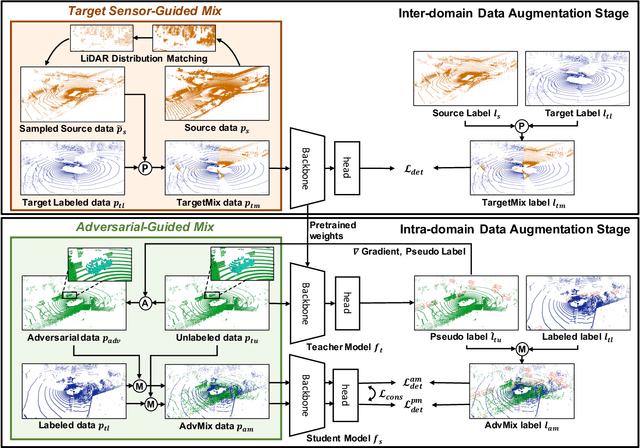
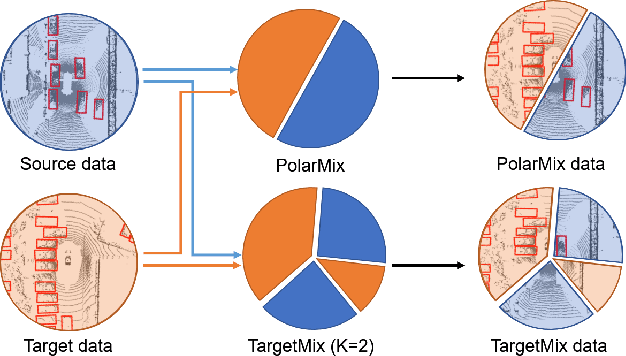
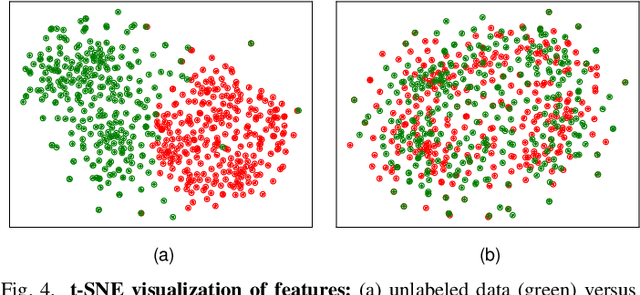
3D object detection is crucial for applications like autonomous driving and robotics. However, in real-world environments, variations in sensor data distribution due to sensor upgrades, weather changes, and geographic differences can adversely affect detection performance. Semi-Supervised Domain Adaptation (SSDA) aims to mitigate these challenges by transferring knowledge from a source domain, abundant in labeled data, to a target domain where labels are scarce. This paper presents a new SSDA method referred to as Target-Oriented Domain Augmentation (TODA) specifically tailored for LiDAR-based 3D object detection. TODA efficiently utilizes all available data, including labeled data in the source domain, and both labeled data and unlabeled data in the target domain to enhance domain adaptation performance. TODA consists of two stages: TargetMix and AdvMix. TargetMix employs mixing augmentation accounting for LiDAR sensor characteristics to facilitate feature alignment between the source-domain and target-domain. AdvMix applies point-wise adversarial augmentation with mixing augmentation, which perturbs the unlabeled data to align the features within both labeled and unlabeled data in the target domain. Our experiments conducted on the challenging domain adaptation tasks demonstrate that TODA outperforms existing domain adaptation techniques designed for 3D object detection by significant margins. The code is available at: https://github.com/rasd3/TODA.
Enhancing Effectiveness and Robustness in a Low-Resource Regime via Decision-Boundary-aware Data Augmentation
Mar 22, 2024Efforts to leverage deep learning models in low-resource regimes have led to numerous augmentation studies. However, the direct application of methods such as mixup and cutout to text data, is limited due to their discrete characteristics. While methods using pretrained language models have exhibited efficiency, they require additional considerations for robustness. Inspired by recent studies on decision boundaries, this paper proposes a decision-boundary-aware data augmentation strategy to enhance robustness using pretrained language models. The proposed technique first focuses on shifting the latent features closer to the decision boundary, followed by reconstruction to generate an ambiguous version with a soft label. Additionally, mid-K sampling is suggested to enhance the diversity of the generated sentences. This paper demonstrates the performance of the proposed augmentation strategy compared to other methods through extensive experiments. Furthermore, the ablation study reveals the effect of soft labels and mid-K sampling and the extensibility of the method with curriculum data augmentation.