 Add to Chrome
 Add to Firefox
 Add to Edge
Equivariant Latent Alignment via Flow Matching under Group Symmetries
May 29, 2026
Geometry-aware generative models and novel view synthesis approaches have shown strong potential in visual fidelity and consistency. In parallel, equivariant representation learning has emerged as a powerful framework for constructing latent spaces where analytically known group transformations could act directly, capturing geometric structure in data and enhancing both interpretability and generalization in novel view synthesis. However, we identify that existing approaches often suffer from latent misalignment, a discrepancy between the intended group action and the actually required transformations in the latent space. Consequently, the learned latents often fail to consistently preserve the equivariant relations imposed by the underlying group symmetry. To address this, we propose Residual Latent Flow, a flow-based framework that corrects the misaligned latents, thereby improving compliance with the underlying equivariance relation. Our comprehensive experiments show that our method significantly reduces latent misalignment and improves novel view synthesis quality, under rotation groups SO(n).

Isometric Representation Learning for Disentangled Latent Space of Diffusion Models
Jul 16, 2024The latent space of diffusion model mostly still remains unexplored, despite its great success and potential in the field of generative modeling. In fact, the latent space of existing diffusion models are entangled, with a distorted mapping from its latent space to image space. To tackle this problem, we present Isometric Diffusion, equipping a diffusion model with a geometric regularizer to guide the model to learn a geometrically sound latent space of the training data manifold. This approach allows diffusion models to learn a more disentangled latent space, which enables smoother interpolation, more accurate inversion, and more precise control over attributes directly in the latent space. Our extensive experiments consisting of image interpolations, image inversions, and linear editing show the effectiveness of our method.
Improvement in Variational Quantum Algorithms by Measurement Simplification
Dec 11, 2023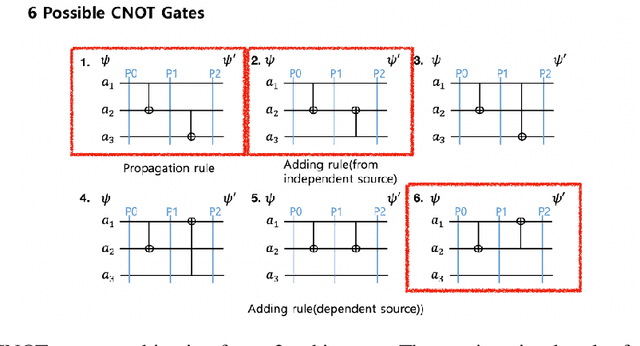
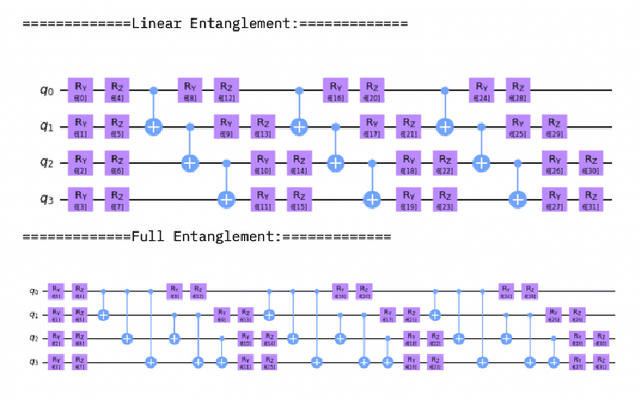
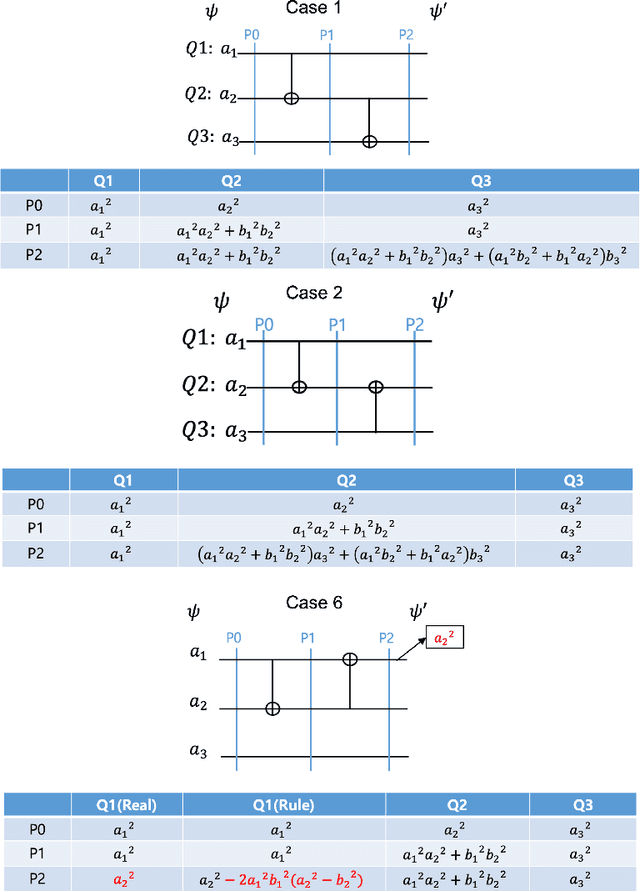
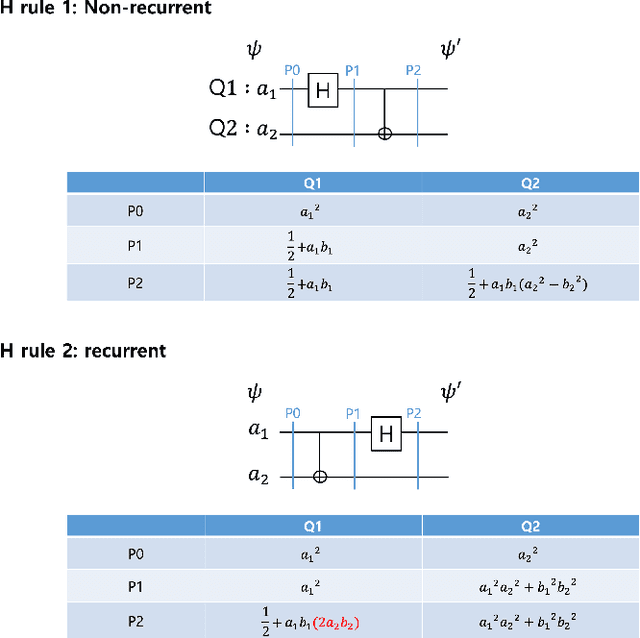
Variational Quantum Algorithms (VQAs) are expected to be promising algorithms with quantum advantages that can be run at quantum computers in the close future. In this work, we review simple rules in basic quantum circuits, and propose a simplification method, Measurement Simplification, that simplifies the expression for the measurement of quantum circuit. By the Measurement Simplification, we simplified the specific result expression of VQAs and obtained large improvements in calculation time and required memory size. Here we applied Measurement Simplification to Variational Quantum Linear Solver (VQLS), Variational Quantum Eigensolver (VQE) and other Quantum Machine Learning Algorithms to show an example of speedup in the calculation time and required memory size.