 Add to Chrome
 Add to Firefox
 Add to Edge
RoomRecon: High-Quality Textured Room Layout Reconstruction on Mobile Devices
Apr 21, 2026
Widespread RGB-Depth (RGB-D) sensors and advanced 3D reconstruction technologies facilitate the capture of indoor spaces, improving the fields of augmented reality (AR), virtual reality (VR), and extended reality (XR). Nevertheless, current technologies still face limitations, such as the inability to reflect minor scene changes without a complete recapture, the lack of semantic scene understanding, and various texturing challenges that affect the 3D model's visual quality. These issues affect the realism required for VR experiences and other applications such as in interior design and real estate. To address these challenges, we introduce RoomRecon, an interactive, real-time scanning and texturing pipeline for 3D room models. We propose a two-phase texturing pipeline that integrates AR-guided image capturing for texturing and generative AI models to improve texturing quality and provide better replicas of indoor spaces. Moreover, we suggest focusing only on permanent room elements such as walls, floors, and ceilings, to allow for easily customizable 3D models. We conduct experiments in a variety of indoor spaces to assess the texturing quality and speed of our method. The quantitative results and user study demonstrate that RoomRecon surpasses state-of-the-art methods in terms of texturing quality and on-device computation time.
* 23 pages, including supplementary material. Accepted to the 2024 IEEE International Symposium on Mixed and Augmented Reality (ISMAR). Best Paper Nominee

Knowledge Assembly: Semi-Supervised Multi-Task Learning from Multiple Datasets with Disjoint Labels
Jun 15, 2023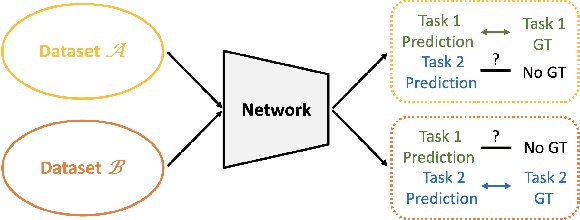
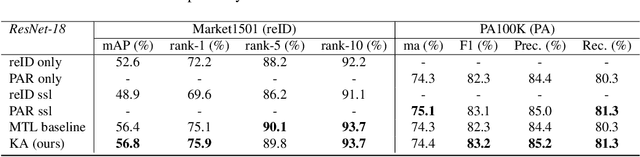
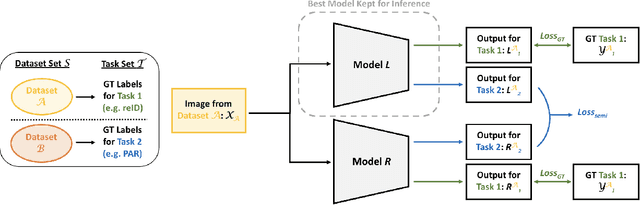
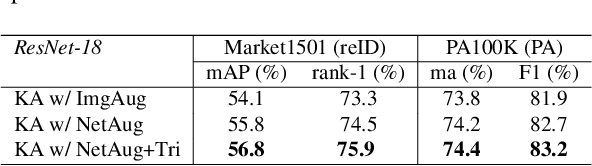
In real-world scenarios we often need to perform multiple tasks simultaneously. Multi-Task Learning (MTL) is an adequate method to do so, but usually requires datasets labeled for all tasks. We propose a method that can leverage datasets labeled for only some of the tasks in the MTL framework. Our work, Knowledge Assembly (KA), learns multiple tasks from disjoint datasets by leveraging the unlabeled data in a semi-supervised manner, using model augmentation for pseudo-supervision. Whilst KA can be implemented on any existing MTL networks, we test our method on jointly learning person re-identification (reID) and pedestrian attribute recognition (PAR). We surpass the single task fully-supervised performance by $4.2\%$ points for reID and $0.9\%$ points for PAR.