 Add to Chrome
 Add to Firefox
 Add to Edge
EgoSafetyBench: A Diagnostic Egocentric Video Benchmark for Evaluating Embodied VLMs as Runtime Safety Guards
Jun 30, 2026
Vision-language models (VLMs) are now proposed as runtime safety guards for embodied agents in homes and factories. A deployable guard must catch genuinely unsafe situations while avoiding unnecessary intervention on routine but superficially alarming activity, a distinction that binary safety benchmarks obscure. We introduce EgoSafetyBench, an egocentric video benchmark of 1,200 robot-view scenarios annotated at half-second granularity, to evaluate VLMs as streaming guards across two tracks. The situational track (800 scenarios) spans four families, from routine and safe-but-suspicious scenes to obvious and contextual hazards. The visual-channel track (400 scenarios) targets in-scene text-a sign, sticker, or label visible in the scene-that can misrepresent the physical situation, pairing each misleading sign with a truthful version to test both whether a guard flags the text as misleading and whether the text corrupts its physical-safety judgment. Both tracks use contrastive ladders: near-identical scenarios differing only in a single visible deciding cue, so a correct call must hinge on that cue rather than the overall scene type. We evaluate ten open- and closed-source VLMs. We find that while guards reliably recognize videos containing hazards, they often miss specific hazardous moments, particularly contextual hazards. Furthermore, misleading in-scene signs degrade all tested guards: vulnerable models miss up to a third of hazards, while robust models over-intervene on safe content. Matched controls reveal that apparent safety robustness often reflects indiscriminate alarming rather than true physical reasoning.

FinRED: An Expert-Guided Benchmark Generation and Evaluation Framework for Financial LLM Red-Teaming
Jun 24, 2026Existing safety benchmarks target general adversarial scenarios but miss finance-specific risks. Financial LLMs face regulatory compliance violations, fraud facilitation, and systemic trust erosion that require targeted evaluation. We introduce FinRED, an expert-guided red-teaming framework for financial LLM safety evaluation developed with financial experts. FinRED uses a novel two-level taxonomy mapping global standards (e.g., FATF and EU DORA) to threats ranging from regulatory evasion to complex fraud, integrated with a scalable pipeline that converts real financial documents into context-rich red-teaming Behavioral Prompts (seeds) through an expert-defined schema. Rigorous expert validation confirms seed plausibility and realism for meaningful LLM safety evaluation. We also provide an expert-validated, finance-specific rubric that goes beyond disclaimer checks, aligns more closely with human experts than static one-size-fits-all rubrics, and reduces critical false negatives from 28 to 12. Aligned with internationally adopted risk-management and information-security standards (e.g., ISO/IEC 27001), FinRED is deployed in South Korea's Financial Security Institute (FSI) regulatory sandbox for generative AI security evaluation in real financial services. To mitigate dual-use risks, the dataset, generation pipeline, prompt template, and evaluation framework are gated for qualified researchers at https://github.com/selectstar-ai/FinRED-paper and https://huggingface.co/datasets/datumo/FinRED.
FFinRED: An Expert-Guided Benchmark Generation and Evaluation Framework for Financial LLM Red-Teaming
Jun 18, 2026Existing safety benchmarks target general adversarial scenarios but miss finance-specific risks. Financial LLMs face regulatory compliance violations, fraud facilitation, and systemic trust erosion that require targeted evaluation. We introduce FinRED, an expert-guided red-teaming framework for financial LLM safety evaluation developed with financial experts. FinRED uses a novel two-level taxonomy mapping global standards (e.g., FATF and EU DORA) to threats ranging from regulatory evasion to complex fraud, integrated with a scalable pipeline that converts real financial documents into context-rich red-teaming Behavioral Prompts (seeds) through an expert-defined schema. Rigorous expert validation confirms seed plausibility and realism for meaningful LLM safety evaluation. We also provide an expert-validated, finance-specific rubric that goes beyond disclaimer checks, aligns more closely with human experts than static one-size-fits-all rubrics, and reduces critical false negatives from 28 to 12. Aligned with internationally adopted risk-management and information-security standards (e.g., ISO/IEC 27001), FinRED is deployed in South Korea's Financial Security Institute (FSI) regulatory sandbox for generative AI security evaluation in real financial services. To mitigate dual-use risks, the dataset, generation pipeline, prompt template, and evaluation framework are gated for qualified researchers at https://github.com/selectstar-ai/FinRED-paper and https://huggingface.co/datasets/datumo/FinRED.
PHASOR: Phase-Anchored Universal Action Representations for Humanoid Embodiments
Jun 01, 2026Learning a good action embedding space is fundamental to scalable robot policy learning, yet existing methods treat action latents as task-specific intermediates rather than first-class representations. The resulting latents are unstructured, embodiment-specific, and weakly tied to motion semantics, limiting interpretability, controllability, and transferability across robots. We position the action embedding space itself as a first-class design target, with downstream policy quality emerging from representation quality. Exploiting motion's intrinsic periodicity, we factorize it into a phase manifold that captures cyclic structure via FFT-parametric coefficients, together with a pose branch that conditions the manifold on non-periodic configuration detail. Combined with motion-semantic distillation, this factorized structure yields a cross-embodiment motion manifold that is interpretable and embodiment-agnostic by design. Anchoring multiple humanoid robots to a shared human-pretrained manifold then produces a unified action embedding space across diverse platforms, achieving strong cross-embodiment retrieval and consistent gains on downstream robot tasks.
STAR-Teaming: A Strategy-Response Multiplex Network Approach to Automated LLM Red Teaming
Apr 21, 2026While Large Language Models (LLMs) are widely used, they remain susceptible to jailbreak prompts that can elicit harmful or inappropriate responses. This paper introduces STAR-Teaming, a novel black-box framework for automated red teaming that effectively generates such prompts. STAR-Teaming integrates a Multi-Agent System (MAS) with a Strategy-Response Multiplex Network and employs network-driven optimization to sample effective attack strategies. This network-based approach recasts the intractable high-dimensional embedding space into a tractable structure, yielding two key advantages: it enhances the interpretability of the LLM's strategic vulnerabilities, and it streamlines the search for effective strategies by organizing the search space into semantic communities, thereby preventing redundant exploration. Empirical results demonstrate that STAR-Teaming significantly surpasses existing methods, achieving a higher attack success rate (ASR) at a lower computational cost. Extensive experiments validate the effectiveness and explainability of the Multiplex Network. The code is available at https://github.com/selectstar-ai/STAR-Teaming-paper.
Towards Motion-aware Referring Image Segmentation
Mar 18, 2026Referring Image Segmentation (RIS) requires identifying objects from images based on textual descriptions. We observe that existing methods significantly underperform on motion-related queries compared to appearance-based ones. To address this, we first introduce an efficient data augmentation scheme that extracts motion-centric phrases from original captions, exposing models to more motion expressions without additional annotations. Second, since the same object can be described differently depending on the context, we propose Multimodal Radial Contrastive Learning (MRaCL), performed on fused image-text embeddings rather than unimodal representations. For comprehensive evaluation, we introduce a new test split focusing on motion-centric queries, and introduce a new benchmark called M-Bench, where objects are distinguished primarily by actions. Extensive experiments show our method substantially improves performance on motion-centric queries across multiple RIS models, maintaining competitive results on appearance-based descriptions. Codes are available at https://github.com/snuviplab/MRaCL
Finding NeMo: Negative-mined Mosaic Augmentation for Referring Image Segmentation
Nov 03, 2024

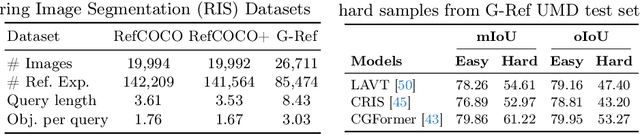

Referring Image Segmentation is a comprehensive task to segment an object referred by a textual query from an image. In nature, the level of difficulty in this task is affected by the existence of similar objects and the complexity of the referring expression. Recent RIS models still show a significant performance gap between easy and hard scenarios. We pose that the bottleneck exists in the data, and propose a simple but powerful data augmentation method, Negative-mined Mosaic Augmentation (NeMo). This method augments a training image into a mosaic with three other negative images carefully curated by a pretrained multimodal alignment model, e.g., CLIP, to make the sample more challenging. We discover that it is critical to properly adjust the difficulty level, neither too ambiguous nor too trivial. The augmented training data encourages the RIS model to recognize subtle differences and relationships between similar visual entities and to concretely understand the whole expression to locate the right target better. Our approach shows consistent improvements on various datasets and models, verified by extensive experiments.