 Add to Chrome
 Add to Firefox
 Add to Edge
The NeurIPS 2022 Neural MMO Challenge: A Massively Multiagent Competition with Specialization and Trade
Nov 07, 2023
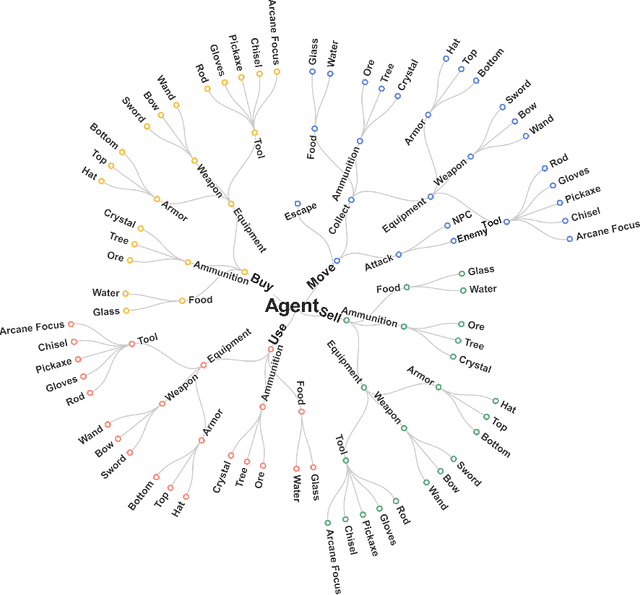
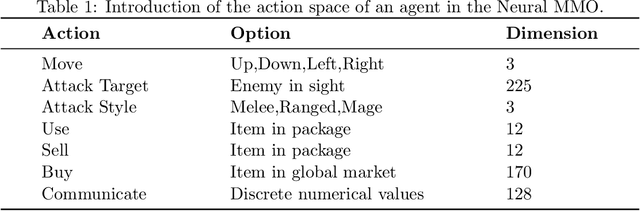
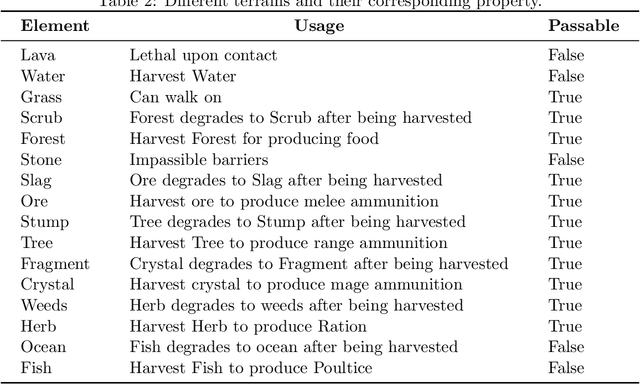
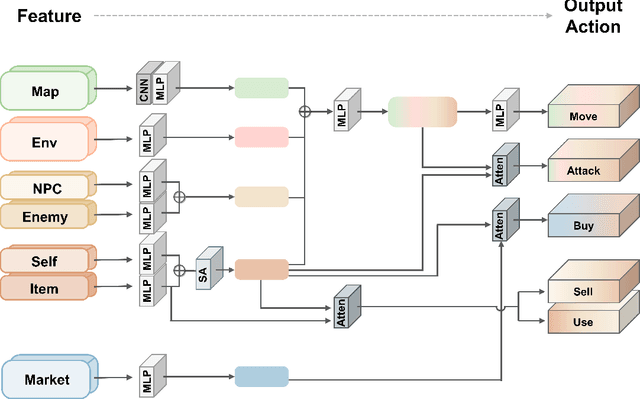
In this paper, we present the results of the NeurIPS-2022 Neural MMO Challenge, which attracted 500 participants and received over 1,600 submissions. Like the previous IJCAI-2022 Neural MMO Challenge, it involved agents from 16 populations surviving in procedurally generated worlds by collecting resources and defeating opponents. This year's competition runs on the latest v1.6 Neural MMO, which introduces new equipment, combat, trading, and a better scoring system. These elements combine to pose additional robustness and generalization challenges not present in previous competitions. This paper summarizes the design and results of the challenge, explores the potential of this environment as a benchmark for learning methods, and presents some practical reinforcement learning training approaches for complex tasks with sparse rewards. Additionally, we have open-sourced our baselines, including environment wrappers, benchmarks, and visualization tools for future research.

Benchmarking Robustness and Generalization in Multi-Agent Systems: A Case Study on Neural MMO
Aug 30, 2023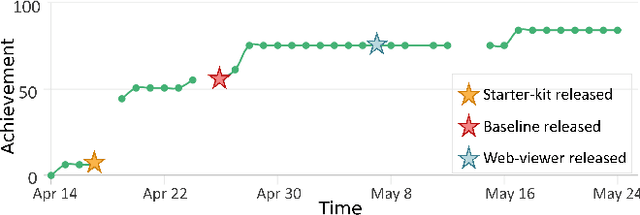
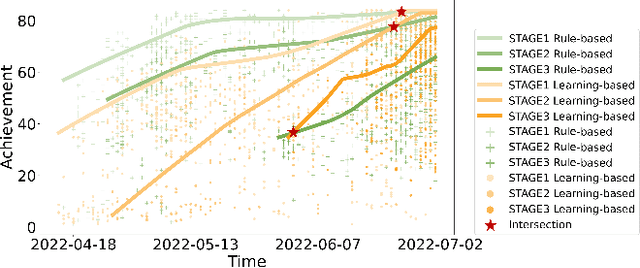
We present the results of the second Neural MMO challenge, hosted at IJCAI 2022, which received 1600+ submissions. This competition targets robustness and generalization in multi-agent systems: participants train teams of agents to complete a multi-task objective against opponents not seen during training. The competition combines relatively complex environment design with large numbers of agents in the environment. The top submissions demonstrate strong success on this task using mostly standard reinforcement learning (RL) methods combined with domain-specific engineering. We summarize the competition design and results and suggest that, as an academic community, competitions may be a powerful approach to solving hard problems and establishing a solid benchmark for algorithms. We will open-source our benchmark including the environment wrapper, baselines, a visualization tool, and selected policies for further research.
A Preliminary Study on a Conceptual Game Feature Generation and Recommendation System
Aug 16, 2023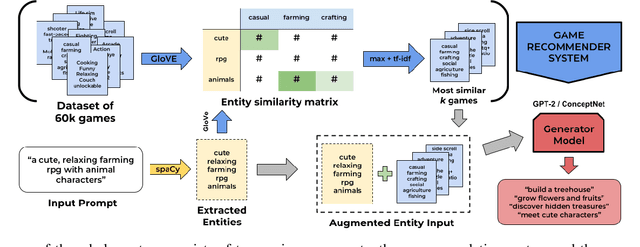
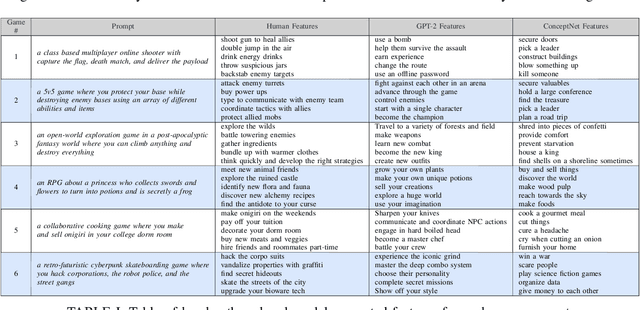
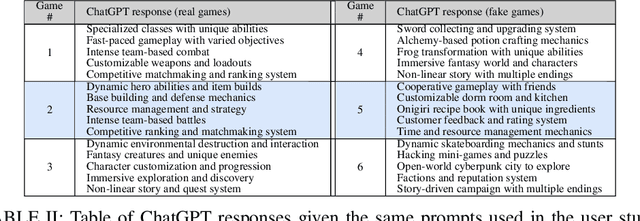
This paper introduces a system used to generate game feature suggestions based on a text prompt. Trained on the game descriptions of almost 60k games, it uses the word embeddings of a small GLoVe model to extract features and entities found in thematically similar games which are then passed through a generator model to generate new features for a user's prompt. We perform a short user study comparing the features generated from a fine-tuned GPT-2 model, a model using the ConceptNet, and human-authored game features. Although human suggestions won the overall majority of votes, the GPT-2 model outperformed the human suggestions in certain games. This system is part of a larger game design assistant tool that is able to collaborate with users at a conceptual level.
Fair GANs through model rebalancing with synthetic data
Aug 16, 2023Deep generative models require large amounts of training data. This often poses a problem as the collection of datasets can be expensive and difficult, in particular datasets that are representative of the appropriate underlying distribution (e.g. demographic). This introduces biases in datasets which are further propagated in the models. We present an approach to mitigate biases in an existing generative adversarial network by rebalancing the model distribution. We do so by generating balanced data from an existing unbalanced deep generative model using latent space exploration and using this data to train a balanced generative model. Further, we propose a bias mitigation loss function that shows improvements in the fairness metric even when trained with unbalanced datasets. We show results for the Stylegan2 models while training on the FFHQ dataset for racial fairness and see that the proposed approach improves on the fairness metric by almost 5 times, whilst maintaining image quality. We further validate our approach by applying it to an imbalanced Cifar-10 dataset. Lastly, we argue that the traditionally used image quality metrics such as Frechet inception distance (FID) are unsuitable for bias mitigation problems.
The Five-Dollar Model: Generating Game Maps and Sprites from Sentence Embeddings
Aug 08, 2023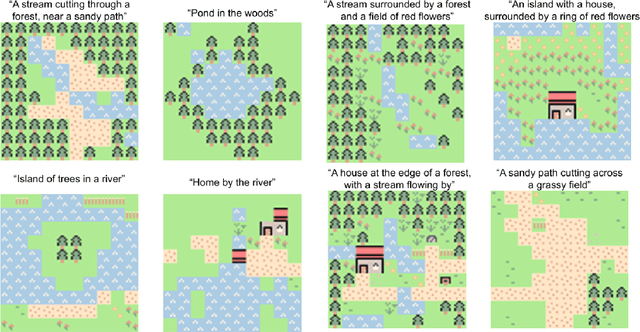
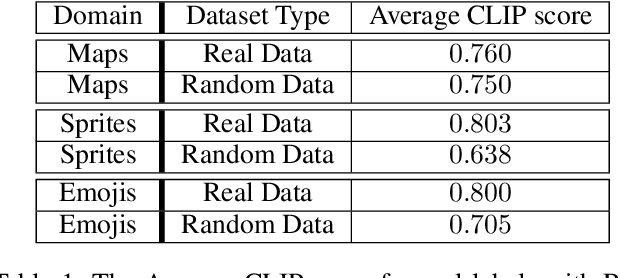
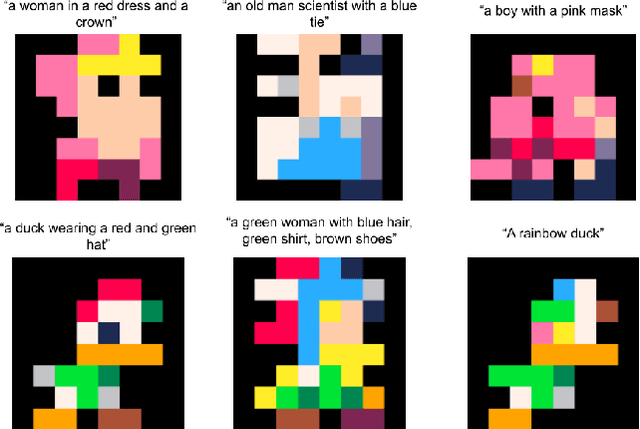
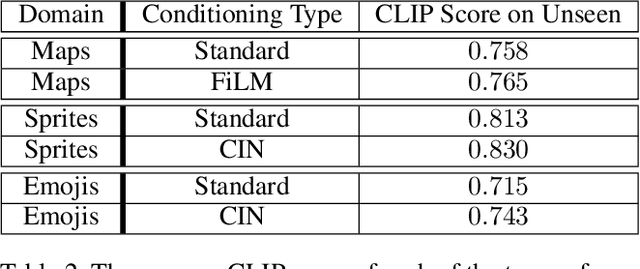
The five-dollar model is a lightweight text-to-image generative architecture that generates low dimensional images from an encoded text prompt. This model can successfully generate accurate and aesthetically pleasing content in low dimensional domains, with limited amounts of training data. Despite the small size of both the model and datasets, the generated images are still able to maintain the encoded semantic meaning of the textual prompt. We apply this model to three small datasets: pixel art video game maps, video game sprite images, and down-scaled emoji images and apply novel augmentation strategies to improve the performance of our model on these limited datasets. We evaluate our models performance using cosine similarity score between text-image pairs generated by the CLIP VIT-B/32 model.
Lode Enhancer: Level Co-creation Through Scaling
Aug 03, 2023We explore AI-powered upscaling as a design assistance tool in the context of creating 2D game levels. Deep neural networks are used to upscale artificially downscaled patches of levels from the puzzle platformer game Lode Runner. The trained networks are incorporated into a web-based editor, where the user can create and edit levels at three different levels of resolution: 4x4, 8x8, and 16x16. An edit at any resolution instantly transfers to the other resolutions. As upscaling requires inventing features that might not be present at lower resolutions, we train neural networks to reproduce these features. We introduce a neural network architecture that is capable of not only learning upscaling but also giving higher priority to less frequent tiles. To investigate the potential of this tool and guide further development, we conduct a qualitative study with 3 designers to understand how they use it. Designers enjoyed co-designing with the tool, liked its underlying concept, and provided feedback for further improvement.
Lode Encoder: AI-constrained co-creativity
Aug 02, 2023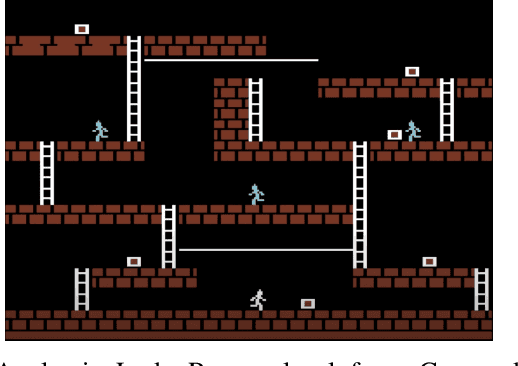
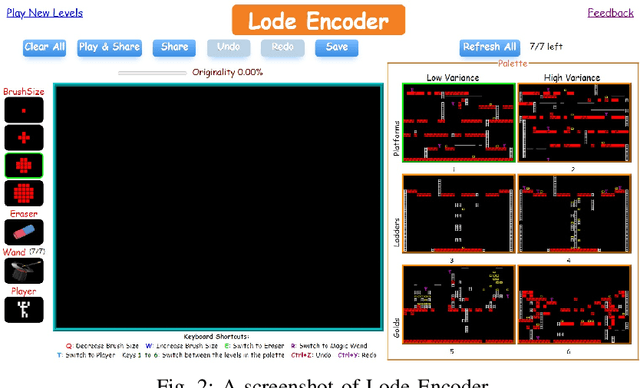
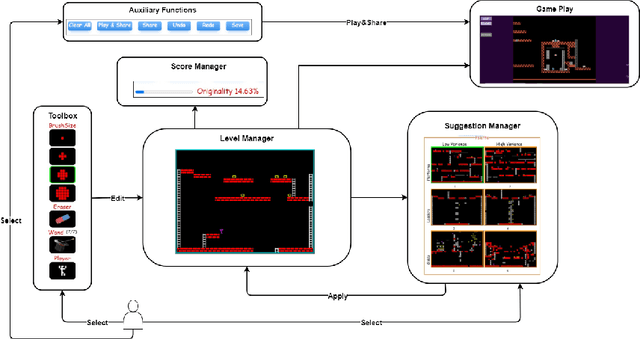
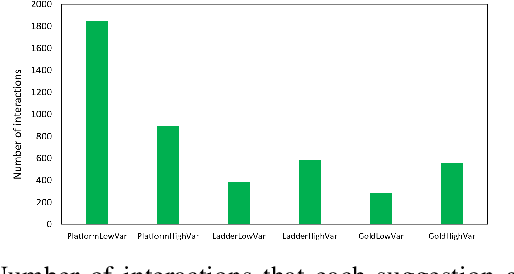
We present Lode Encoder, a gamified mixed-initiative level creation system for the classic platform-puzzle game Lode Runner. The system is built around several autoencoders which are trained on sets of Lode Runner levels. When fed with the user's design, each autoencoder produces a version of that design which is closer in style to the levels that it was trained on. The Lode Encoder interface allows the user to build and edit levels through 'painting' from the suggestions provided by the autoencoders. Crucially, in order to encourage designers to explore new possibilities, the system does not include more traditional editing tools. We report on the system design and training procedure, as well as on the evolution of the system itself and user tests.
Generating Redstone Style Cities in Minecraft
Jul 19, 2023Procedurally generating cities in Minecraft provides players more diverse scenarios and could help understand and improve the design of cities in other digital worlds and the real world. This paper presents a city generator that was submitted as an entry to the 2023 Edition of Minecraft Settlement Generation Competition for Minecraft. The generation procedure is composed of six main steps, namely vegetation clearing, terrain reshaping, building layout generation, route planning, streetlight placement, and wall construction. Three algorithms, including a heuristic-based algorithm, an evolving layout algorithm, and a random one are applied to generate the building layout, thus determining where to place different redstone style buildings, and tested by generating cities on random maps in limited time. Experimental results show that the heuristic-based algorithm is capable of finding an acceptable building layout faster for flat maps, while the evolving layout algorithm performs better in evolving layout for rugged maps. A user study is conducted to compare our generator with outstanding entries of the competition's 2022 edition using the competition's evaluation criteria and shows that our generator performs well in the adaptation and functionality criteria
Amorphous Fortress: Observing Emergent Behavior in Multi-Agent FSMs
Jun 22, 2023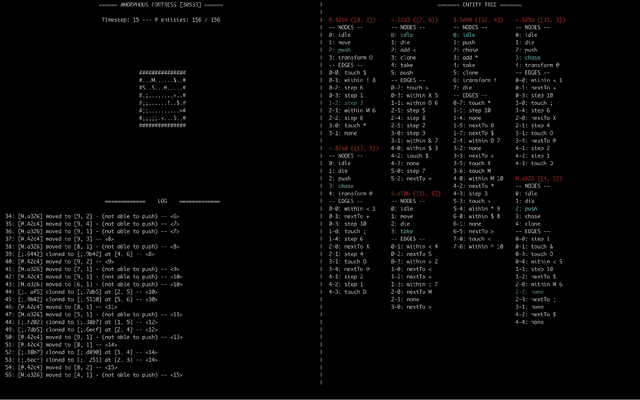
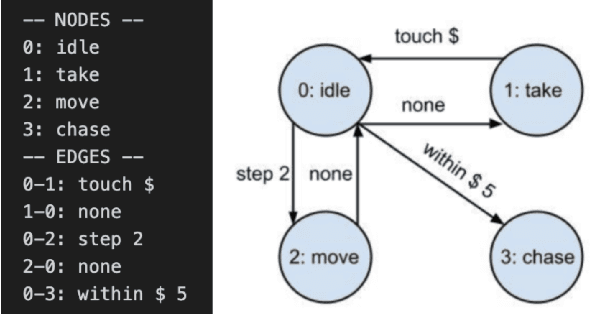
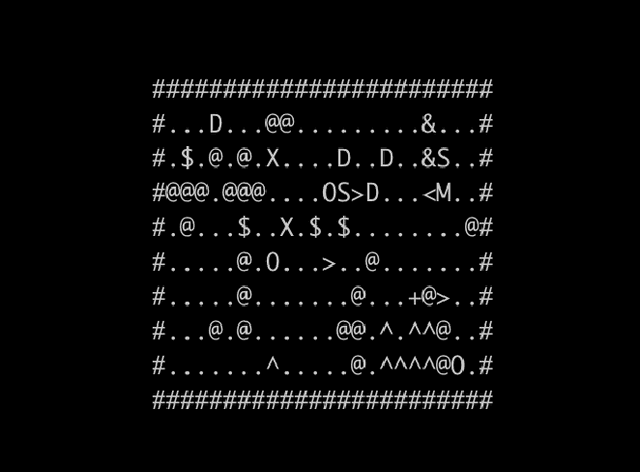
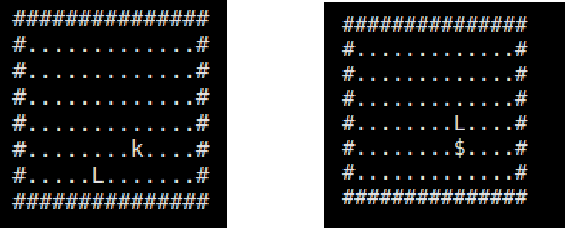
We introduce a system called Amorphous Fortress -- an abstract, yet spatial, open-ended artificial life simulation. In this environment, the agents are represented as finite-state machines (FSMs) which allow for multi-agent interaction within a constrained space. These agents are created by randomly generating and evolving the FSMs; sampling from pre-defined states and transitions. This environment was designed to explore the emergent AI behaviors found implicitly in simulation games such as Dwarf Fortress or The Sims. We apply the hill-climber evolutionary search algorithm to this environment to explore the various levels of depth and interaction from the generated FSMs.
LLMatic: Neural Architecture Search via Large Language Models and Quality-Diversity Optimization
Jun 01, 2023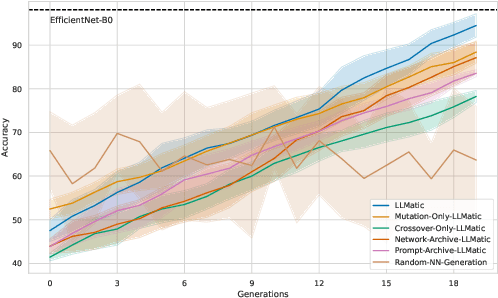
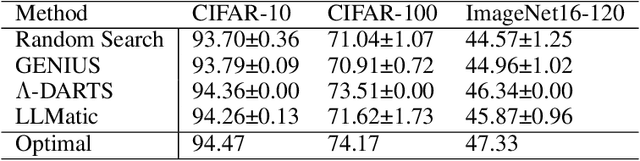
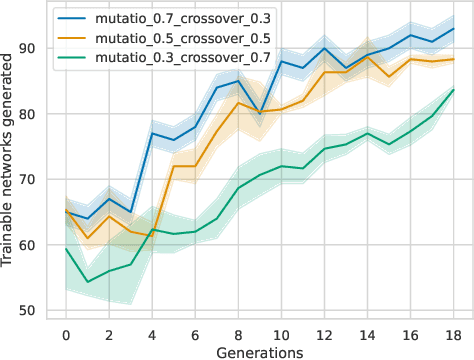
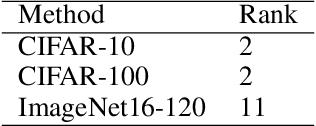
Large Language Models (LLMs) have emerged as powerful tools capable of accomplishing a broad spectrum of tasks. Their abilities span numerous areas, and one area where they have made a significant impact is in the domain of code generation. In this context, we view LLMs as mutation and crossover tools. Meanwhile, Quality-Diversity (QD) algorithms are known to discover diverse and robust solutions. By merging the code-generating abilities of LLMs with the diversity and robustness of QD solutions, we introduce LLMatic, a Neural Architecture Search (NAS) algorithm. While LLMs struggle to conduct NAS directly through prompts, LLMatic uses a procedural approach, leveraging QD for prompts and network architecture to create diverse and highly performant networks. We test LLMatic on the CIFAR-10 image classification benchmark, demonstrating that it can produce competitive networks with just $2,000$ searches, even without prior knowledge of the benchmark domain or exposure to any previous top-performing models for the benchmark.