 Add to Chrome
 Add to Firefox
 Add to Edge
Redistribution-based Cost Inference Improves Sparse Safe Offline RL
Aug 12, 2026
Safe offline RL typically assumes access to dense per-step cost annotations, but in practice supervisors provide only trajectory-level stop-feedback: a binary signal at the first unsafe transition, with no per-step attribution. We frame this as a temporal credit assignment problem and propose the Redistribution-based Cost Inference (RCI) framework, which converts sparse stop-feedback into dense per-step costs via return decomposition, then trains a constrained offline policy on the augmented dataset. We show that return-equivalent redistribution preserves the feasible policy set and the optimal Lagrangian in a CMDP, establishing that the transformation is lossless in theory while yielding better-conditioned cost critic learning in practice. Experiments on highway driving and robotic manipulation demonstrate substantially lower violation rates than sparse and classifier-based baselines, with robustness to heterogeneous dataset compositions and label noise.

CORDA: A Benchmark for Hierarchical Harm-Centric Moral Reasoning in Large Language Models
Aug 08, 2026The key question in moral judgement is not simply whether someone chooses the "right" answer, but how they decide what matters most when moral principles conflict. Current evaluations of large language models (LLMs) remain limited: most test whether models give morally acceptable answers, match human preferences, or avoid obvious violations, rather than whether they can prioritise between competing principles when no option is morally cost-free. We introduce CORDA (Conditioned Ordering and Ranked Directive Adherence), a benchmark for evaluating hierarchical, harm-centred moral reasoning in LLMs. Building on the morality chains formalism, CORDA tests 90 moral dilemmas involving trolley-style cases, medical trade-offs, resource allocation, and human-animal-robot conflicts across four ordered ethical frameworks: Utility, Utility + Agent Harm, Dual-Process, and Dual-Process + Agent Harm. Together, these frameworks test whether models can adapt their decisions when moral priorities change. Across ten instruction-tuned models from seven providers, we find a strong deontological default, with 9 of 10 prioritising avoidance of direct personal harm over reducing overall harm. Models also perform more reliably on categorical harm-avoidance rules, such as avoiding killing, than on outcome-based comparisons, such as minimising total harm, suggesting that they recognise moral red lines more easily than they reason through competing harms. Although all models respond to explicit chain conditioning, several fail to consistently follow specified priority orderings, such as humans over animals and animals over robots. CORDA addresses a central gap in LLM moral evaluation by testing whether models can move beyond default harm-avoidant responses and apply context-specified moral priorities. Moral reliability requires more than default restraint; it requires controllability under conflict.
Position: the Stochastic Parrot in the Coal Mine. Model Collapse is a Threat to Low-Resource Communities
May 05, 2026Model collapse, the degradation in performance that arises when generative models are trained on the outputs of prior models, is an increasing concern as artificially generated content proliferates. Related critiques of large language models have highlighted their tendency to reproduce frequent patterns in training data, their reliance on vast datasets, and their substantial environmental cost. Together, these factors contribute to data degradation, the reinforcement of cultural biases, and inefficient resource use. In this position paper we aim to combine these views and argue that model collapse threatens current efforts to democratize AI. By reducing training efficiency and skewing data distributions away from the tails of their support, model collapse disproportionately impacts low-resource and marginalized communities. We examine both the environmental and cultural implications of this phenomenon, situate our position within recent position papers on model collapse, and conclude with a call to action. Finally, we outline initial directions for mitigating these effects.
MoralityGym: A Benchmark for Evaluating Hierarchical Moral Alignment in Sequential Decision-Making Agents
Feb 13, 2026Evaluating moral alignment in agents navigating conflicting, hierarchically structured human norms is a critical challenge at the intersection of AI safety, moral philosophy, and cognitive science. We introduce Morality Chains, a novel formalism for representing moral norms as ordered deontic constraints, and MoralityGym, a benchmark of 98 ethical-dilemma problems presented as trolley-dilemma-style Gymnasium environments. By decoupling task-solving from moral evaluation and introducing a novel Morality Metric, MoralityGym allows the integration of insights from psychology and philosophy into the evaluation of norm-sensitive reasoning. Baseline results with Safe RL methods reveal key limitations, underscoring the need for more principled approaches to ethical decision-making. This work provides a foundation for developing AI systems that behave more reliably, transparently, and ethically in complex real-world contexts.
Unsupervised Hierarchical Skill Discovery
Jan 30, 2026We consider the problem of unsupervised skill segmentation and hierarchical structure discovery in reinforcement learning. While recent approaches have sought to segment trajectories into reusable skills or options, most rely on action labels, rewards, or handcrafted annotations, limiting their applicability. We propose a method that segments unlabelled trajectories into skills and induces a hierarchical structure over them using a grammar-based approach. The resulting hierarchy captures both low-level behaviours and their composition into higher-level skills. We evaluate our approach in high-dimensional, pixel-based environments, including Craftax and the full, unmodified version of Minecraft. Using metrics for skill segmentation, reuse, and hierarchy quality, we find that our method consistently produces more structured and semantically meaningful hierarchies than existing baselines. Furthermore, as a proof of concept for utility, we demonstrate that these discovered hierarchies accelerate and stabilise learning on downstream reinforcement learning tasks.
Mortar: Evolving Mechanics for Automatic Game Design
Dec 31, 2025We present Mortar, a system for autonomously evolving game mechanics for automatic game design. Game mechanics define the rules and interactions that govern gameplay, and designing them manually is a time-consuming and expert-driven process. Mortar combines a quality-diversity algorithm with a large language model to explore a diverse set of mechanics, which are evaluated by synthesising complete games that incorporate both evolved mechanics and those drawn from an archive. The mechanics are evaluated by composing complete games through a tree search procedure, where the resulting games are evaluated by their ability to preserve a skill-based ordering over players -- that is, whether stronger players consistently outperform weaker ones. We assess the mechanics based on their contribution towards the skill-based ordering score in the game. We demonstrate that Mortar produces games that appear diverse and playable, and mechanics that contribute more towards the skill-based ordering score in the game. We perform ablation studies to assess the role of each system component and a user study to evaluate the games based on human feedback.
Word2Minecraft: Generating 3D Game Levels through Large Language Models
Mar 18, 2025We present Word2Minecraft, a system that leverages large language models to generate playable game levels in Minecraft based on structured stories. The system transforms narrative elements-such as protagonist goals, antagonist challenges, and environmental settings-into game levels with both spatial and gameplay constraints. We introduce a flexible framework that allows for the customization of story complexity, enabling dynamic level generation. The system employs a scaling algorithm to maintain spatial consistency while adapting key game elements. We evaluate Word2Minecraft using both metric-based and human-based methods. Our results show that GPT-4-Turbo outperforms GPT-4o-Mini in most areas, including story coherence and objective enjoyment, while the latter excels in aesthetic appeal. We also demonstrate the system' s ability to generate levels with high map enjoyment, offering a promising step forward in the intersection of story generation and game design. We open-source the code at https://github.com/JMZ-kk/Word2Minecraft/tree/word2mc_v0
GameTraversalBenchmark: Evaluating Planning Abilities Of Large Language Models Through Traversing 2D Game Maps
Oct 10, 2024


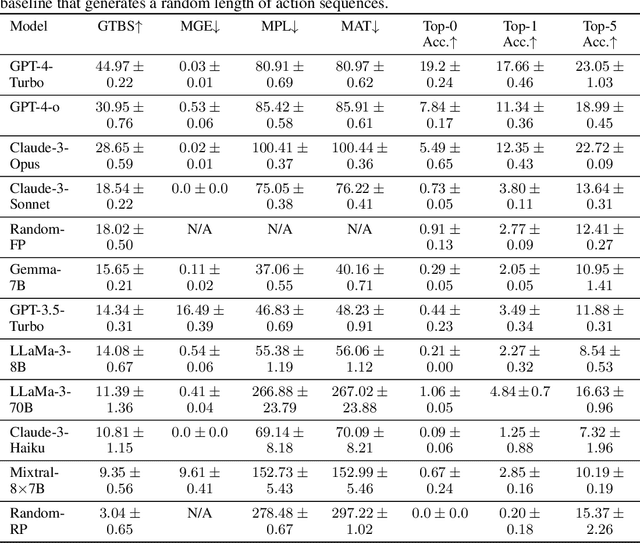
Large language models (LLMs) have recently demonstrated great success in generating and understanding natural language. While they have also shown potential beyond the domain of natural language, it remains an open question as to what extent and in which way these LLMs can plan. We investigate their planning capabilities by proposing GameTraversalBenchmark (GTB), a benchmark consisting of diverse 2D grid-based game maps. An LLM succeeds if it can traverse through given objectives, with a minimum number of steps and a minimum number of generation errors. We evaluate a number of LLMs on GTB and found that GPT-4-Turbo achieved the highest score of 44.97% on GTB\_Score (GTBS), a composite score that combines the three above criteria. Furthermore, we preliminarily test large reasoning models, namely o1, which scores $67.84\%$ on GTBS, indicating that the benchmark remains challenging for current models. Code, data, and documentation are available at https://github.com/umair-nasir14/Game-Traversal-Benchmark.
Word2World: Generating Stories and Worlds through Large Language Models
May 06, 2024Large Language Models (LLMs) have proven their worth across a diverse spectrum of disciplines. LLMs have shown great potential in Procedural Content Generation (PCG) as well, but directly generating a level through a pre-trained LLM is still challenging. This work introduces Word2World, a system that enables LLMs to procedurally design playable games through stories, without any task-specific fine-tuning. Word2World leverages the abilities of LLMs to create diverse content and extract information. Combining these abilities, LLMs can create a story for the game, design narrative, and place tiles in appropriate places to create coherent worlds and playable games. We test Word2World with different LLMs and perform a thorough ablation study to validate each step. We open-source the code at https://github.com/umair-nasir14/Word2World.
MinePlanner: A Benchmark for Long-Horizon Planning in Large Minecraft Worlds
Dec 20, 2023We propose a new benchmark for planning tasks based on the Minecraft game. Our benchmark contains 45 tasks overall, but also provides support for creating both propositional and numeric instances of new Minecraft tasks automatically. We benchmark numeric and propositional planning systems on these tasks, with results demonstrating that state-of-the-art planners are currently incapable of dealing with many of the challenges advanced by our new benchmark, such as scaling to instances with thousands of objects. Based on these results, we identify areas of improvement for future planners. Our framework is made available at https://github.com/IretonLiu/mine-pddl/.