 Add to Chrome
 Add to Firefox
 Add to Edge
SPIRAL: Learning to Search and Aggregate
Jun 22, 2026
Language model reasoning can be substantially improved at test time via scaffolds that scale inference compute across different primitives -- sequential reasoning within a trace, independently sampled parallel traces, and aggregation of multiple reasoning traces into a final response. During post-training, however, language models are optimized only for sequential reasoning within a single trace. We introduce Sequential-Parallel-Aggregative Reinforcement Learning (SPIRAL), a framework in which a language model is trained to use all three primitives, as part of a unified inference compute pipeline. Concretely, the language model first samples a set of independent traces in parallel, each produced through sequential chain-of-thought reasoning, and then generates a final aggregation trace conditioned on those traces; all components are optimized end-to-end against the reward of the final aggregated response. To train this system, SPIRAL uses set reinforcement learning to teach models to produce a set of traces that are collectively useful for an aggregator and standard reinforcement learning to teach models to aggregate the set into improved final responses. Our experiments on reasoning tasks show that SPIRAL effectively scales with inference compute, outperforming GRPO by up to 11$\times$ scaling efficiency and 15% higher performance when all three compute primitives are scaled.

Neural Garbage Collection: Learning to Forget while Learning to Reason
Apr 20, 2026Chain-of-thought reasoning has driven striking advances in language model capability, yet every reasoning step grows the KV cache, creating a bottleneck to scaling this paradigm further. Current approaches manage these constraints on the model's behalf using hand-designed criteria. A more scalable approach would let end-to-end learning subsume this design choice entirely, following a broader pattern in deep learning. After all, if a model can learn to reason, why can't it learn to forget? We introduce Neural Garbage Collection (NGC), in which a language model learns to forget while learning to reason, trained end-to-end from outcome-based task reward alone. As the model reasons, it periodically pauses, decides which KV cache entries to evict, and continues to reason conditioned on the remaining cache. By treating tokens in a chain-of-thought and cache-eviction decisions as discrete actions sampled from the language model, we can use reinforcement learning to jointly optimize how the model reasons and how it manages its own memory: what the model evicts shapes what it remembers, what it remembers shapes its reasoning, and the correctness of that reasoning determines its reward. Crucially, the model learns this behavior entirely from a single learning signal - the outcome-based task reward - without supervised fine-tuning or proxy objectives. On Countdown, AMC, and AIME tasks, NGC maintains strong accuracy relative to the full-cache upper bound at 2-3x peak KV cache size compression and substantially outperforms eviction baselines. Our results are a first step towards a broader vision where end-to-end optimization drives both capability and efficiency in language models.
Poly-EPO: Training Exploratory Reasoning Models
Apr 19, 2026Exploration is a cornerstone of learning from experience: it enables agents to find solutions to complex problems, generalize to novel ones, and scale performance with test-time compute. In this paper, we present a framework for post-training language models (LMs) that explicitly encourages optimistic exploration and promotes a synergy between exploration and exploitation. The central idea is to train the LM to generate sets of responses that are collectively accurate under the reward function and exploratory in their reasoning strategies. We first develop a general recipe for optimizing LMs with set reinforcement learning (set RL) under arbitrary objective functions, showing how standard RL algorithms can be adapted to this setting through a modification to the advantage computation. We then propose Polychromic Exploratory Policy Optimization (Poly-EPO), which instantiates this framework with an objective that explicitly synergizes exploration and exploitation. Across a range of reasoning benchmarks, we show that Poly-EPO improves generalization, as evidenced by higher pass@$k$ coverage, preserves greater diversity in model generations, and effectively scales with test-time compute.
RoboCade: Gamifying Robot Data Collection
Dec 24, 2025Imitation learning from human demonstrations has become a dominant approach for training autonomous robot policies. However, collecting demonstration datasets is costly: it often requires access to robots and needs sustained effort in a tedious, long process. These factors limit the scale of data available for training policies. We aim to address this scalability challenge by involving a broader audience in a gamified data collection experience that is both accessible and motivating. Specifically, we develop a gamified remote teleoperation platform, RoboCade, to engage general users in collecting data that is beneficial for downstream policy training. To do this, we embed gamification strategies into the design of the system interface and data collection tasks. In the system interface, we include components such as visual feedback, sound effects, goal visualizations, progress bars, leaderboards, and badges. We additionally propose principles for constructing gamified tasks that have overlapping structure with useful downstream target tasks. We instantiate RoboCade on three manipulation tasks -- including spatial arrangement, scanning, and insertion. To illustrate the viability of gamified robot data collection, we collect a demonstration dataset through our platform, and show that co-training robot policies with this data can improve success rate on non-gamified target tasks (+16-56%). Further, we conduct a user study to validate that novice users find the gamified platform significantly more enjoyable than a standard non-gamified platform (+24%). These results highlight the promise of gamified data collection as a scalable, accessible, and engaging method for collecting demonstration data.
Bidirectional Decoding: Improving Action Chunking via Closed-Loop Resampling
Aug 30, 2024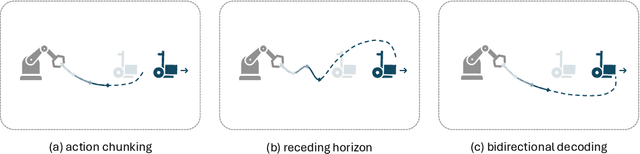
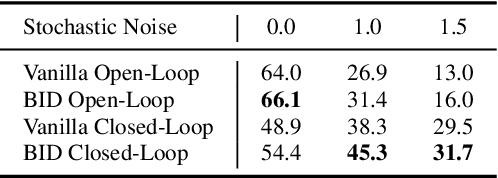
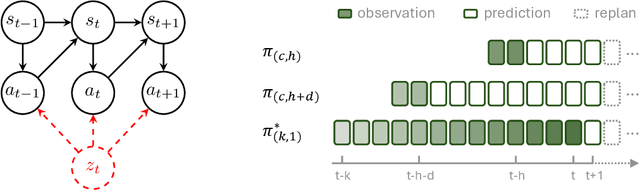
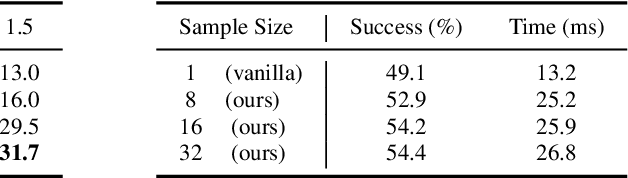
Predicting and executing a sequence of actions without intermediate replanning, known as action chunking, is increasingly used in robot learning from human demonstrations. However, its effects on learned policies remain puzzling: some studies highlight its importance for achieving strong performance, while others observe detrimental effects. In this paper, we first dissect the role of action chunking by analyzing the divergence between the learner and the demonstrator. We find that longer action chunks enable a policy to better capture temporal dependencies by taking into account more past states and actions within the chunk. However, this advantage comes at the cost of exacerbating errors in stochastic environments due to fewer observations of recent states. To address this, we propose Bidirectional Decoding (BID), a test-time inference algorithm that bridges action chunking with closed-loop operations. BID samples multiple predictions at each time step and searches for the optimal one based on two criteria: (i) backward coherence, which favors samples aligned with previous decisions, (ii) forward contrast, which favors samples close to outputs of a stronger policy and distant from those of a weaker policy. By coupling decisions within and across action chunks, BID enhances temporal consistency over extended sequences while enabling adaptive replanning in stochastic environments. Experimental results show that BID substantially outperforms conventional closed-loop operations of two state-of-the-art generative policies across seven simulation benchmarks and two real-world tasks.
Tripod: Three Complementary Inductive Biases for Disentangled Representation Learning
Apr 16, 2024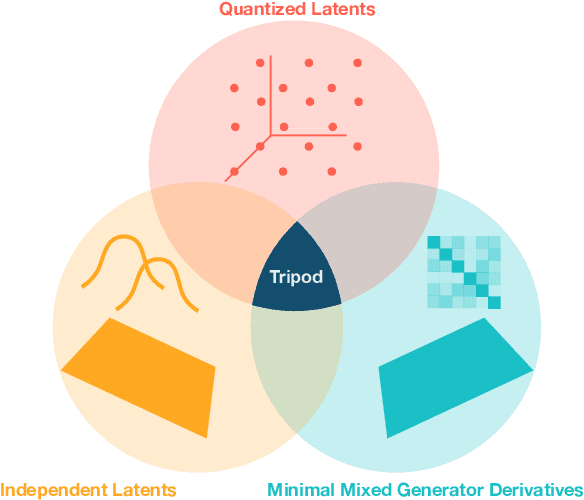
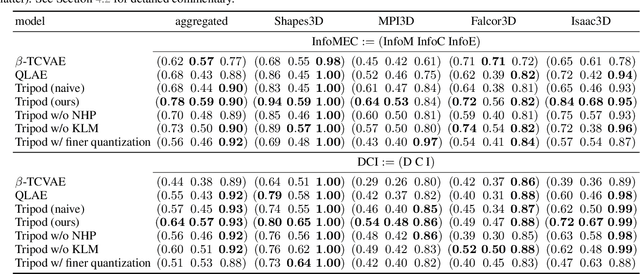
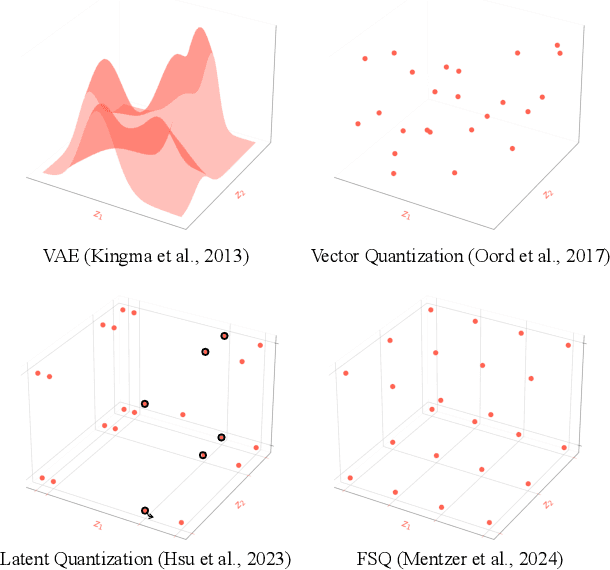
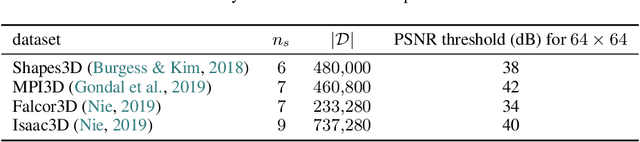
Inductive biases are crucial in disentangled representation learning for narrowing down an underspecified solution set. In this work, we consider endowing a neural network autoencoder with three select inductive biases from the literature: data compression into a grid-like latent space via quantization, collective independence amongst latents, and minimal functional influence of any latent on how other latents determine data generation. In principle, these inductive biases are deeply complementary: they most directly specify properties of the latent space, encoder, and decoder, respectively. In practice, however, naively combining existing techniques instantiating these inductive biases fails to yield significant benefits. To address this, we propose adaptations to the three techniques that simplify the learning problem, equip key regularization terms with stabilizing invariances, and quash degenerate incentives. The resulting model, Tripod, achieves state-of-the-art results on a suite of four image disentanglement benchmarks. We also verify that Tripod significantly improves upon its naive incarnation and that all three of its "legs" are necessary for best performance.