 Add to Chrome
 Add to Firefox
 Add to Edge
An Independent Safety Evaluation of Kimi K2.5
Apr 03, 2026
Kimi K2.5 is an open-weight LLM that rivals closed models across coding, multimodal, and agentic benchmarks, but was released without an accompanying safety evaluation. In this work, we conduct a preliminary safety assessment of Kimi K2.5 focusing on risks likely to be exacerbated by powerful open-weight models. Specifically, we evaluate the model for CBRNE misuse risk, cybersecurity risk, misalignment, political censorship, bias, and harmlessness, in both agentic and non-agentic settings. We find that Kimi K2.5 shows similar dual-use capabilities to GPT 5.2 and Claude Opus 4.5, but with significantly fewer refusals on CBRNE-related requests, suggesting it may uplift malicious actors in weapon creation. On cyber-related tasks, we find that Kimi K2.5 demonstrates competitive cybersecurity performance, but it does not appear to possess frontier-level autonomous cyberoffensive capabilities such as vulnerability discovery and exploitation. We further find that Kimi K2.5 shows concerning levels of sabotage ability and self-replication propensity, although it does not appear to have long-term malicious goals. In addition, Kimi K2.5 exhibits narrow censorship and political bias, especially in Chinese, and is more compliant with harmful requests related to spreading disinformation and copyright infringement. Finally, we find the model refuses to engage in user delusions and generally has low over-refusal rates. While preliminary, our findings highlight how safety risks exist in frontier open-weight models and may be amplified by the scale and accessibility of open-weight releases. Therefore, we strongly urge open-weight model developers to conduct and release more systematic safety evaluations required for responsible deployment.

Optimizing Large Language Models for Detecting Symptoms of Comorbid Depression or Anxiety in Chronic Diseases: Insights from Patient Messages
Mar 14, 2025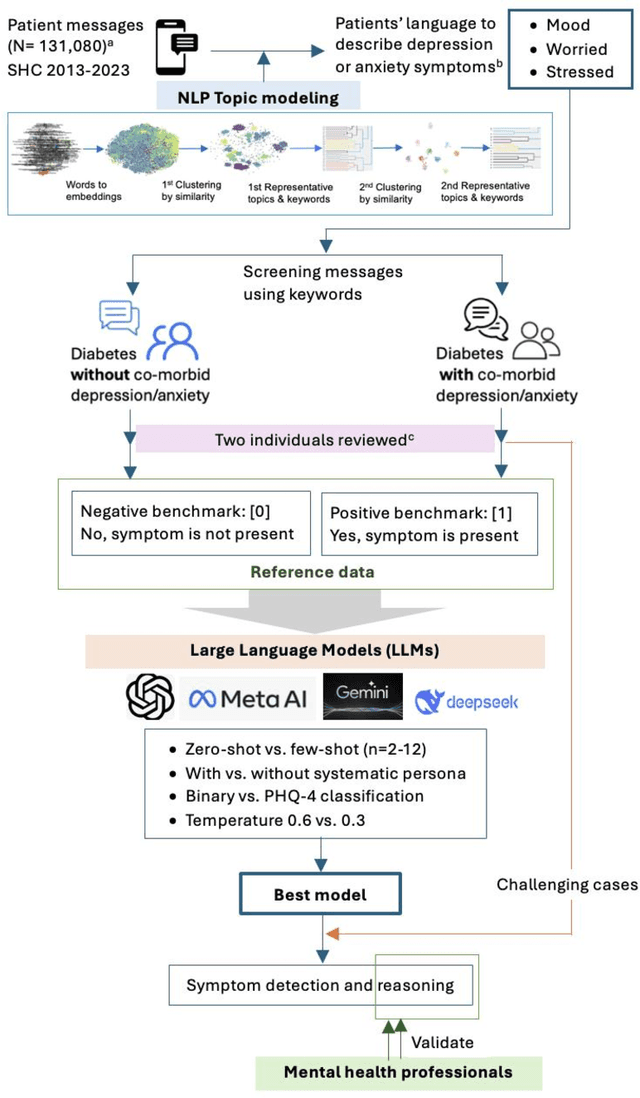
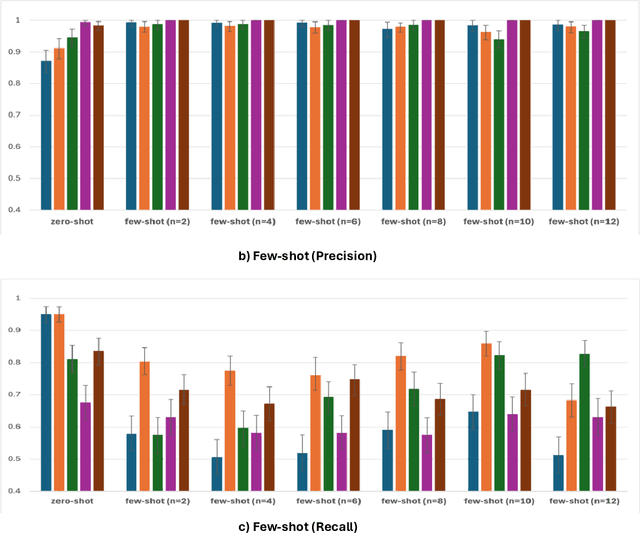
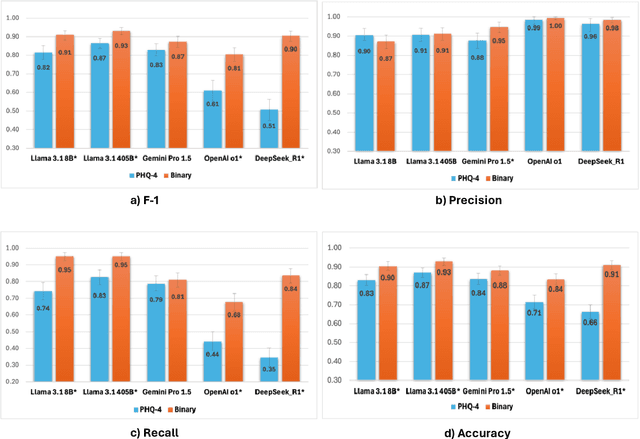
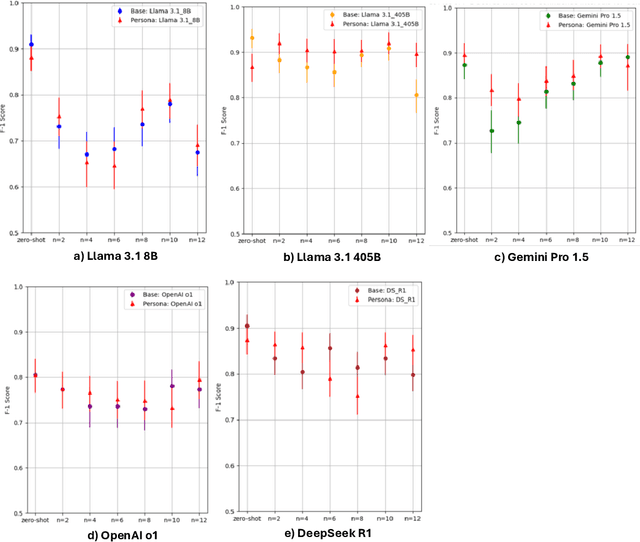
Patients with diabetes are at increased risk of comorbid depression or anxiety, complicating their management. This study evaluated the performance of large language models (LLMs) in detecting these symptoms from secure patient messages. We applied multiple approaches, including engineered prompts, systemic persona, temperature adjustments, and zero-shot and few-shot learning, to identify the best-performing model and enhance performance. Three out of five LLMs demonstrated excellent performance (over 90% of F-1 and accuracy), with Llama 3.1 405B achieving 93% in both F-1 and accuracy using a zero-shot approach. While LLMs showed promise in binary classification and handling complex metrics like Patient Health Questionnaire-4, inconsistencies in challenging cases warrant further real-life assessment. The findings highlight the potential of LLMs to assist in timely screening and referrals, providing valuable empirical knowledge for real-world triage systems that could improve mental health care for patients with chronic diseases.
Can Artificial Intelligence Generate Quality Research Topics Reflecting Patient Concerns?
Nov 15, 2024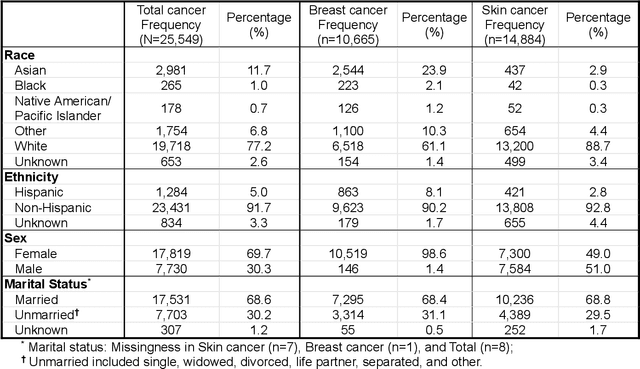
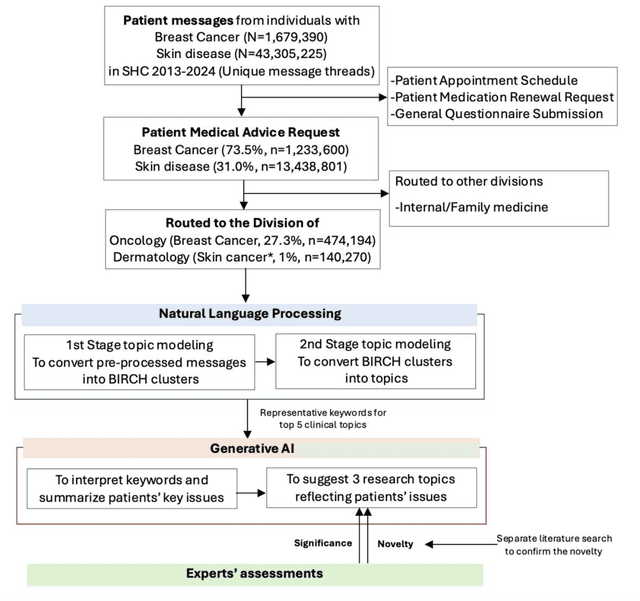
Patient-centered research is increasingly important in narrowing the gap between research and patient care, yet incorporating patient perspectives into health research has been inconsistent. We propose an automated framework leveraging innovative natural language processing (NLP) and artificial intelligence (AI) with patient portal messages to generate research ideas that prioritize important patient issues. We further quantified the quality of AI-generated research topics. To define patient clinical concerns, we analyzed 614,464 patient messages from 25,549 individuals with breast or skin cancer obtained from a large academic hospital (2013 to 2024), constructing a 2-staged unsupervised NLP topic model. Then, we generated research topics to resolve the defined issues using a widely used AI (ChatGPT-4o, OpenAI Inc, April 2024 version) with prompt-engineering strategies. We guided AI to perform multi-level tasks: 1) knowledge interpretation and summarization (e.g., interpreting and summarizing the NLP-defined topics), 2) knowledge generation (e.g., generating research ideas corresponding to patients issues), 3) self-reflection and correction (e.g., ensuring and revising the research ideas after searching for scientific articles), and 4) self-reassurance (e.g., confirming and finalizing the research ideas). Six highly experienced breast oncologists and dermatologists assessed the significance and novelty of AI-generated research topics using a 5-point Likert scale (1-exceptional, 5-poor). One-third of the AI-suggested research topics were highly significant and novel when both scores were lower than the average. Two-thirds of the AI-suggested topics were novel in both cancers. Our findings demonstrate that AI-generated research topics reflecting patient perspectives via a large volume of patient messages can meaningfully guide future directions in patient-centered health research.