 Add to Chrome
 Add to Firefox
 Add to Edge
Global Simulation-Guided Dynamic Operator Scheduling for Efficient Multi-Tenant Model Serving
Aug 16, 2026
Container-granularity scheduling leaves abundant short-lived idle slices within containers unexploited. Reallocating containers is too heavyweight to utilize such fine-grained opportunities under SLA constraints, and operator-level scheduling requires reasoning about dependencies, memory safety, and cluster-wide execution dynamics in real time. In this paper, we present SliceScheduler, a dynamic operator-level scheduling system for multi-tenant model serving. The key idea is to expose cluster-wide operator execution state and enable what-if reasoning over scheduling decisions. SliceScheduler consists of four key components. First, we introduce the Global Mapping Graph (GMG), a unified abstraction that captures operator dependencies, tensor shapes, resource mappings, and execution states, providing a real-time, cluster-wide view with explicit resource semantics. Second, we build a global simulator on top of GMG to predict operator-level execution and memory evolution under candidate placements. Third, we design an incremental, simulation-based scheduling module that selects placements to exploit fragmented idle slices while avoiding memory violations and preserving SLA. Finally, we develop an operator executor that materializes scheduling decisions on GPUs and coordinates computation and cross-accelerator transfers. We implement SliceScheduler as a PyTorch backend and evaluate it using production trace replay. Experimental results show that SliceScheduler improves token throughput by 1.10--2.29$\times$ compared to existing approaches, while maintaining SLA violations within 9\%. SliceScheduler demonstrates that operator-level scheduling is a practical and effective approach to improving GPU utilization for multi-tenant LLM serving.

SPORK: Self-Speculative Forking to Accelerate Agentic LLM Inference
Jul 03, 2026LLM agents are becoming a common interface for research, coding, and question answering, yet their Thought-Action-Observation loop is often serial: the model reasons, emits a tool call, then idles the GPU until the result returns. This wait consumes 16-37% of wall time in our workloads and 35-61% in prior reports. Speculative tool execution can hide this wait, but existing systems need auxiliary predictors, historical traces, or static workflow graphs, leaving a gap for training-free, day-one deployment. We observe that the model can be its own predictor: a probe forked at the start of generation predicts Qwen3-32B's upcoming tool name with 74.6-99.6% accuracy across five benchmarks. We present SPORK (Self-sPeculative fORKing), a training-free controller that dispatches the speculated tool call early, overlapping its execution with the remaining chain-of-thought decode. A cost model captures when speculation breaks even, and each component improves one of its terms: a prefix-cache fork cuts probe cost, a confidence gate filters mispredictions, and partial-token accept turns rejected probes into speculative-decoding drafts. On acceptance, the tool result is ready when reasoning ends; on rejection, SPORK falls back to serial execution with no correctness penalty. On real-tool benchmarks, SPORK cuts Qwen3-32B's GAIA P95 by 18% (131.9 to 108.1 s); the mechanism holds across model sizes from 4B to 32B and across dense and mixture-of-experts models, with task accuracy within 1 pp of baseline or better wherever measured. SPORK deploys as a thin controller over standard completion APIs (no retraining, no auxiliary models, no offline traces) and is orthogonal to token-level speculative decoding. SPORK is open source at https://github.com/baihuajun24/spork.
Unlabeled Action Quality Assessment Based on Multi-dimensional Adaptive Constrained Dynamic Time Warping
Oct 18, 2024

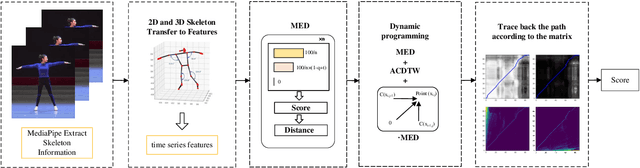
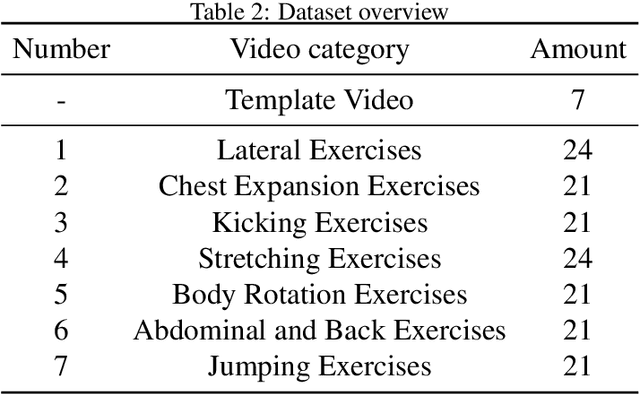
The growing popularity of online sports and exercise necessitates effective methods for evaluating the quality of online exercise executions. Previous action quality assessment methods, which relied on labeled scores from motion videos, exhibited slightly lower accuracy and discriminability. This limitation hindered their rapid application to newly added exercises. To address this problem, this paper presents an unlabeled Multi-Dimensional Exercise Distance Adaptive Constrained Dynamic Time Warping (MED-ACDTW) method for action quality assessment. Our approach uses an athletic version of DTW to compare features from template and test videos, eliminating the need for score labels during training. The result shows that utilizing both 2D and 3D spatial dimensions, along with multiple human body features, improves the accuracy by 2-3% compared to using either 2D or 3D pose estimation alone. Additionally, employing MED for score calculation enhances the precision of frame distance matching, which significantly boosts overall discriminability. The adaptive constraint scheme enhances the discriminability of action quality assessment by approximately 30%. Furthermore, to address the absence of a standardized perspective in sports class evaluations, we introduce a new dataset called BGym.
Toward Reproducing Network Research Results Using Large Language Models
Sep 09, 2023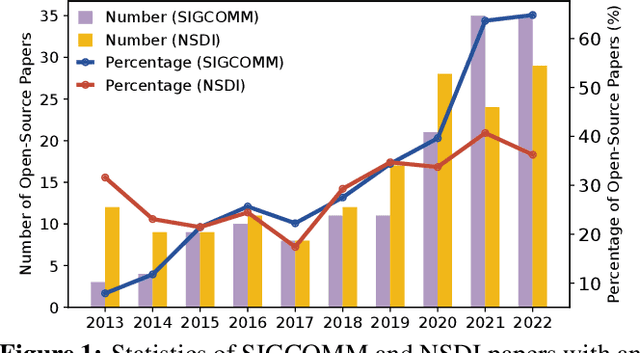
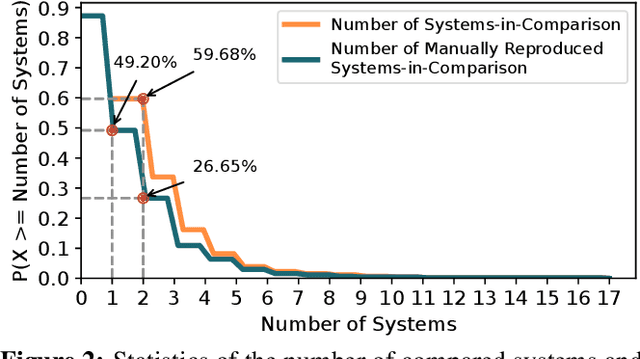
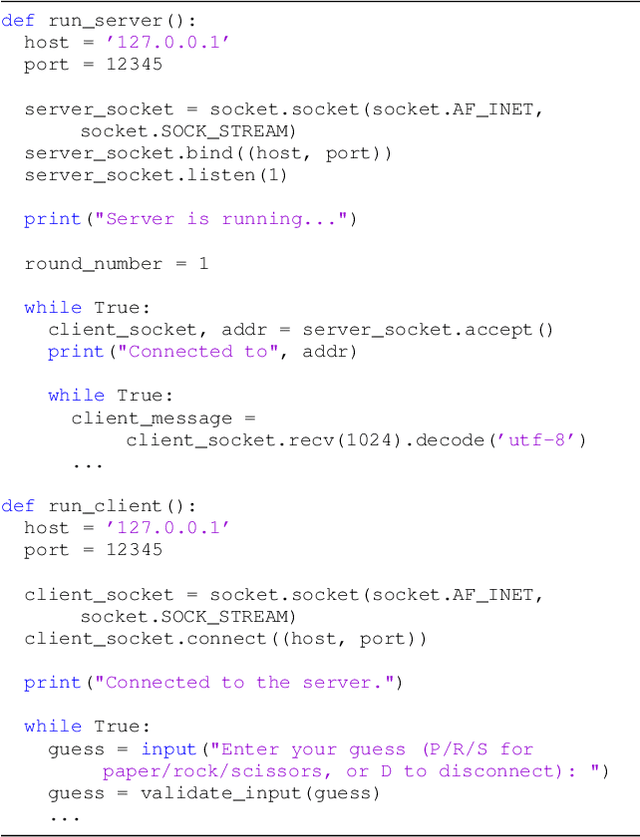
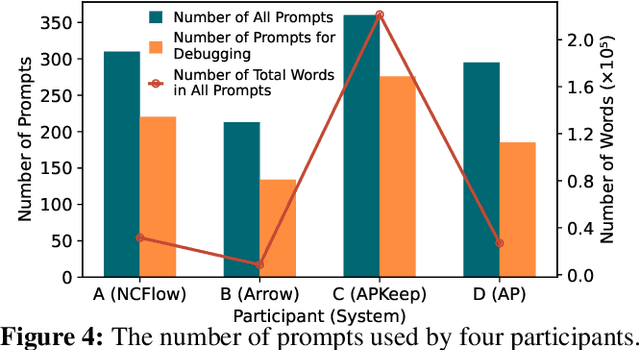
Reproducing research results in the networking community is important for both academia and industry. The current best practice typically resorts to three approaches: (1) looking for publicly available prototypes; (2) contacting the authors to get a private prototype; and (3) manually implementing a prototype following the description of the publication. However, most published network research does not have public prototypes and private prototypes are hard to get. As such, most reproducing efforts are spent on manual implementation based on the publications, which is both time and labor consuming and error-prone. In this paper, we boldly propose reproducing network research results using the emerging large language models (LLMs). In particular, we first prove its feasibility with a small-scale experiment, in which four students with essential networking knowledge each reproduces a different networking system published in prominent conferences and journals by prompt engineering ChatGPT. We report the experiment's observations and lessons and discuss future open research questions of this proposal. This work raises no ethical issue.
Sapphire: Automatic Configuration Recommendation for Distributed Storage Systems
Jul 07, 2020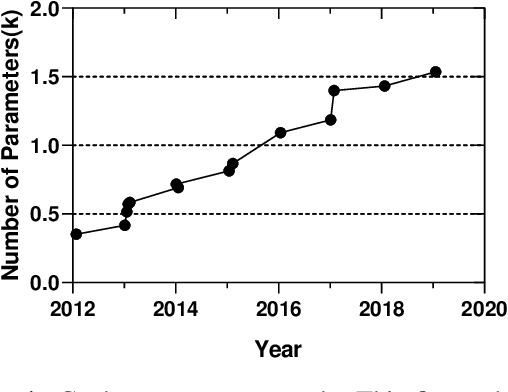
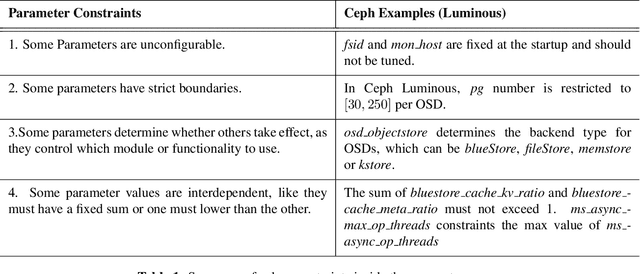
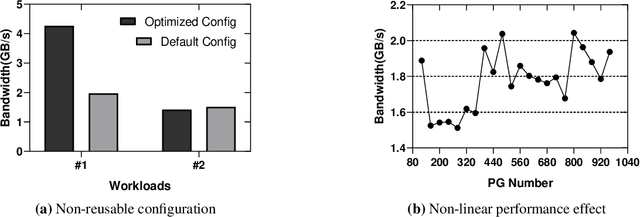
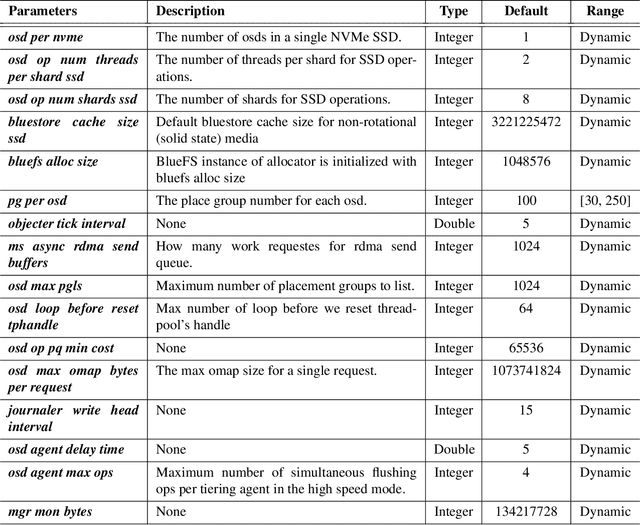
Modern distributed storage systems come with aplethora of configurable parameters that controlmodule behavior and affect system performance. Default settings provided by developers are often suboptimal for specific user cases. Tuning parameters can provide significant performance gains but is a difficult task requiring profound experience and expertise, due to the immense number of configurable parameters, complex inner dependencies and non-linearsystem behaviors. To overcome these difficulties, we propose an automatic simulation-based approach, Sapphire, to recommend optimal configurations by leveraging machine learning and black-box optimization techniques. We evaluate Sapphire on Ceph. Results show that Sapphire significantly boosts Ceph performance to 2.2x compared to the default configuration.