 Add to Chrome
 Add to Firefox
 Add to Edge
SPORK: Self-Speculative Forking to Accelerate Agentic LLM Inference
Jul 03, 2026
LLM agents are becoming a common interface for research, coding, and question answering, yet their Thought-Action-Observation loop is often serial: the model reasons, emits a tool call, then idles the GPU until the result returns. This wait consumes 16-37% of wall time in our workloads and 35-61% in prior reports. Speculative tool execution can hide this wait, but existing systems need auxiliary predictors, historical traces, or static workflow graphs, leaving a gap for training-free, day-one deployment. We observe that the model can be its own predictor: a probe forked at the start of generation predicts Qwen3-32B's upcoming tool name with 74.6-99.6% accuracy across five benchmarks. We present SPORK (Self-sPeculative fORKing), a training-free controller that dispatches the speculated tool call early, overlapping its execution with the remaining chain-of-thought decode. A cost model captures when speculation breaks even, and each component improves one of its terms: a prefix-cache fork cuts probe cost, a confidence gate filters mispredictions, and partial-token accept turns rejected probes into speculative-decoding drafts. On acceptance, the tool result is ready when reasoning ends; on rejection, SPORK falls back to serial execution with no correctness penalty. On real-tool benchmarks, SPORK cuts Qwen3-32B's GAIA P95 by 18% (131.9 to 108.1 s); the mechanism holds across model sizes from 4B to 32B and across dense and mixture-of-experts models, with task accuracy within 1 pp of baseline or better wherever measured. SPORK deploys as a thin controller over standard completion APIs (no retraining, no auxiliary models, no offline traces) and is orthogonal to token-level speculative decoding. SPORK is open source at https://github.com/baihuajun24/spork.

Ripple: Accelerating LLM Inference on Smartphones with Correlation-Aware Neuron Management
Oct 29, 2024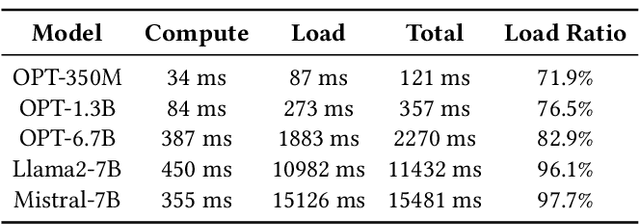
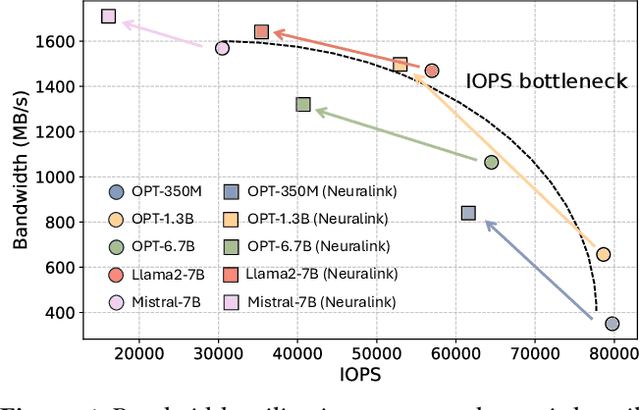
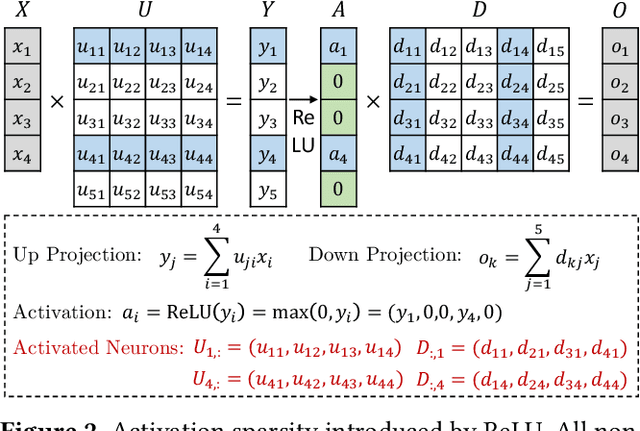

Large Language Models (LLMs) have achieved remarkable success across various domains, yet deploying them on mobile devices remains an arduous challenge due to their extensive computational and memory demands. While lightweight LLMs have been developed to fit mobile environments, they suffer from degraded model accuracy. In contrast, sparsity-based techniques minimize DRAM usage by selectively transferring only relevant neurons to DRAM while retaining the full model in external storage, such as flash. However, such approaches are critically limited by numerous I/O operations, particularly on smartphones with severe IOPS constraints. In this paper, we propose Ripple, a novel approach that accelerates LLM inference on smartphones by optimizing neuron placement in flash memory. Ripple leverages the concept of Neuron Co-Activation, where neurons frequently activated together are linked to facilitate continuous read access and optimize data transfer efficiency. Our approach incorporates a two-stage solution: an offline stage that reorganizes neuron placement based on co-activation patterns, and an online stage that employs tailored data access and caching strategies to align well with hardware characteristics. Evaluations conducted on a variety of smartphones and LLMs demonstrate that Ripple achieves up to 5.93x improvements in I/O latency compared to the state-of-the-art. As the first solution to optimize storage placement under sparsity, Ripple explores a new optimization space at the intersection of sparsity-driven algorithm and storage-level system co-design in LLM inference.
Sapphire: Automatic Configuration Recommendation for Distributed Storage Systems
Jul 07, 2020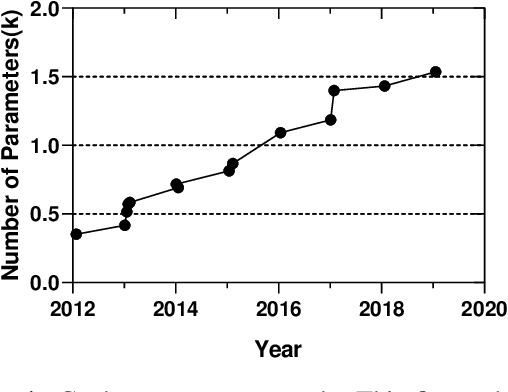
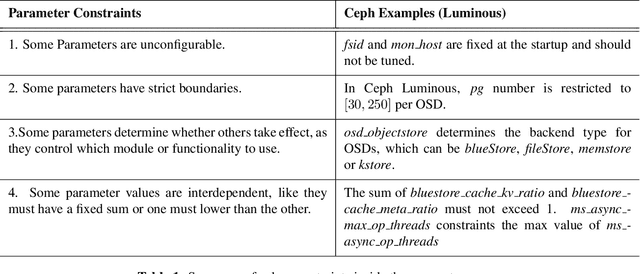
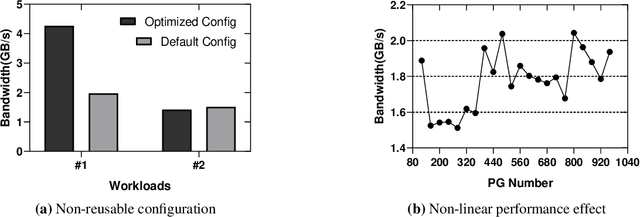
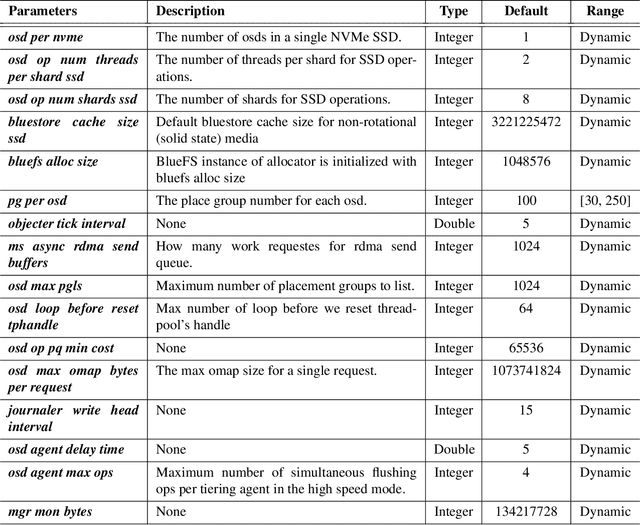
Modern distributed storage systems come with aplethora of configurable parameters that controlmodule behavior and affect system performance. Default settings provided by developers are often suboptimal for specific user cases. Tuning parameters can provide significant performance gains but is a difficult task requiring profound experience and expertise, due to the immense number of configurable parameters, complex inner dependencies and non-linearsystem behaviors. To overcome these difficulties, we propose an automatic simulation-based approach, Sapphire, to recommend optimal configurations by leveraging machine learning and black-box optimization techniques. We evaluate Sapphire on Ceph. Results show that Sapphire significantly boosts Ceph performance to 2.2x compared to the default configuration.