 Add to Chrome
 Add to Firefox
 Add to Edge
Nano-EmoX: Unifying Multimodal Emotional Intelligence from Perception to Empathy
Mar 03, 2026
The development of affective multimodal language models (MLMs) has long been constrained by a gap between low-level perception and high-level interaction, leading to fragmented affective capabilities and limited generalization. To bridge this gap, we propose a cognitively inspired three-level hierarchy that organizes affective tasks according to their cognitive depth-perception, understanding, and interaction-and provides a unified conceptual foundation for advancing affective modeling. Guided by this hierarchy, we introduce Nano-EmoX, a small-scale multitask MLM, and P2E (Perception-to-Empathy), a curriculum-based training framework. Nano-EmoX integrates a suite of omni-modal encoders, including an enhanced facial encoder and a fusion encoder, to capture key multimodal affective cues and improve cross-task transferability. The outputs are projected into a unified language space via heterogeneous adapters, empowering a lightweight language model to tackle diverse affective tasks. Concurrently, P2E progressively cultivates emotional intelligence by aligning rapid perception with chain-of-thought-driven empathy. To the best of our knowledge, Nano-EmoX is the first compact MLM (2.2B) to unify six core affective tasks across all three hierarchy levels, achieving state-of-the-art or highly competitive performance across multiple benchmarks, demonstrating excellent efficiency and generalization.

Unlabeled Action Quality Assessment Based on Multi-dimensional Adaptive Constrained Dynamic Time Warping
Oct 18, 2024

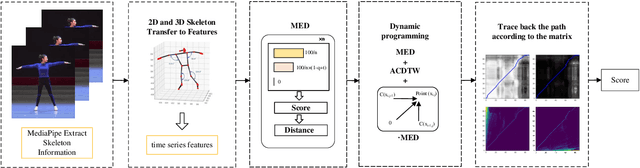
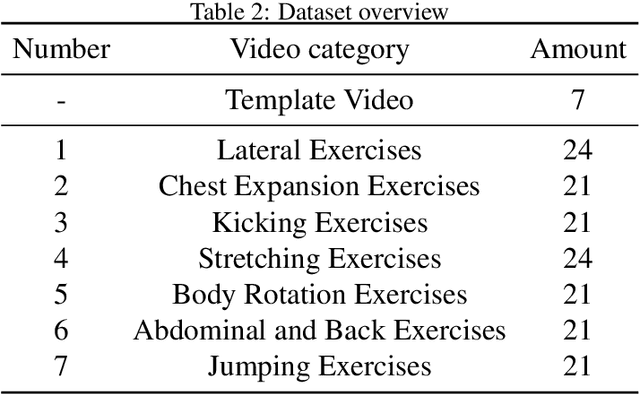
The growing popularity of online sports and exercise necessitates effective methods for evaluating the quality of online exercise executions. Previous action quality assessment methods, which relied on labeled scores from motion videos, exhibited slightly lower accuracy and discriminability. This limitation hindered their rapid application to newly added exercises. To address this problem, this paper presents an unlabeled Multi-Dimensional Exercise Distance Adaptive Constrained Dynamic Time Warping (MED-ACDTW) method for action quality assessment. Our approach uses an athletic version of DTW to compare features from template and test videos, eliminating the need for score labels during training. The result shows that utilizing both 2D and 3D spatial dimensions, along with multiple human body features, improves the accuracy by 2-3% compared to using either 2D or 3D pose estimation alone. Additionally, employing MED for score calculation enhances the precision of frame distance matching, which significantly boosts overall discriminability. The adaptive constraint scheme enhances the discriminability of action quality assessment by approximately 30%. Furthermore, to address the absence of a standardized perspective in sports class evaluations, we introduce a new dataset called BGym.