 Add to Chrome
 Add to Firefox
 Add to Edge
Can Graphs Improve Tabular Foundation Models?
Dec 13, 2025
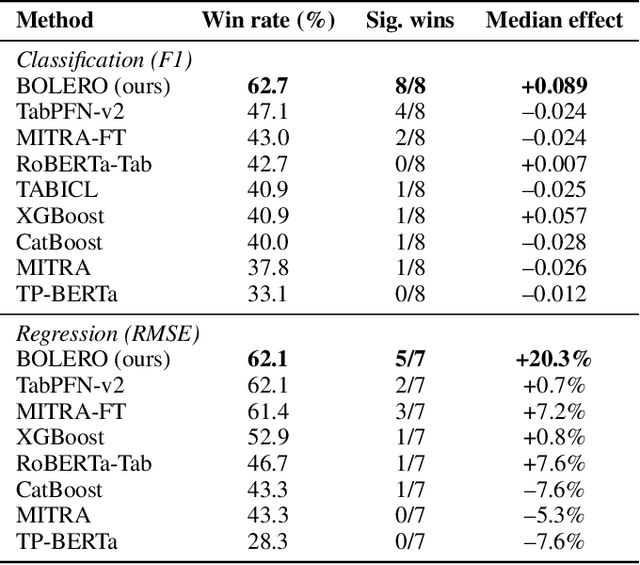
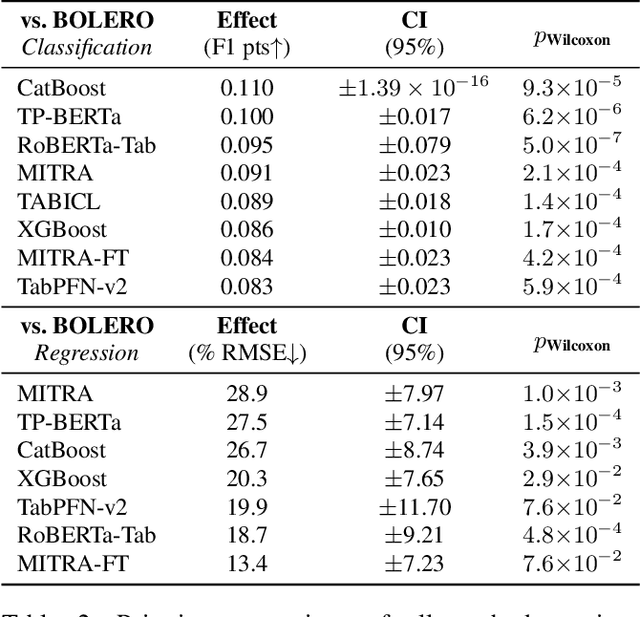
Tabular data are central to many real-world systems. While recent tabular transformers and in-context learners such as SAINT, TP-BERTa, TabPFN, TabICL, and MITRA incorporate limited inter-row reasoning, most approaches still lack an explicit mechanism to model relationships among instances, even though similar samples often share related outcomes. We investigate whether introducing \emph{simple graph priors} can enhance \emph{pretrained tabular transformers}. Concretely, we introduce {BOLERO}, a lightweight, static bipartite graph head that augments {RoBERTa-Tab} (a RoBERTa-style tabular backbone pretrained with masked-token prediction.) Each instance connects to feature/value anchors; a small GNN refines row representations, while the backbone remains frozen. We evaluate on 80 classification and 64 regression datasets from the TP-BERTa benchmark suites, comparing against strong baselines including XGBoost, CatBoost, TabPFN-v2, MITRA, TabICL, TP-BERTa, and RoBERTa-Tab. To ensure statistically sound conclusions, we follow best practices for multi-dataset evaluation: pairwise Wilcoxon signed-rank tests on per-dataset score differences and effect sizes (median improvement with confidence intervals), rather than mean-rank post-hoc tests that depend on the competitor pool. BOLERO achieves the highest number of statistically significant wins across both classification and regression, demonstrating that lightweight graph priors meaningfully improve pretrained tabular transformers.

Toward Reproducing Network Research Results Using Large Language Models
Sep 09, 2023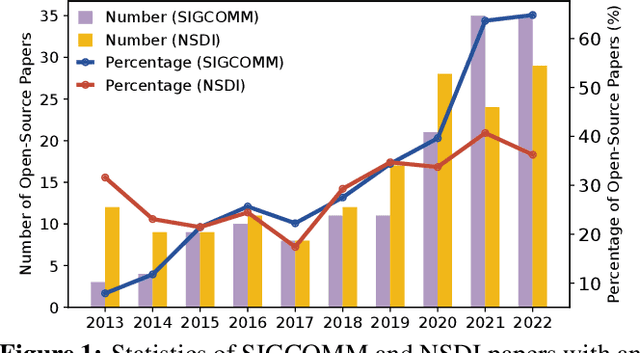
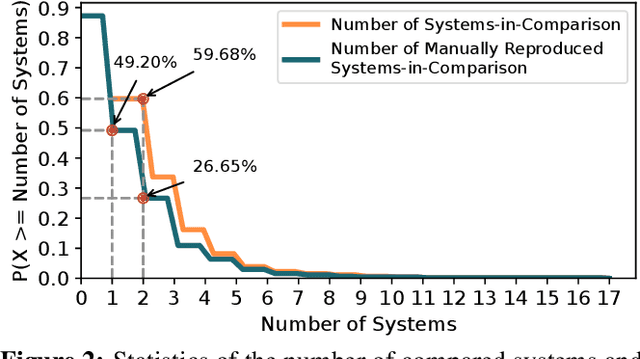
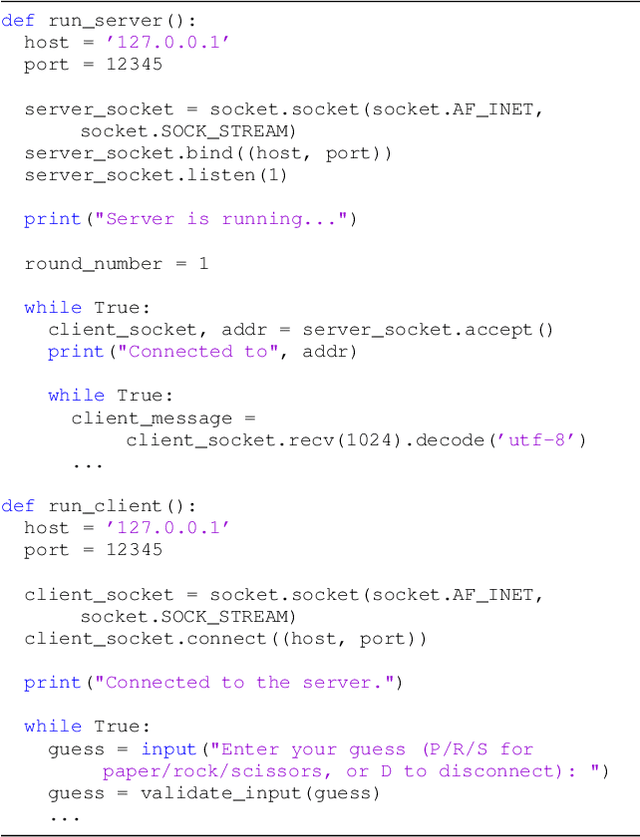
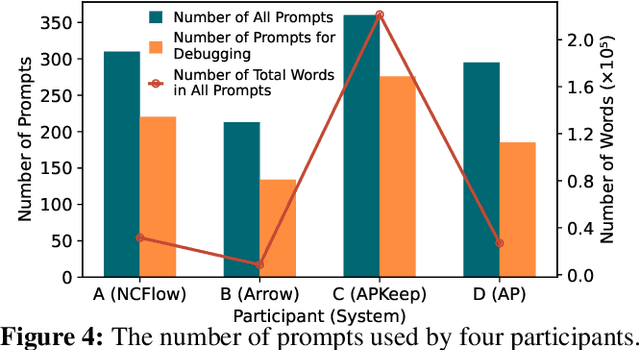
Reproducing research results in the networking community is important for both academia and industry. The current best practice typically resorts to three approaches: (1) looking for publicly available prototypes; (2) contacting the authors to get a private prototype; and (3) manually implementing a prototype following the description of the publication. However, most published network research does not have public prototypes and private prototypes are hard to get. As such, most reproducing efforts are spent on manual implementation based on the publications, which is both time and labor consuming and error-prone. In this paper, we boldly propose reproducing network research results using the emerging large language models (LLMs). In particular, we first prove its feasibility with a small-scale experiment, in which four students with essential networking knowledge each reproduces a different networking system published in prominent conferences and journals by prompt engineering ChatGPT. We report the experiment's observations and lessons and discuss future open research questions of this proposal. This work raises no ethical issue.