 Add to Chrome
 Add to Firefox
 Add to Edge
Auto-JEPA: A Latent World Model of Continuous Intent for End-to-End Autonomous Driving
Jul 31, 2026
Existing autonomous-driving world models typically perform dense prediction of future videos, occupancy states, BEV representations, or agent motion. We argue that planning need not reconstruct the complete future world, but only focus on scene features that affect future ego action. Based on this perspective, we propose Auto-JEPA, an action-oriented latent world model that learns continuous future driving intent through joint-embedding prediction. Given visual observations, egomotion history, and navigation commands, Auto-JEPA predicts an intent embedding aligned with the latent representation of the future ego trajectory. The predicted intent retrieves executable trajectories from a fixed trajectory memory, which are then ranked by a scene-conditioned candidate selection module. Auto-JEPA keeps the visual encoder frozen, requires no explicit perception annotations, and uses no learned trajectory generator. By optimizing only task-specific modules for trajectory representation, intent prediction, and candidate selection, Auto-JEPA achieves 91.3 PDMS on NAVSIM v1 and 89.1 EPDMS on NAVSIM v2. Semantic occlusion experiments show that masking dynamic-agent regions induces an average intent change 2.97x that of equal-area random masking. Moreover, occluding vehicles that affect future driving substantially changes the predicted intent and selected trajectory, whereas both remain essentially unchanged when non-influential vehicles are occluded. These results show that future-intent prediction encourages the model to focus on planning-relevant visual features and supports high-quality planning without dense future-world modeling.

Quantization Networks
Nov 28, 2019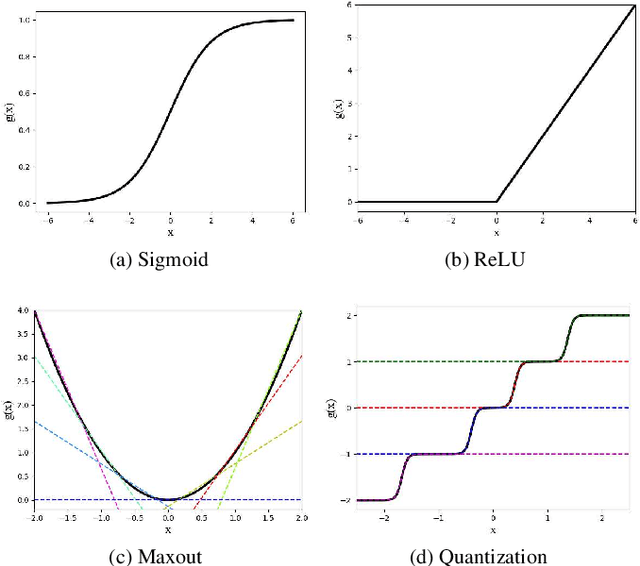
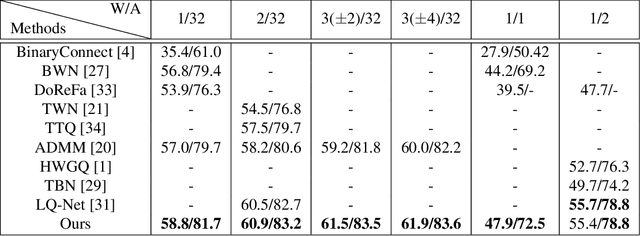

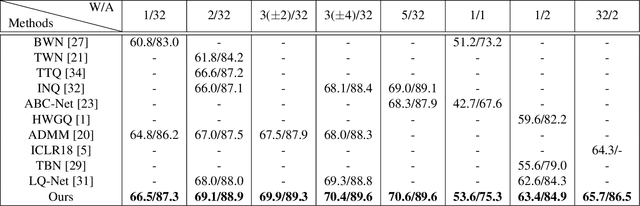
Although deep neural networks are highly effective, their high computational and memory costs severely challenge their applications on portable devices. As a consequence, low-bit quantization, which converts a full-precision neural network into a low-bitwidth integer version, has been an active and promising research topic. Existing methods formulate the low-bit quantization of networks as an approximation or optimization problem. Approximation-based methods confront the gradient mismatch problem, while optimization-based methods are only suitable for quantizing weights and could introduce high computational cost in the training stage. In this paper, we propose a novel perspective of interpreting and implementing neural network quantization by formulating low-bit quantization as a differentiable non-linear function (termed quantization function). The proposed quantization function can be learned in a lossless and end-to-end manner and works for any weights and activations of neural networks in a simple and uniform way. Extensive experiments on image classification and object detection tasks show that our quantization networks outperform the state-of-the-art methods. We believe that the proposed method will shed new insights on the interpretation of neural network quantization. Our code is available at https://github.com/aliyun/alibabacloud-quantization-networks.