 Add to Chrome
 Add to Firefox
 Add to Edge
SPLIT: Sparse Incremental Learning of Error Dynamics for Control-Oriented Modeling in Autonomous Vehicles
Feb 14, 2026
Accurate, computationally efficient, and adaptive vehicle models are essential for autonomous vehicle control. Hybrid models that combine a nominal model with a Gaussian Process (GP)-based residual model have emerged as a promising approach. However, the GP-based residual model suffers from the curse of dimensionality, high evaluation complexity, and the inefficiency of online learning, which impede the deployment in real-time vehicle controllers. To address these challenges, we propose SPLIT, a sparse incremental learning framework for control-oriented vehicle dynamics modeling. SPLIT integrates three key innovations: (i) Model Decomposition. We decompose the vehicle model into invariant elements calibrated by experiments, and variant elements compensated by the residual model to reduce feature dimensionality. (ii) Local Incremental Learning. We define the valid region in the feature space and partition it into subregions, enabling efficient online learning from streaming data. (iii) GP Sparsification. We use bayesian committee machine to ensure scalable online evaluation. Integrated into model-based controllers, SPLIT is evaluated in aggressive simulations and real-vehicle experiments. Results demonstrate that SPLIT improves model accuracy and control performance online. Moreover, it enables rapid adaptation to vehicle dynamics deviations and exhibits robust generalization to previously unseen scenarios.

Learning Based MPC for Autonomous Driving Using a Low Dimensional Residual Model
Dec 05, 2024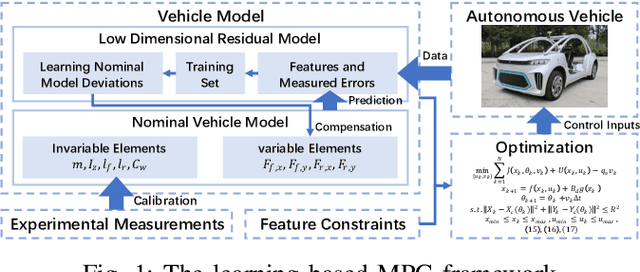
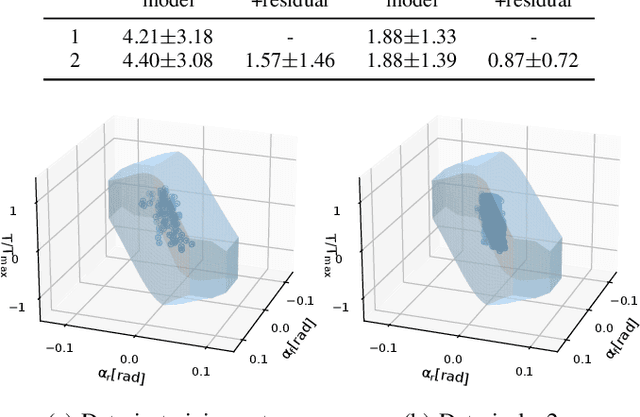
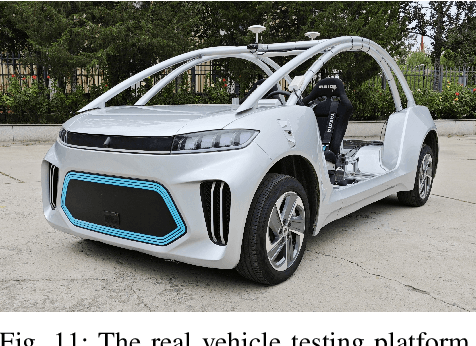
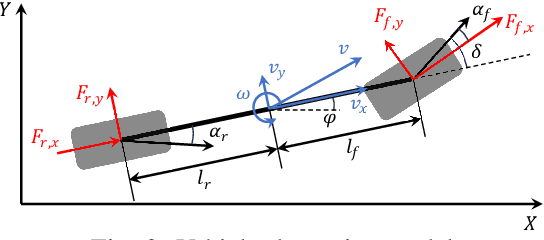
In this paper, a learning based Model Predictive Control (MPC) using a low dimensional residual model is proposed for autonomous driving. One of the critical challenge in autonomous driving is the complexity of vehicle dynamics, which impedes the formulation of accurate vehicle model. Inaccurate vehicle model can significantly impact the performance of MPC controller. To address this issue, this paper decomposes the nominal vehicle model into invariable and variable elements. The accuracy of invariable component is ensured by calibration, while the deviations in the variable elements are learned by a low-dimensional residual model. The features of residual model are selected as the physical variables most correlated with nominal model errors. Physical constraints among these features are formulated to explicitly define the valid region within the feature space. The formulated model and constraints are incorporated into the MPC framework and validated through both simulation and real vehicle experiments. The results indicate that the proposed method significantly enhances the model accuracy and controller performance.