 Add to Chrome
 Add to Firefox
 Add to Edge
BrainBench: Benchmarking Large Language Models for Comprehensive EEG Understanding
Aug 04, 2026
Electroencephalography (EEG) analysis extends beyond assigning predefined labels to recordings; it requires workflows connecting natural-language instructions, signal processing, quantitative evidence, and scientific interpretation. We term this capability \emph{comprehensive EEG understanding}. Existing evaluations, however, primarily target isolated decoding tasks or system-specific demonstrations, leaving the competence of large language models (LLMs) insufficiently quantified. We introduce \benchmarkname{}, a unified benchmark for comprehensive, instruction-conditioned EEG understanding. It comprises four subsets---Foundational Analysis, Sleep Assessment, Neurocognitive Assessment, and Physiological Integration---covering 17 datasets, \numcases{} tasks, and over \numinstances{} real-data instances. Given an instruction and EEG recordings with optional physiological signals, a system must perform the analysis and produce a scientifically grounded report and, when required, artifacts. Outputs are assessed through numerical, categorical, set, sequence, semantic, and artifact validation. We evaluate \nummodels{} representative LLMs across more than 100K executions under two paradigms: autonomous code execution with CodeAct and structured agentic analysis with BrainAgent. Results vary substantially across models, subsets, difficulty levels, and execution paradigms, showing that EEG competence depends on the model and its operationalization. \benchmarkname{} provides a reproducible testbed for advancing LLM-based EEG understanding. The code and benchmark will be released soon, with evaluation results continuously updated.

BrainAgent: A Large Language Model-Driven Multi-Agent Framework for Autonomous Brain Signal Understanding
Jun 24, 2026Brain-Computer Interfaces (BCIs) and brain signal understanding are pivotal for clinical health and next-generation interactions. Despite this significance, its widespread adoption in real-world scenarios remains restricted, primarily because current analytical paradigms lack sufficient agentic intelligence. First, existing methodologies impose prohibitive technical barriers, requiring extensive specialized expertise. Second, they remain inherently static and task-specific, failing to execute the complex, long-horizon workflows essential for real-world deployment. To accelerate the democratization of brain signal understanding, we draw inspiration from Large Language Models (LLMs) to introduce BrainAgent, an LLM-driven multi-agent framework designed to ground abstract natural language intent into rigorous, executable, and end-to-end processing pipelines. BrainAgent employs a hierarchical architecture where a central supervisor orchestrates specialized sub-agents for adaptive task decomposition and execution. Furthermore, we establish a comprehensive, systematic benchmark for evaluating agentic systems in brain signal analysis. Empirical results demonstrate that BrainAgent effectively automates complex workflows with superior reliability, marking a paradigm shift toward democratized brain signal understanding.
EvoBrain: Continual Learning of EEG Foundation Models Across Heterogeneous BCI Tasks
Jun 01, 2026Electroencephalography (EEG) is the cornerstone of non-invasive brain-computer interfaces (BCIs), yet conventional decoding relies on fragmented, task-specific architectures that severely limit cross-task scalability. While EEG foundation models pre-trained on massive corpora promise universal brain decoding, current post-training depends on task-isolated fine-tuning. This static paradigm restricts knowledge transfer across heterogeneous tasks, hinders model scalability, and incurs computational and storage overheads that scale linearly with task count. To overcome these bottlenecks, we formulate downstream adaptation as a cross-task continual learning problem and propose EvoBrain, a dynamic, task-aware continual learning framework for unified EEG decoding. EvoBrain addresses the plasticity-stability trade-off via two complementary components: (1) Neuro-Spectral Task Normalization (NSN) aligns incoming tasks with historical statistics while recalibrating spectral responses to handle distributional and neuro-spectral shifts; and (2) Response-Affinity Distillation (RAD), combined with time-dependent replay, preserves old-task response geometry and promotes selective knowledge transfer between spectrally compatible tasks, effectively mitigating forgetting. Extensive evaluations across six distinct BCI tasks demonstrate that EvoBrain consistently surpasses state-of-the-art methods across diverse foundation backbones, optimally balancing plasticity and stability. To our knowledge, this work pioneers cross-task continual learning in the EEG domain, advancing the realization of a unified, one-for-all brain decoding system.
Personalized Sleep Staging Leveraging Source-free Unsupervised Domain Adaptation
Dec 11, 2024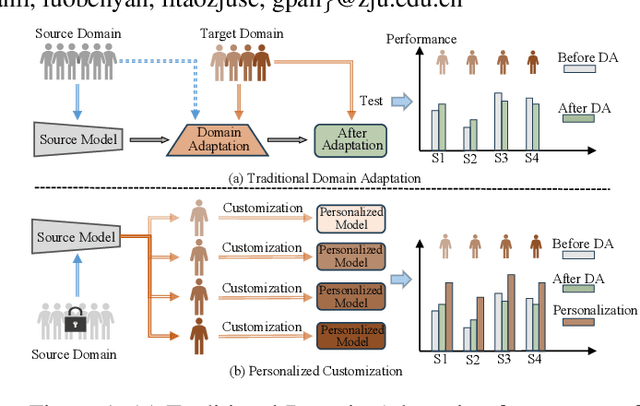


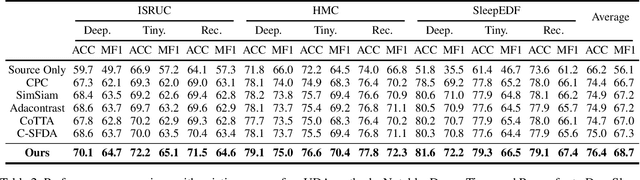
Sleep staging is crucial for assessing sleep quality and diagnosing related disorders. Recent deep learning models for automatic sleep staging using polysomnography often suffer from poor generalization to new subjects because they are trained and tested on the same labeled datasets, overlooking individual differences. To tackle this issue, we propose a novel Source-Free Unsupervised Individual Domain Adaptation (SF-UIDA) framework. This two-step adaptation scheme allows the model to effectively adjust to new unlabeled individuals without needing source data, facilitating personalized customization in clinical settings. Our framework has been applied to three established sleep staging models and tested on three public datasets, achieving state-of-the-art performance.
CBraMod: A Criss-Cross Brain Foundation Model for EEG Decoding
Dec 10, 2024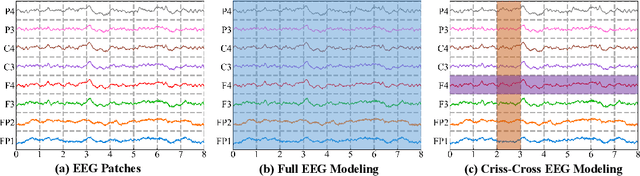
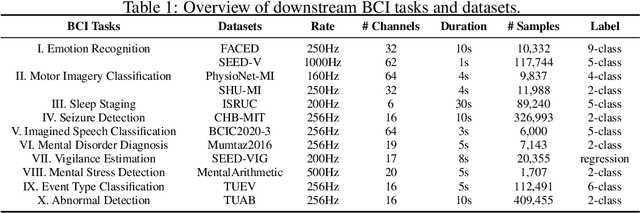
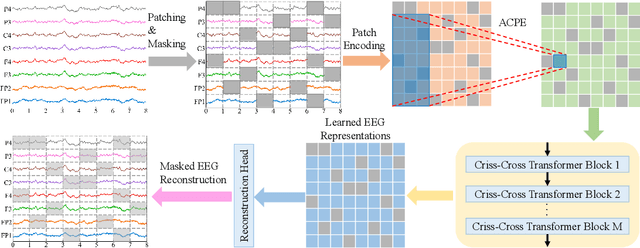
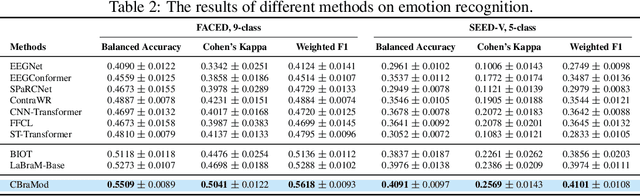
Electroencephalography (EEG) is a non-invasive technique to measure and record brain electrical activity, widely used in various BCI and healthcare applications. Early EEG decoding methods rely on supervised learning, limited by specific tasks and datasets, hindering model performance and generalizability. With the success of large language models, there is a growing body of studies focusing on EEG foundation models. However, these studies still leave challenges: Firstly, most of existing EEG foundation models employ full EEG modeling strategy. It models the spatial and temporal dependencies between all EEG patches together, but ignores that the spatial and temporal dependencies are heterogeneous due to the unique structural characteristics of EEG signals. Secondly, existing EEG foundation models have limited generalizability on a wide range of downstream BCI tasks due to varying formats of EEG data, making it challenging to adapt to. To address these challenges, we propose a novel foundation model called CBraMod. Specifically, we devise a criss-cross transformer as the backbone to thoroughly leverage the structural characteristics of EEG signals, which can model spatial and temporal dependencies separately through two parallel attention mechanisms. And we utilize an asymmetric conditional positional encoding scheme which can encode positional information of EEG patches and be easily adapted to the EEG with diverse formats. CBraMod is pre-trained on a very large corpus of EEG through patch-based masked EEG reconstruction. We evaluate CBraMod on up to 10 downstream BCI tasks (12 public datasets). CBraMod achieves the state-of-the-art performance across the wide range of tasks, proving its strong capability and generalizability. The source code is publicly available at \url{https://github.com/wjq-learning/CBraMod}.
RpBERT: A Text-image Relation Propagation-based BERT Model for Multimodal NER
Feb 05, 2021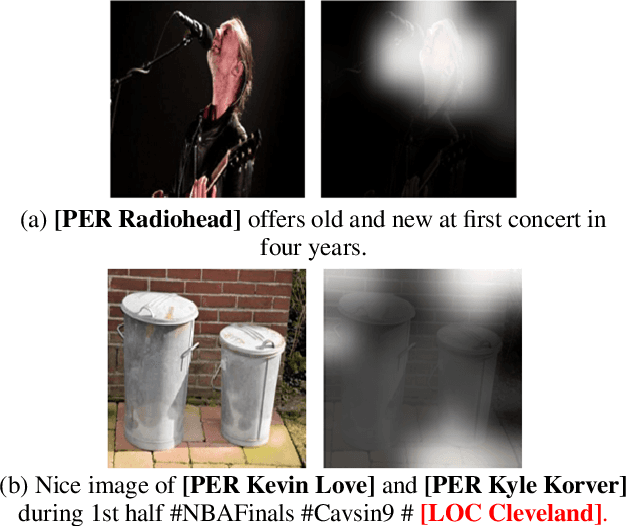
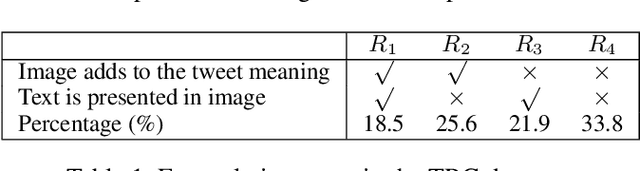
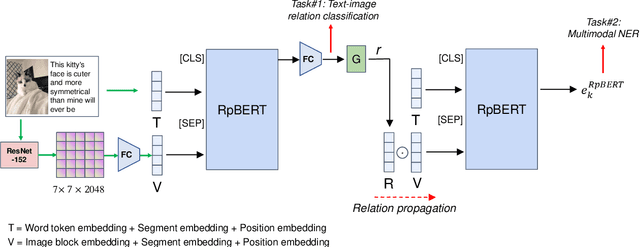
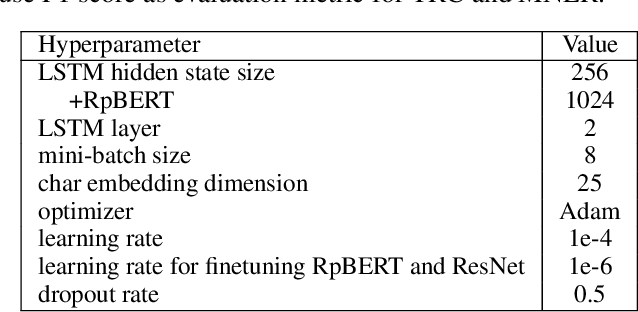
Recently multimodal named entity recognition (MNER) has utilized images to improve the accuracy of NER in tweets. However, most of the multimodal methods use attention mechanisms to extract visual clues regardless of whether the text and image are relevant. Practically, the irrelevant text-image pairs account for a large proportion in tweets. The visual clues that are unrelated to the texts will exert uncertain or even negative effects on multimodal model learning. In this paper, we introduce a method of text-image relation propagation into the multimodal BERT model. We integrate soft or hard gates to select visual clues and propose a multitask algorithm to train on the MNER datasets. In the experiments, we deeply analyze the changes in visual attention before and after the use of text-image relation propagation. Our model achieves state-of-the-art performance on the MNER datasets.