 Add to Chrome
 Add to Firefox
 Add to Edge
BrainBench: Benchmarking Large Language Models for Comprehensive EEG Understanding
Aug 04, 2026
Electroencephalography (EEG) analysis extends beyond assigning predefined labels to recordings; it requires workflows connecting natural-language instructions, signal processing, quantitative evidence, and scientific interpretation. We term this capability \emph{comprehensive EEG understanding}. Existing evaluations, however, primarily target isolated decoding tasks or system-specific demonstrations, leaving the competence of large language models (LLMs) insufficiently quantified. We introduce \benchmarkname{}, a unified benchmark for comprehensive, instruction-conditioned EEG understanding. It comprises four subsets---Foundational Analysis, Sleep Assessment, Neurocognitive Assessment, and Physiological Integration---covering 17 datasets, \numcases{} tasks, and over \numinstances{} real-data instances. Given an instruction and EEG recordings with optional physiological signals, a system must perform the analysis and produce a scientifically grounded report and, when required, artifacts. Outputs are assessed through numerical, categorical, set, sequence, semantic, and artifact validation. We evaluate \nummodels{} representative LLMs across more than 100K executions under two paradigms: autonomous code execution with CodeAct and structured agentic analysis with BrainAgent. Results vary substantially across models, subsets, difficulty levels, and execution paradigms, showing that EEG competence depends on the model and its operationalization. \benchmarkname{} provides a reproducible testbed for advancing LLM-based EEG understanding. The code and benchmark will be released soon, with evaluation results continuously updated.

Learning Spatiotemporal Decision Priors for Efficient Path Planning under Partial Observability
Jul 24, 2026Path planning under partial observability remains challenging because an agent must make long-horizon navigation decisions from only locally bounded observations. Nevertheless, historical trajectories contain reusable experience-guided directional preferences. Classical planners, however, typically solve each instance from scratch and lack an explicit mechanism to exploit such transferable decision knowledge, often leading to redundant node expansions and locally myopic search behaviors. Motivated by this limitation, this paper proposes ImiPath, a prior-guided learning framework that distills reusable spatiotemporal decision priors from demonstration trajectories and uses them as experience-informed directional guidance to bias planners toward reliable and promising search directions under partial observability. Specifically, ImiPath first constructs a local spatiotemporal observation representation, which encodes the spatial information of the local environment and the temporal information of historical trajectories. The SpatioTemporal-Attention Policy Network (STAPNet) then transforms this representation into dicision priors. These priors are further incorporated into heterogeneous planners as directional guidance, biasing the search toward locally promising regions. Extensive experiments demonstrate that ImiPath achieves competitive path quality and improves search efficiency by reducing redundant node expansions under local observability. Additional physical experiments on a magnetic microrobot platform further validate the adaptability and practical deployment potential of the proposed framework.
Efficient Policy Learning with Hybrid Evaluation-Based Genetic Programming for Uncertain Agile Earth Observation Satellite Scheduling
Mar 09, 2026The Uncertain Agile Earth Observation Satellite Scheduling Problem (UAEOSSP) is a novel combinatorial optimization problem and a practical engineering challenge that aligns with the current demands of space technology development. It incorporates uncertainties in profit, resource consumption, and visibility, which may render pre-planned schedules suboptimal or even infeasible. Genetic Programming Hyper-Heuristic (GPHH) shows promise for evolving interpretable scheduling policies; however, their simulation-based evaluation incurs high computational costs. Moreover, the design of the constructive method, denoted as Online Scheduling Algorithm (OSA), directly affects fitness assessment, resulting in evaluation-dependent local optima within the policy space. To address these issues, this paper proposes a Hybrid Evaluation-based Genetic Programming (HE-GP) for effectively solving UAEOSSP. A Hybrid Evaluation (HE) mechanism is integrated into the policy-driven OSA, combining exact and approximate filtering modes: exact mode ensures evaluation accuracy through elaborately designed constraint verification modules, while approximate mode reduces computational overhead via simplified logic. HE-GP dynamically switches between evaluation models based on real-time evolutionary state information. Experiments on 16 simulated instance sets demonstrate that HE-GP significantly outperforms handcrafted heuristics and single-evaluation based GPHH, achieving substantial reductions in computational cost while maintaining excellent scheduling performance across diverse scenarios. Specifically, the average training time of HE-GP was reduced by 17.77\% compared to GP employing exclusively exact evaluation, while the optimal policy generated by HE-GP achieved the highest average ranks across all scenarios.
An effective Genetic Programming Hyper-Heuristic for Uncertain Agile Satellite Scheduling
Feb 15, 2026This paper investigates a novel problem, namely the Uncertain Agile Earth Observation Satellite Scheduling Problem (UAEOSSP). Unlike the static AEOSSP, it takes into account a range of uncertain factors (e.g., task profit, resource consumption, and task visibility) in order to reflect the reality that the actual information is inherently unknown beforehand. An effective Genetic Programming Hyper-Heuristic (GPHH) is designed to automate the generation of scheduling policies. The evolved scheduling policies can be utilized to adjust plans in real time and perform exceptionally well. Experimental results demonstrate that evolved scheduling policies significantly outperform both well-designed Look-Ahead Heuristics (LAHs) and Manually Designed Heuristics (MDHs). Specifically, the policies generated by GPHH achieve an average improvement of 5.03% compared to LAHs and 8.14% compared to MDHs.
Pheromone-Focused Ant Colony Optimization algorithm for path planning
Jan 12, 2026Ant Colony Optimization (ACO) is a prominent swarm intelligence algorithm extensively applied to path planning. However, traditional ACO methods often exhibit shortcomings, such as blind search behavior and slow convergence within complex environments. To address these challenges, this paper proposes the Pheromone-Focused Ant Colony Optimization (PFACO) algorithm, which introduces three key strategies to enhance the problem-solving ability of the ant colony. First, the initial pheromone distribution is concentrated in more promising regions based on the Euclidean distances of nodes to the start and end points, balancing the trade-off between exploration and exploitation. Second, promising solutions are reinforced during colony iterations to intensify pheromone deposition along high-quality paths, accelerating convergence while maintaining solution diversity. Third, a forward-looking mechanism is implemented to penalize redundant path turns, promoting smoother and more efficient solutions. These strategies collectively produce the focused pheromones to guide the ant colony's search, which enhances the global optimization capabilities of the PFACO algorithm, significantly improving convergence speed and solution quality across diverse optimization problems. The experimental results demonstrate that PFACO consistently outperforms comparative ACO algorithms in terms of convergence speed and solution quality.
EMOD: A Unified EEG Emotion Representation Framework Leveraging V-A Guided Contrastive Learning
Nov 14, 2025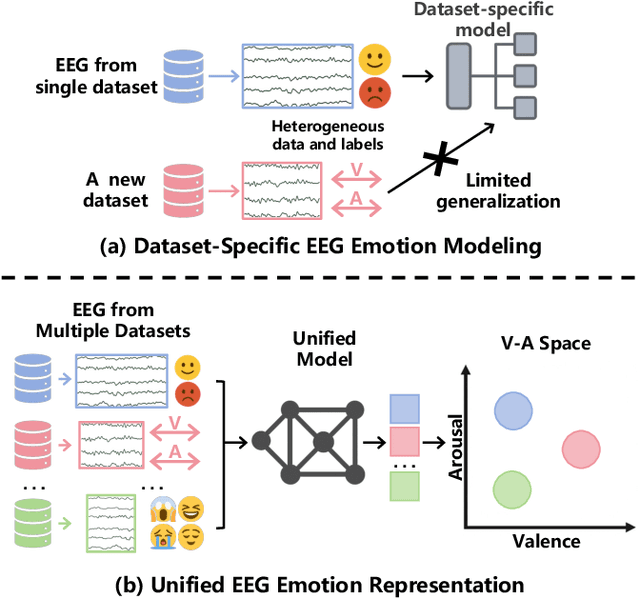
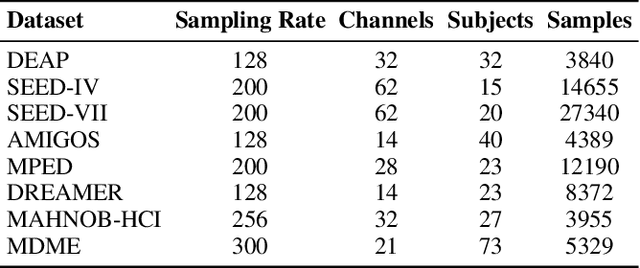
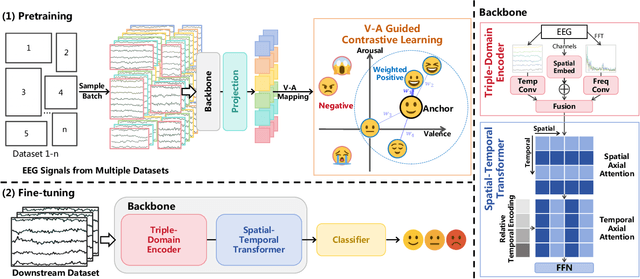
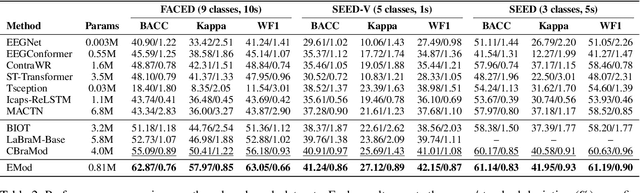
Emotion recognition from EEG signals is essential for affective computing and has been widely explored using deep learning. While recent deep learning approaches have achieved strong performance on single EEG emotion datasets, their generalization across datasets remains limited due to the heterogeneity in annotation schemes and data formats. Existing models typically require dataset-specific architectures tailored to input structure and lack semantic alignment across diverse emotion labels. To address these challenges, we propose EMOD: A Unified EEG Emotion Representation Framework Leveraging Valence-Arousal (V-A) Guided Contrastive Learning. EMOD learns transferable and emotion-aware representations from heterogeneous datasets by bridging both semantic and structural gaps. Specifically, we project discrete and continuous emotion labels into a unified V-A space and formulate a soft-weighted supervised contrastive loss that encourages emotionally similar samples to cluster in the latent space. To accommodate variable EEG formats, EMOD employs a flexible backbone comprising a Triple-Domain Encoder followed by a Spatial-Temporal Transformer, enabling robust extraction and integration of temporal, spectral, and spatial features. We pretrain EMOD on 8 public EEG datasets and evaluate its performance on three benchmark datasets. Experimental results show that EMOD achieves the state-of-the-art performance, demonstrating strong adaptability and generalization across diverse EEG-based emotion recognition scenarios.
SoilX: Calibration-Free Comprehensive Soil Sensing Through Contrastive Cross-Component Learning
Nov 07, 2025Precision agriculture demands continuous and accurate monitoring of soil moisture (M) and key macronutrients, including nitrogen (N), phosphorus (P), and potassium (K), to optimize yields and conserve resources. Wireless soil sensing has been explored to measure these four components; however, current solutions require recalibration (i.e., retraining the data processing model) to handle variations in soil texture, characterized by aluminosilicates (Al) and organic carbon (C), limiting their practicality. To address this, we introduce SoilX, a calibration-free soil sensing system that jointly measures six key components: {M, N, P, K, C, Al}. By explicitly modeling C and Al, SoilX eliminates texture- and carbon-dependent recalibration. SoilX incorporates Contrastive Cross-Component Learning (3CL), with two customized terms: the Orthogonality Regularizer and the Separation Loss, to effectively disentangle cross-component interference. Additionally, we design a novel tetrahedral antenna array with an antenna-switching mechanism, which can robustly measure soil dielectric permittivity independent of device placement. Extensive experiments demonstrate that SoilX reduces estimation errors by 23.8% to 31.5% over baselines and generalizes well to unseen fields.
GWRF: A Generalizable Wireless Radiance Field for Wireless Signal Propagation Modeling
Feb 08, 2025
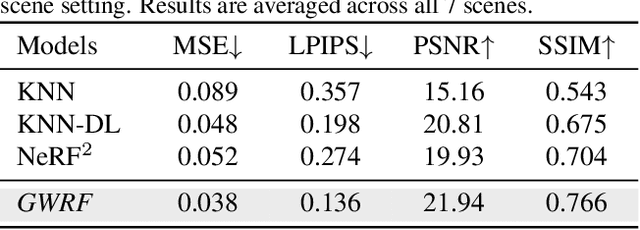
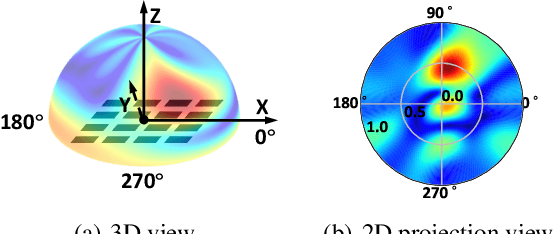
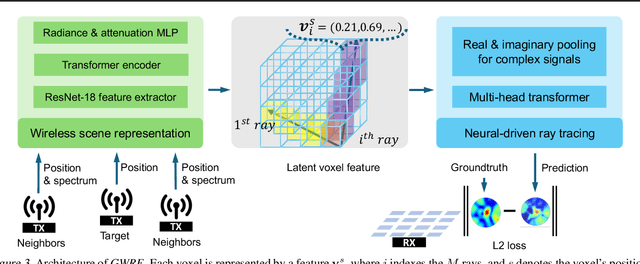
We present Generalizable Wireless Radiance Fields (GWRF), a framework for modeling wireless signal propagation at arbitrary 3D transmitter and receiver positions. Unlike previous methods that adapt vanilla Neural Radiance Fields (NeRF) from the optical to the wireless signal domain, requiring extensive per-scene training, GWRF generalizes effectively across scenes. First, a geometry-aware Transformer encoder-based wireless scene representation module incorporates information from geographically proximate transmitters to learn a generalizable wireless radiance field. Second, a neural-driven ray tracing algorithm operates on this field to automatically compute signal reception at the receiver. Experimental results demonstrate that GWRF outperforms existing methods on single scenes and achieves state-of-the-art performance on unseen scenes.
See Behind Walls in Real-time Using Aerial Drones and Augmented Reality
Oct 17, 2024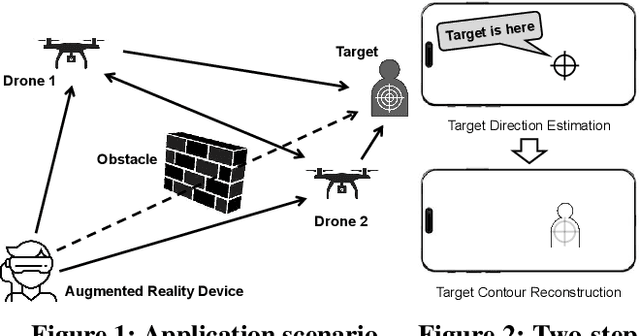
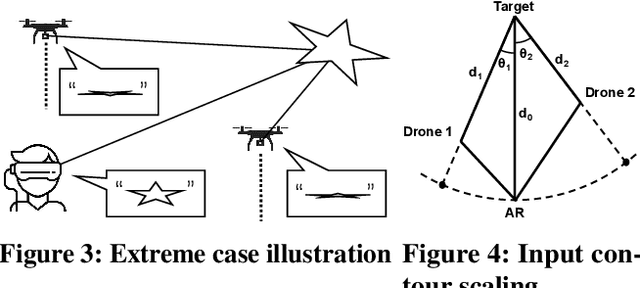
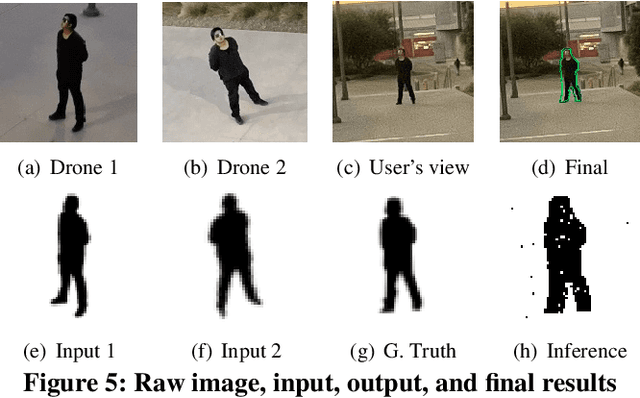
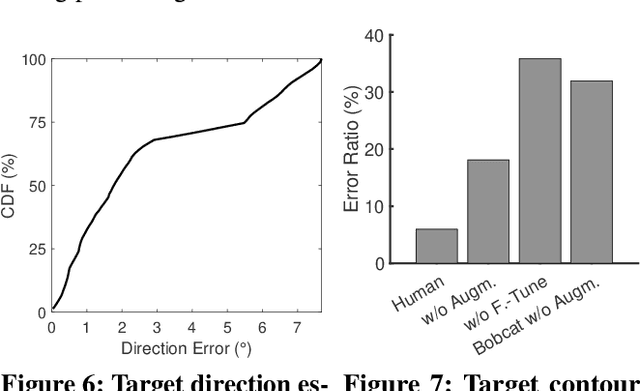
This work presents ARD2, a framework that enables real-time through-wall surveillance using two aerial drones and an augmented reality (AR) device. ARD2 consists of two main steps: target direction estimation and contour reconstruction. In the first stage, ARD2 leverages geometric relationships between the drones, the user, and the target to project the target's direction onto the user's AR display. In the second stage, images from the drones are synthesized to reconstruct the target's contour, allowing the user to visualize the target behind walls. Experimental results demonstrate the system's accuracy in both direction estimation and contour reconstruction.
MARLP: Time-series Forecasting Control for Agricultural Managed Aquifer Recharge
Jul 01, 2024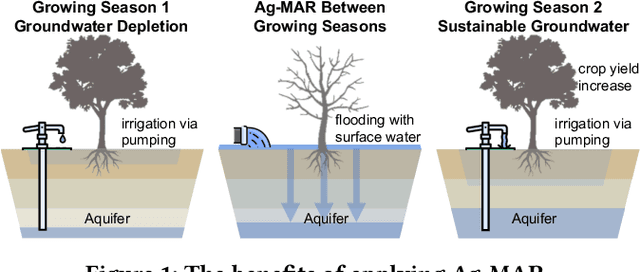
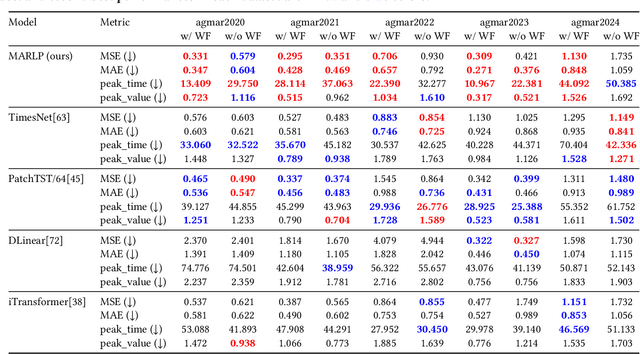
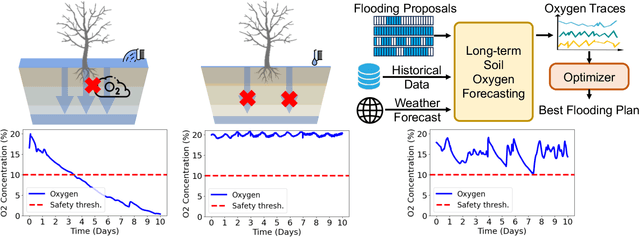
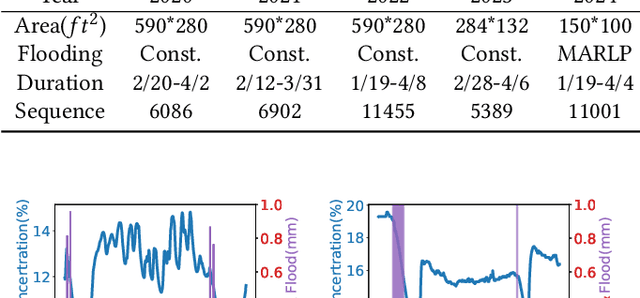
The rapid decline in groundwater around the world poses a significant challenge to sustainable agriculture. To address this issue, agricultural managed aquifer recharge (Ag-MAR) is proposed to recharge the aquifer by artificially flooding agricultural lands using surface water. Ag-MAR requires a carefully selected flooding schedule to avoid affecting the oxygen absorption of crop roots. However, current Ag-MAR scheduling does not take into account complex environmental factors such as weather and soil oxygen, resulting in crop damage and insufficient recharging amounts. This paper proposes MARLP, the first end-to-end data-driven control system for Ag-MAR. We first formulate Ag-MAR as an optimization problem. To that end, we analyze four-year in-field datasets, which reveal the multi-periodicity feature of the soil oxygen level trends and the opportunity to use external weather forecasts and flooding proposals as exogenous clues for soil oxygen prediction. Then, we design a two-stage forecasting framework. In the first stage, it extracts both the cross-variate dependency and the periodic patterns from historical data to conduct preliminary forecasting. In the second stage, it uses weather-soil and flooding-soil causality to facilitate an accurate prediction of soil oxygen levels. Finally, we conduct model predictive control (MPC) for Ag-MAR flooding. To address the challenge of large action spaces, we devise a heuristic planning module to reduce the number of flooding proposals to enable the search for optimal solutions. Real-world experiments show that MARLP reduces the oxygen deficit ratio by 86.8% while improving the recharging amount in unit time by 35.8%, compared with the previous four years.