 Add to Chrome
 Add to Firefox
 Add to Edge
NeuroRefiner: Morphology-Aware Multi-Agent Refinement for 3D Fluorescence Microscopy Neuron Segmentation
Aug 10, 2026
Accurate 3D neuron segmentation in fluorescence microscopy is critical for neuroscience. However, the sparse and elongated morphology of neurons poses significant challenges to existing segmentation methods. These methods struggle to preserve both local details and global topology, leading to fragmented results. To address this, we propose NeuroRefiner, a multi-agent system that formalizes the human expert workflow involving iterative global observation and local editing. Specifically, NeuroRefiner comprises three collaborative agents dedicated to diagnosing topological errors, generating correction instructions, and validating refinement quality. To facilitate agent instruction-guided segmentation refinement, we propose TopoRefineNet, a dedicated 3D U-Net-based tool that leverages cross-modality feature fusion to generate refined masks. Through multi-round agent reasoning and voxel-level editing, NeuroRefiner produces topologically more accurate segmentations with enhanced interpretability. Experiments on the BigNeuron, CWMBS, and ZBFWB datasets demonstrate that NeuroRefiner outperforms state-of-the-art methods, notably achieving a 3.02% improvement in F1 score on the challenging ZBFWB dataset.

Probe-EM: Targeted Neuron Tracing via Training-Free Semantic Verification
Jul 06, 2026Establishing large-scale, high-resolution neural connectivity maps is fundamental to elucidating the structural basis of brain function. However, when processing terabyte- or petabyte-scale electron microscopy data, over-segmentation inherent in automated reconstruction algorithms remains a critical bottleneck, requiring extensive manual proofreading spanning person-years. To alleviate the heavy reliance on annotated data and the limited flexibility of conventional tracing methods, we propose a training-free, targeted neuron tracing framework. Specifically, we introduce a skeleton-guided Heuristic Spatial Search paradigm that leverages geometric priors to iteratively reconstruct neuronal morphologies through a probing-verification cycle. To achieve robust zero-shot semantic verification, we further develop a Dimension-Aware Semantic Verification strategy built upon the foundation model NeuroSAM 2. This strategy resolves intra-slice splits via Planar Ensemble Consensus and inter-slice splits via Axial Spatio-Temporal Propagation. Notably, we integrate the proposed workflow into the Neuroglancer visualization platform, enabling an interactive human-in-the-loop proofreading system. Experimental results demonstrate that the proposed method outperforms supervised baselines and reduces manual proofreading time by 33.4%. The source code is publicly available at https://github.com/HeadLiuYun/Probe-EM.
Evo-Retriever: LLM-Guided Curriculum Evolution with Viewpoint-Pathway Collaboration for Multimodal Document Retrieval
Mar 17, 2026Visual-language models (VLMs) excel at data mappings, but real-world document heterogeneity and unstructuredness disrupt the consistency of cross-modal embeddings. Recent late-interaction methods enhance image-text alignment through multi-vector representations, yet traditional training with limited samples and static strategies cannot adapt to the model's dynamic evolution, causing cross-modal retrieval confusion. To overcome this, we introduce Evo-Retriever, a retrieval framework featuring an LLM-guided curriculum evolution built upon a novel Viewpoint-Pathway collaboration. First, we employ multi-view image alignment to enhance fine-grained matching via multi-scale and multi-directional perspectives. Then, a bidirectional contrastive learning strategy generates "hard queries" and establishes complementary learning paths for visual and textual disambiguation to rebalance supervision. Finally, the model-state summary from the above collaboration is fed into an LLM meta-controller, which adaptively adjusts the training curriculum using expert knowledge to promote the model's evolution. On ViDoRe V2 and MMEB (VisDoc), Evo-Retriever achieves state-of-the-art performance, with nDCG@5 scores of 65.2% and 77.1%.
Diffusion Model-Based Data Augmentation for Enhanced Neuron Segmentation
Jan 22, 2026Neuron segmentation in electron microscopy (EM) aims to reconstruct the complete neuronal connectome; however, current deep learning-based methods are limited by their reliance on large-scale training data and extensive, time-consuming manual annotations. Traditional methods augment the training set through geometric and photometric transformations; however, the generated samples remain highly correlated with the original images and lack structural diversity. To address this limitation, we propose a diffusion-based data augmentation framework capable of generating diverse and structurally plausible image-label pairs for neuron segmentation. Specifically, the framework employs a resolution-aware conditional diffusion model with multi-scale conditioning and EM resolution priors to enable voxel-level image synthesis from 3D masks. It further incorporates a biology-guided mask remodeling module that produces augmented masks with enhanced structural realism. Together, these components effectively enrich the training set and improve segmentation performance. On the AC3 and AC4 datasets under low-annotation regimes, our method improves the ARAND metric by 32.1% and 30.7%, respectively, when combined with two different post-processing methods. Our code is available at https://github.com/HeadLiuYun/NeuroDiff.
FAQ: Mitigating Quantization Error via Regenerating Calibration Data with Family-Aware Quantization
Jan 16, 2026Although post-training quantization (PTQ) provides an efficient numerical compression scheme for deploying large language models (LLMs) on resource-constrained devices, the representativeness and universality of calibration data remain a core bottleneck in determining the accuracy of quantization parameters. Traditional PTQ methods typically rely on limited samples, making it difficult to capture the activation distribution during the inference phase, leading to biases in quantization parameters. To address this, we propose \textbf{FAQ} (Family-Aware Quantization), a calibration data regeneration framework that leverages prior knowledge from LLMs of the same family to generate high-fidelity calibration samples. Specifically, FAQ first inputs the original calibration samples into a larger LLM from the same family as the target model, regenerating a series of high-fidelity calibration data using a highly consistent knowledge system. Subsequently, this data, carrying Chain-of-Thought reasoning and conforming to the expected activation distribution, undergoes group competition under expert guidance to select the best samples, which are then re-normalized to enhance the effectiveness of standard PTQ. Experiments on multiple model series, including Qwen3-8B, show that FAQ reduces accuracy loss by up to 28.5\% compared to the baseline with original calibration data, demonstrating its powerful potential and contribution.
LVNS-RAVE: Diversified audio generation with RAVE and Latent Vector Novelty Search
Apr 22, 2024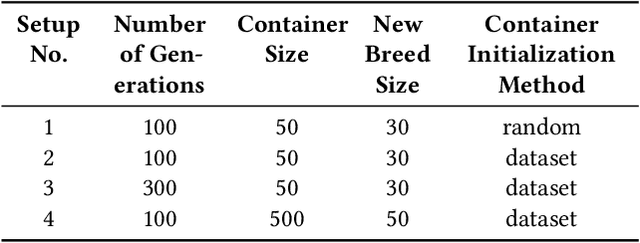
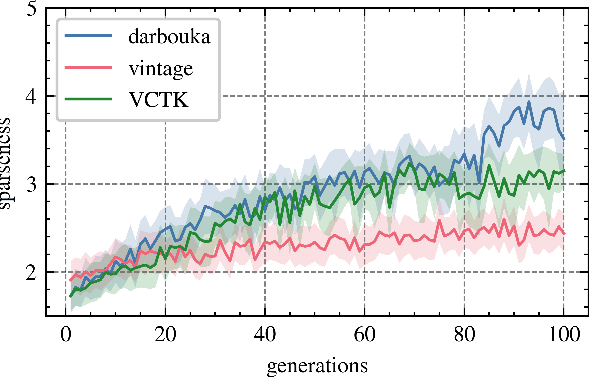
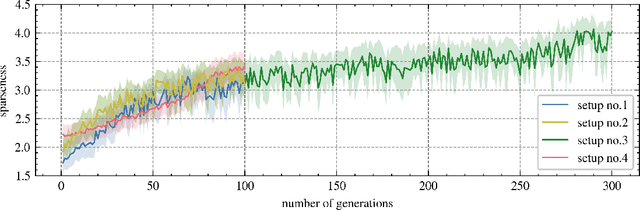
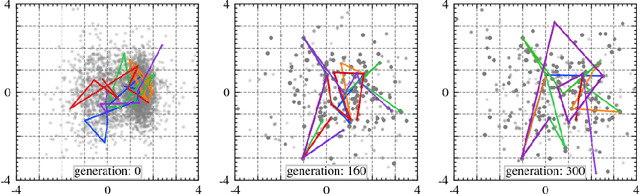
Evolutionary Algorithms and Generative Deep Learning have been two of the most powerful tools for sound generation tasks. However, they have limitations: Evolutionary Algorithms require complicated designs, posing challenges in control and achieving realistic sound generation. Generative Deep Learning models often copy from the dataset and lack creativity. In this paper, we propose LVNS-RAVE, a method to combine Evolutionary Algorithms and Generative Deep Learning to produce realistic and novel sounds. We use the RAVE model as the sound generator and the VGGish model as a novelty evaluator in the Latent Vector Novelty Search (LVNS) algorithm. The reported experiments show that the method can successfully generate diversified, novel audio samples under different mutation setups using different pre-trained RAVE models. The characteristics of the generation process can be easily controlled with the mutation parameters. The proposed algorithm can be a creative tool for sound artists and musicians.