 Add to Chrome
 Add to Firefox
 Add to Edge
JD Oxygen AI Item Center (Oxygen AIIC) V1: An Industrial-Scale LLM/VLM-Centric Solution for Item Understanding, Management, and Applications
Jun 29, 2026
JD$.$com, one of the world's largest e-commerce platforms, serves over 700 million active users and millions of merchants, with a catalog of tens of billions of SKUs. At this scale, high-quality, structured item knowledge underpins a better consumer experience, lower management costs, and higher operational efficiency-yet producing and serving it poses three industrial-scale challenges: fast-emerging concepts, high-quality knowledge production for massive SKUs, and diverse downstream requirements. To address these challenges, we present the JD Oxygen AI Item Center (Oxygen AIIC), an industrial-scale platform built on LLMs/VLMs for item-knowledge production and service. Oxygen AIIC is built around four core pillars: (i) ontology engineering driven by efficient human-AI collaboration, which supports the dynamic evolution and agile expansion of an ontology with millions of entries; (ii) a "Semantic Search then Discrimination"(S2D) knowledge identification architecture that, combined with throughput improvement strategies, enables scalable, extensible, and high-throughput AI Item Library production for tens of billions of SKUs; (iii) self-evolving item-understanding LLMs/VLMs that improve in a stable and controllable manner, enabling knowledge production with 94.2% precision and 82.8% recall; and (iv) a unified item tunnel that serves as the data and service hub. Oxygen AIIC now covers tens of thousands of JD categories and processes hundreds of millions of item updates per day on Huawei Ascend NPUs. It has accumulated hundreds of billions of item-knowledge assets. Deployed across core business scenarios-including search, recommendation, operations, category planning-Oxygen AIIC has delivered measurable gains at scale. Search-traffic coverage reaches 80.4%, item-information quality issues drop by 37%, the automated fill rate of core attributes during item listing exceeds 80%.

Adaptive Value Decomposition: Coordinating a Varying Number of Agents in Urban Systems
Feb 10, 2026Multi-agent reinforcement learning (MARL) provides a promising paradigm for coordinating multi-agent systems (MAS). However, most existing methods rely on restrictive assumptions, such as a fixed number of agents and fully synchronous action execution. These assumptions are often violated in urban systems, where the number of active agents varies over time, and actions may have heterogeneous durations, resulting in a semi-MARL setting. Moreover, while sharing policy parameters among agents is commonly adopted to improve learning efficiency, it can lead to highly homogeneous actions when a subset of agents make decisions concurrently under similar observations, potentially degrading coordination quality. To address these challenges, we propose Adaptive Value Decomposition (AVD), a cooperative MARL framework that adapts to a dynamically changing agent population. AVD further incorporates a lightweight mechanism to mitigate action homogenization induced by shared policies, thereby encouraging behavioral diversity and maintaining effective cooperation among agents. In addition, we design a training-execution strategy tailored to the semi-MARL setting that accommodates asynchronous decision-making when some agents act at different times. Experiments on real-world bike-sharing redistribution tasks in two major cities, London and Washington, D.C., demonstrate that AVD outperforms state-of-the-art baselines, confirming its effectiveness and generalizability.
Spectral Disentanglement and Enhancement: A Dual-domain Contrastive Framework for Representation Learning
Feb 09, 2026Large-scale multimodal contrastive learning has recently achieved impressive success in learning rich and transferable representations, yet it remains fundamentally limited by the uniform treatment of feature dimensions and the neglect of the intrinsic spectral structure of the learned features. Empirical evidence indicates that high-dimensional embeddings tend to collapse into narrow cones, concentrating task-relevant semantics in a small subspace, while the majority of dimensions remain occupied by noise and spurious correlations. Such spectral imbalance and entanglement undermine model generalization. We propose Spectral Disentanglement and Enhancement (SDE), a novel framework that bridges the gap between the geometry of the embedded spaces and their spectral properties. Our approach leverages singular value decomposition to adaptively partition feature dimensions into strong signals that capture task-critical semantics, weak signals that reflect ancillary correlations, and noise representing irrelevant perturbations. A curriculum-based spectral enhancement strategy is then applied, selectively amplifying informative components with theoretical guarantees on training stability. Building upon the enhanced features, we further introduce a dual-domain contrastive loss that jointly optimizes alignment in both the feature and spectral spaces, effectively integrating spectral regularization into the training process and encouraging richer, more robust representations. Extensive experiments on large-scale multimodal benchmarks demonstrate that SDE consistently improves representation robustness and generalization, outperforming state-of-the-art methods. SDE integrates seamlessly with existing contrastive pipelines, offering an effective solution for multimodal representation learning.
Grad2Reward: From Sparse Judgment to Dense Rewards for Improving Open-Ended LLM Reasoning
Feb 02, 2026Reinforcement Learning with Verifiable Rewards (RLVR) has catalyzed significant breakthroughs in complex LLM reasoning within verifiable domains, such as mathematics and programming. Recent efforts have sought to extend this paradigm to open-ended tasks by employing LLMs-as-a-Judge to provide sequence-level rewards for policy optimization. However, these rewards are inherently sparse, failing to provide the fine-grained supervision necessary for generating complex, long-form trajectories. Furthermore, current work treats the Judge as a black-box oracle, discarding the rich intermediate feedback signals encoded in it. To address these limitations, we introduce Grad2Reward, a novel framework that extracts dense process rewards directly from the Judge's model inference process via a single backward pass. By leveraging gradient-based attribution, Grad2Reward enables precise token-level credit assignment, substantially enhancing training efficiency and reasoning quality. Additionally, Grad2Reward introduces a self-judging mechanism, allowing the policy to improve through its own evaluative signals without training specialized reward models or reliance on superior external Judges. The experiments demonstrate that policies optimized with Grad2Reward achieve outstanding performance across diverse open-ended tasks, affirming its effectiveness and broad generalizability.
Recurrent Coupled Topic Modeling over Sequential Documents
Jun 23, 2021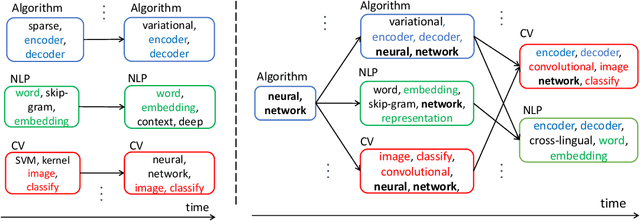
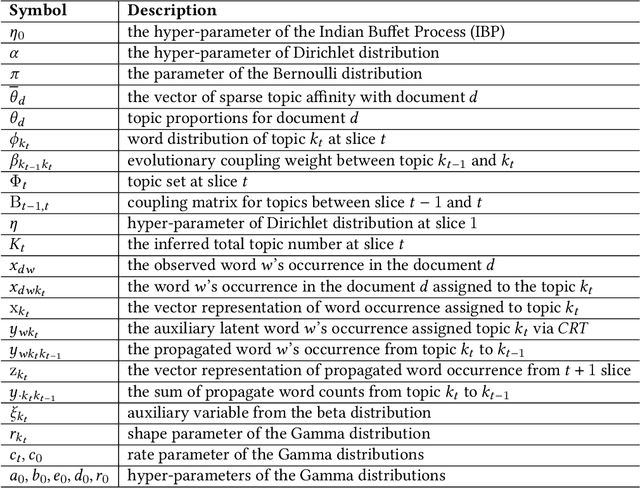
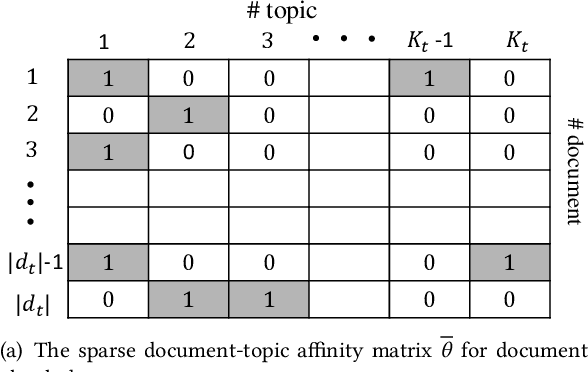
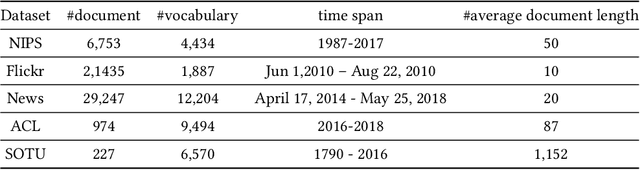
The abundant sequential documents such as online archival, social media and news feeds are streamingly updated, where each chunk of documents is incorporated with smoothly evolving yet dependent topics. Such digital texts have attracted extensive research on dynamic topic modeling to infer hidden evolving topics and their temporal dependencies. However, most of the existing approaches focus on single-topic-thread evolution and ignore the fact that a current topic may be coupled with multiple relevant prior topics. In addition, these approaches also incur the intractable inference problem when inferring latent parameters, resulting in a high computational cost and performance degradation. In this work, we assume that a current topic evolves from all prior topics with corresponding coupling weights, forming the multi-topic-thread evolution. Our method models the dependencies between evolving topics and thoroughly encodes their complex multi-couplings across time steps. To conquer the intractable inference challenge, a new solution with a set of novel data augmentation techniques is proposed, which successfully discomposes the multi-couplings between evolving topics. A fully conjugate model is thus obtained to guarantee the effectiveness and efficiency of the inference technique. A novel Gibbs sampler with a backward-forward filter algorithm efficiently learns latent timeevolving parameters in a closed-form. In addition, the latent Indian Buffet Process (IBP) compound distribution is exploited to automatically infer the overall topic number and customize the sparse topic proportions for each sequential document without bias. The proposed method is evaluated on both synthetic and real-world datasets against the competitive baselines, demonstrating its superiority over the baselines in terms of the low per-word perplexity, high coherent topics, and better document time prediction.