 Add to Chrome
 Add to Firefox
 Add to Edge
Unified Static-Dynamic Pruning for Efficient LLM Inference
Jul 24, 2026
The increasing deployment of large language models (LLMs) has magnified the computational and memory bottlenecks of autoregressive decoding, where low compute intensity and bandwidth-bound kernels dominate inference cost. Weight pruning offers a promising remedy, but existing methods remain confined to either static pruning (SP), which permanently removes redundant weights but lacks adaptivity, or dynamic pruning (DP), which adapts to input sparsity but introduces runtime irregularity. This paper presents SPDP, a unified sparse-inference framework that integrates unstructured SP with input-adaptive DP for efficient LLM inference on GPUs. SPDP co-designs a new Tiled-Column-wise Bitmap Compressed (Tiled-CBC) format and two complementary GPU kernels: (1) a CUDA-core spMspV kernel featuring Hybrid Activation-aware Dynamic Shared-Memory Bitmap Decoding (HAD-SMBD) for fine-grained, runtime activation skipping, and (2) a Tensor-Core SpMM kernel optimized for prefill computation. This joint format-kernel design harmonizes static and dynamic sparsity, maintaining bandwidth-efficient memory access and high compute intensity under both phases of LLM inference. Comprehensive evaluations on inference-optimized GPUs demonstrate that SPDP achieves 1.24x-1.37x average speedup (up to 2.51x) over state-of-the- art sparse frameworks such as SpInfer, while matching. perplexity with up to 25% higher sparsity. SPDP advances the inference efficiency-quality Pareto frontier, showing that unified static-dynamic pruning can deliver substantial throughput and performance-per-watt improvements in large-scale LLM serving

RFEval: Benchmarking Reasoning Faithfulness under Counterfactual Reasoning Intervention in Large Reasoning Models
Feb 19, 2026Large Reasoning Models (LRMs) exhibit strong performance, yet often produce rationales that sound plausible but fail to reflect their true decision process, undermining reliability and trust. We introduce a formal framework for reasoning faithfulness, defined by two testable conditions: stance consistency (a coherent stance linking reasoning to answer) and causal influence (the stated reasoning causally drives the answer under output-level interventions), explicitly decoupled from accuracy. To operationalize this, we present RFEval, a benchmark of 7,186 instances across seven tasks that probes faithfulness via controlled, output-level counterfactual interventions. Evaluating twelve open-source LRMs, we find unfaithfulness in 49.7% of outputs, predominantly from stance inconsistency. Failures are concentrated in brittle, convergent domains such as math and code, and correlate more with post-training regimes than with scale: within-family ablations indicate that adding current RL-style objectives on top of supervised fine-tuning can reduce reasoning faithfulness, even when accuracy is maintained. Crucially, accuracy is neither a sufficient nor a reliable proxy for faithfulness: once controlling for model and task, the accuracy-faithfulness link is weak and statistically insignificant. Our work establishes a rigorous methodology for auditing LRM reliability and shows that trustworthy AI requires optimizing not only for correct outcomes but also for the structural integrity of the reasoning process. Our code and dataset can be found at project page: $\href{https://aidaslab.github.io/RFEval/}{https://aidaslab.github.io/RFEval/}$
Knowledge Corpus Error in Question Answering
Oct 27, 2023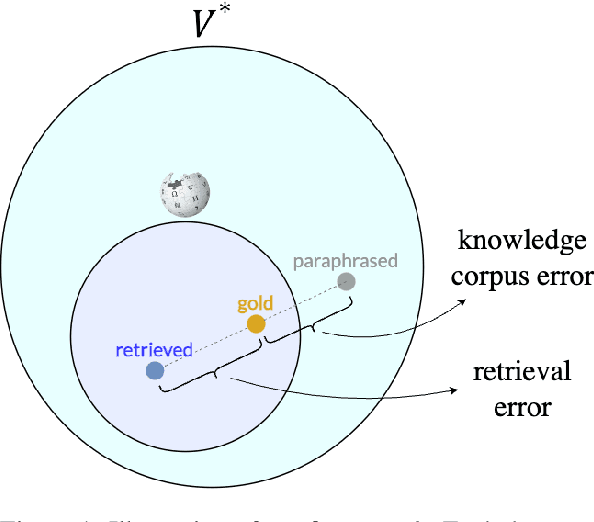
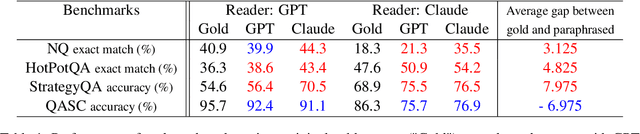

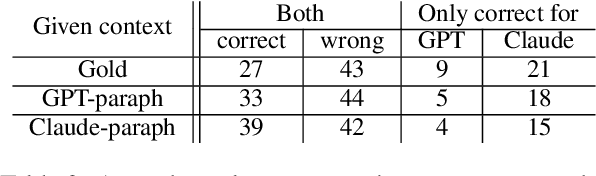
Recent works in open-domain question answering (QA) have explored generating context passages from large language models (LLMs), replacing the traditional retrieval step in the QA pipeline. However, it is not well understood why generated passages can be more effective than retrieved ones. This study revisits the conventional formulation of QA and introduces the concept of knowledge corpus error. This error arises when the knowledge corpus used for retrieval is only a subset of the entire string space, potentially excluding more helpful passages that exist outside the corpus. LLMs may mitigate this shortcoming by generating passages in a larger space. We come up with an experiment of paraphrasing human-annotated gold context using LLMs to observe knowledge corpus error empirically. Our results across three QA benchmarks reveal an increased performance (10% - 13%) when using paraphrased passage, indicating a signal for the existence of knowledge corpus error. Our code is available at https://github.com/xfactlab/emnlp2023-knowledge-corpus-error