 Add to Chrome
 Add to Firefox
 Add to Edge
Slack More, Predict Better: Proximal Relaxation for Probabilistic Latent Variable Model-based Soft Sensors
Mar 12, 2026
Nonlinear Probabilistic Latent Variable Models (NPLVMs) are a cornerstone of soft sensor modeling due to their capacity for uncertainty delineation. However, conventional NPLVMs are trained using amortized variational inference, where neural networks parameterize the variational posterior. While facilitating model implementation, this parameterization converts the distributional optimization problem within an infinite-dimensional function space to parameter optimization within a finite-dimensional parameter space, which introduces an approximation error gap, thereby degrading soft sensor modeling accuracy. To alleviate this issue, we introduce KProxNPLVM, a novel NPLVM that pivots to relaxing the objective itself and improving the NPLVM's performance. Specifically, we first prove the approximation error induced by the conventional approach. Based on this, we design the Wasserstein distance as the proximal operator to relax the learning objective, yielding a new variational inference strategy derived from solving this relaxed optimization problem. Based on this foundation, we provide a rigorous derivation of KProxNPLVM's optimization implementation, prove the convergence of our algorithm can finally sidestep the approximation error, and propose the KProxNPLVM by summarizing the abovementioned content. Finally, extensive experiments on synthetic and real-world industrial datasets are conducted to demonstrate the efficacy of the proposed KProxNPLVM.

CSPRD: A Financial Policy Retrieval Dataset for Chinese Stock Market
Sep 11, 2023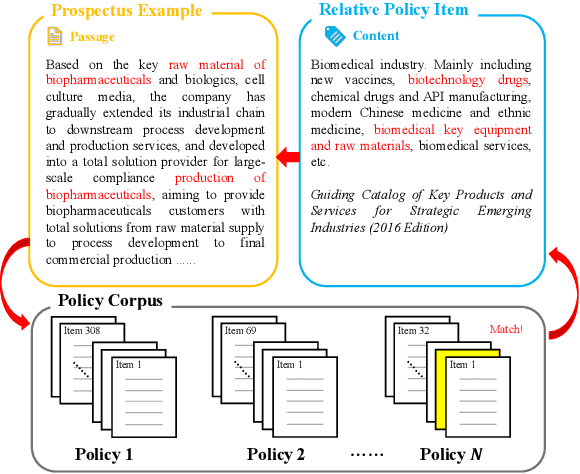
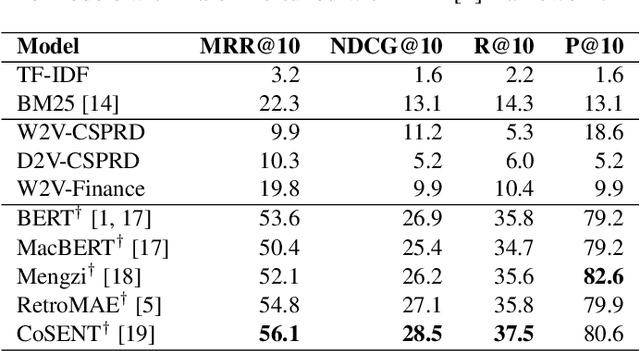
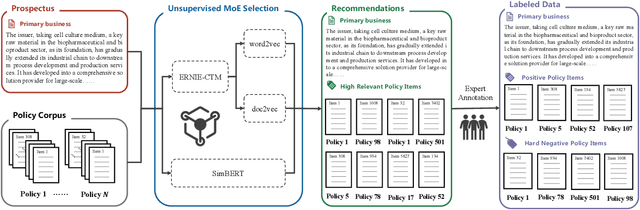
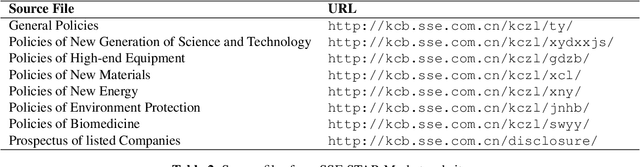
In recent years, great advances in pre-trained language models (PLMs) have sparked considerable research focus and achieved promising performance on the approach of dense passage retrieval, which aims at retrieving relative passages from massive corpus with given questions. However, most of existing datasets mainly benchmark the models with factoid queries of general commonsense, while specialised fields such as finance and economics remain unexplored due to the deficiency of large-scale and high-quality datasets with expert annotations. In this work, we propose a new task, policy retrieval, by introducing the Chinese Stock Policy Retrieval Dataset (CSPRD), which provides 700+ prospectus passages labeled by experienced experts with relevant articles from 10k+ entries in our collected Chinese policy corpus. Experiments on lexical, embedding and fine-tuned bi-encoder models show the effectiveness of our proposed CSPRD yet also suggests ample potential for improvement. Our best performing baseline achieves 56.1% MRR@10, 28.5% NDCG@10, 37.5% Recall@10 and 80.6% Precision@10 on dev set.