 Add to Chrome
 Add to Firefox
 Add to Edge
QwenPaw-Data: Bridging Facts, Methodology, and Execution for Autonomous Enterprise Data Analytics
Jul 14, 2026
Enterprise data analysis is emerging as a distinct frontier for autonomous agents. Compared with general-purpose interaction and software engineering, it operates in an open, ambiguous, and continuously evolving environment. These characteristics call for a data-agent architecture that treats semantics, methodology, execution, and evolution as first-class system concerns. To this end, we introduce QwenPaw-Data, an agentic data system designed for enterprise intelligent data analysis. QwenPaw-Data consolidates heterogeneous assets from warehouses, dashboards, documents, interaction logs, and historical tasks into reusable, governable, and evolvable analysis assets, then turns natural-language requests into end-to-end analytical workflows spanning data understanding, retrieval, analysis, report generation, and decision support. Its architecture decomposes the problem into three collaborative subsystems: DataBridge provides trustworthy semantic grounding through interconnected metadata, knowledge, and trace graphs; Skill-Hub codifies expert analytical methodology into reusable and verifiable skills; and Host materializes these evidence and method assets into controllable, artifact-centric runtime execution. Across these subsystems, semantics, methods, traces, and feedback are continuously deposited back into the system, forming a self-evolving asset flywheel. Experiments on public benchmarks and real-world industrial BI workloads show that QwenPaw-Data improves both verifiable data access capability and higher-level analytical quality, offering a practical foundation for reliable, traceable, and continuously improving enterprise data agents.

NavIsaacLab: Generating Realistic Crowd via Parallel Robot Learning for Benchmarking Human-aware Navigation
Jun 24, 2026Robot autonomous navigation that accounts for surrounding human activities is crucial for ensuring both safety and natural human-robot interaction in real-world environments shared by humans and robots. Simulation of complex and diverse navigation scenarios serves as the foundation for training reliable robot navigation policies and accurately evaluating the performance of algorithms, offering an efficient alternative to manual supervision of real data. However, current human-aware navigation research faces significant challenges due to the scarcity of diverse, high-quality scene data. Existing simulation platforms often rely on handcrafted rules to approximate pedestrian behavior and lack the capability to provide extensive sensor signals, typically assuming perfect observations. To address these limitations, this paper presents NavIsaacLab, a comprehensive framework for benchmarking and training human-aware navigation policies through physics-based and photo-realistic simulations of pedestrians and scenes. Based on Isaac Lab, the proposed framework employs photo-realistic scene rendering capabilities and supports parallel simulation on GPU, delivering real-time and accurate 3D visual feedback to robots. To enhance the realism of human behavior, a data-driven approach is employed that incorporates a trajectory diffusion model and an adversarial motion learning controller, enabling controllable, physics-based pedestrian simulation. Furthermore, the integration of diverse cross-scale scenes provides a robust benchmark for state-of-the-art human-aware navigation methods.
On the Duality Between Sharpness-Aware Minimization and Adversarial Training
Feb 23, 2024

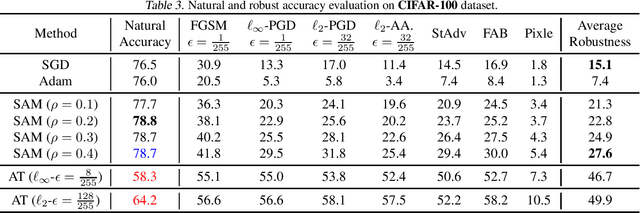

Adversarial Training (AT), which adversarially perturb the input samples during training, has been acknowledged as one of the most effective defenses against adversarial attacks, yet suffers from a fundamental tradeoff that inevitably decreases clean accuracy. Instead of perturbing the samples, Sharpness-Aware Minimization (SAM) perturbs the model weights during training to find a more flat loss landscape and improve generalization. However, as SAM is designed for better clean accuracy, its effectiveness in enhancing adversarial robustness remains unexplored. In this work, considering the duality between SAM and AT, we investigate the adversarial robustness derived from SAM. Intriguingly, we find that using SAM alone can improve adversarial robustness. To understand this unexpected property of SAM, we first provide empirical and theoretical insights into how SAM can implicitly learn more robust features, and conduct comprehensive experiments to show that SAM can improve adversarial robustness notably without sacrificing any clean accuracy, shedding light on the potential of SAM to be a substitute for AT when accuracy comes at a higher priority. Code is available at https://github.com/weizeming/SAM_AT.
On the Relation between Sharpness-Aware Minimization and Adversarial Robustness
May 09, 2023We propose a novel understanding of Sharpness-Aware Minimization (SAM) in the context of adversarial robustness. In this paper, we point out that both SAM and adversarial training (AT) can be viewed as specific feature perturbations, which improve adversarial robustness. However, we note that SAM and AT are distinct in terms of perturbation strength, leading to different accuracy and robustness trade-offs. We provide theoretical evidence for these claims in a simplified model with rigorous mathematical proofs. Furthermore, we conduct experiment to demonstrate that only utilizing SAM can achieve superior adversarial robustness compared to standard training, which is an unexpected benefit. As adversarial training can suffer from a decrease in clean accuracy, we show that using SAM alone can improve robustness without sacrificing clean accuracy. Code is available at https://github.com/weizeming/SAM_AT.