 Add to Chrome
 Add to Firefox
 Add to Edge
AdvDex: Learning Dexterous Manipulation from Human Demonstrations via Joint-Aligned Actions and Adversarial Learning
Aug 14, 2026
Dexterous manipulation is a fundamental capability for embodied intelligence, but scaling it remains difficult because robot demonstrations are expensive to collect and action spaces vary across embodiments. Policies trained on heterogeneous data can also entangle task-relevant visual cues with embodiment-specific appearance, limiting cross-embodiment generalization. We present AdvDex, a unified Vision-Language-Action framework for learning dexterous manipulation from human and robot demonstrations. First, we introduce OmniShare, a large-scale multimodal dataset of human manipulation demonstrations that provides high-quality kinematic supervision and tactile measurements while reducing reliance on robot teleoperation. Second, we propose the Joint-Aligned Action Space (JAAS), a canonical action representation comprising an $\mathrm{SE}(3)$ wrist pose and 15 finger joints, thereby functionally aligning human hands, dexterous robot hands, and parallel grippers. Finally, we use domain-adversarial learning to reduce embodiment-specific information in the learned visual representation. Experiments on hand-action prediction and real-world dexterous manipulation show consistent improvements over baselines, effective zero-shot human-to-robot skill transfer, generalization to unseen objects and environments, and data-efficient few-shot adaptation.

ETCH-X: Robustify Expressive Body Fitting to Clothed Humans with Composable Datasets
Apr 09, 2026Human body fitting, which aligns parametric body models such as SMPL to raw 3D point clouds of clothed humans, serves as a crucial first step for downstream tasks like animation and texturing. An effective fitting method should be both locally expressive-capturing fine details such as hands and facial features-and globally robust to handle real-world challenges, including clothing dynamics, pose variations, and noisy or partial inputs. Existing approaches typically excel in only one aspect, lacking an all-in-one solution.We upgrade ETCH to ETCH-X, which leverages a tightness-aware fitting paradigm to filter out clothing dynamics ("undress"), extends expressiveness with SMPL-X, and replaces explicit sparse markers (which are highly sensitive to partial data) with implicit dense correspondences ("dense fit") for more robust and fine-grained body fitting. Our disentangled "undress" and "dense fit" modular stages enable separate and scalable training on composable data sources, including diverse simulated garments (CLOTH3D), large-scale full-body motions (AMASS), and fine-grained hand gestures (InterHand2.6M), improving outfit generalization and pose robustness of both bodies and hands. Our approach achieves robust and expressive fitting across diverse clothing, poses, and levels of input completeness, delivering a substantial performance improvement over ETCH on both: 1) seen data, such as 4D-Dress (MPJPE-All, 33.0% ) and CAPE (V2V-Hands, 35.8% ), and 2) unseen data, such as BEDLAM2.0 (MPJPE-All, 80.8% ; V2V-All, 80.5% ). Code and models will be released at https://xiaobenli00.github.io/ETCH-X/.
Robust Embodied Perception in Dynamic Environments via Disentangled Weight Fusion
Apr 02, 2026Embodied perception systems face severe challenges of dynamic environment distribution drift when they continuously interact in open physical spaces. However, the existing domain incremental awareness methods often rely on the domain id obtained in advance during the testing phase, which limits their practicability in unknown interaction scenarios. At the same time, the model often overfits to the context-specific perceptual noise, which leads to insufficient generalization ability and catastrophic forgetting. To address these limitations, we propose a domain-id and exemplar-free incremental learning framework for embodied multimedia systems, which aims to achieve robust continuous environment adaptation. This method designs a disentangled representation mechanism to remove non-essential environmental style interference, and guide the model to focus on extracting semantic intrinsic features shared across scenes, thereby eliminating perceptual uncertainty and improving generalization. We further use the weight fusion strategy to dynamically integrate the old and new environment knowledge in the parameter space, so as to ensure that the model adapts to the new distribution without storing historical data and maximally retains the discrimination ability of the old environment. Extensive experiments on multiple standard benchmark datasets show that the proposed method significantly reduces catastrophic forgetting in a completely exemplar-free and domain-id free setting, and its accuracy is better than the existing state-of-the-art methods.
The Pragmatic Mind of Machines: Tracing the Emergence of Pragmatic Competence in Large Language Models
May 24, 2025Current large language models (LLMs) have demonstrated emerging capabilities in social intelligence tasks, including implicature resolution (Sravanthi et al. (2024)) and theory-of-mind reasoning (Shapira et al. (2024)), both of which require substantial pragmatic understanding. However, how LLMs acquire this competence throughout the training process remains poorly understood. In this work, we introduce ALTPRAG, a dataset grounded in the pragmatic concept of alternatives, designed to evaluate whether LLMs at different training stages can accurately infer nuanced speaker intentions. Each instance pairs two contextually appropriate but pragmatically distinct continuations, enabling fine-grained assessment of both pragmatic interpretation and contrastive reasoning. We systematically evaluate 22 LLMs across key training stages: pre-training, supervised fine-tuning (SFT), and preference optimization, to examine the development of pragmatic competence. Our results show that even base models exhibit notable sensitivity to pragmatic cues, which improves consistently with increases in model and data scale. Additionally, SFT and RLHF contribute further gains, particularly in cognitive-pragmatic reasoning. These findings highlight pragmatic competence as an emergent and compositional property of LLM training and offer new insights for aligning models with human communicative norms.
ChatSchema: A pipeline of extracting structured information with Large Multimodal Models based on schema
Jul 26, 2024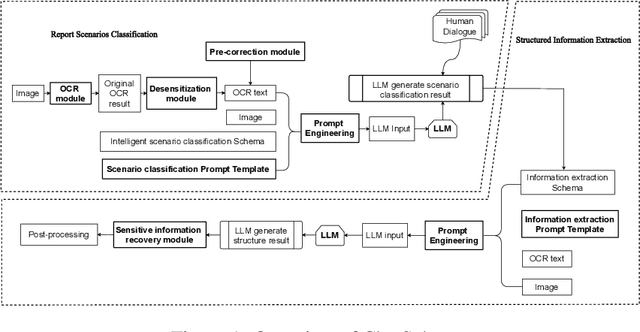
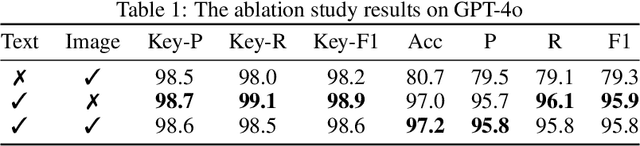
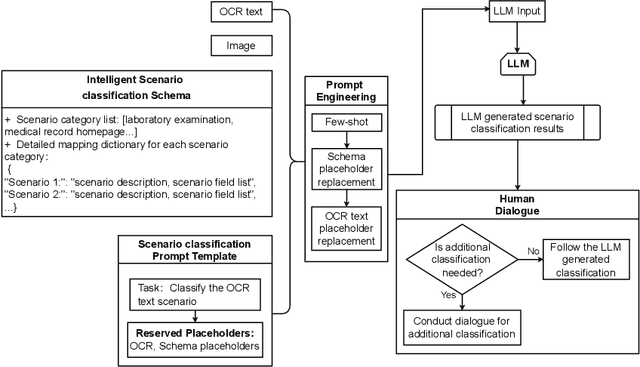
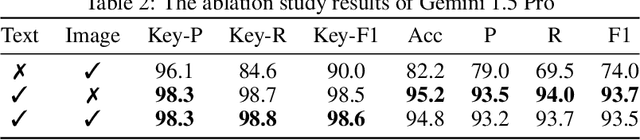
Objective: This study introduces ChatSchema, an effective method for extracting and structuring information from unstructured data in medical paper reports using a combination of Large Multimodal Models (LMMs) and Optical Character Recognition (OCR) based on the schema. By integrating predefined schema, we intend to enable LMMs to directly extract and standardize information according to the schema specifications, facilitating further data entry. Method: Our approach involves a two-stage process, including classification and extraction for categorizing report scenarios and structuring information. We established and annotated a dataset to verify the effectiveness of ChatSchema, and evaluated key extraction using precision, recall, F1-score, and accuracy metrics. Based on key extraction, we further assessed value extraction. We conducted ablation studies on two LMMs to illustrate the improvement of structured information extraction with different input modals and methods. Result: We analyzed 100 medical reports from Peking University First Hospital and established a ground truth dataset with 2,945 key-value pairs. We evaluated ChatSchema using GPT-4o and Gemini 1.5 Pro and found a higher overall performance of GPT-4o. The results are as follows: For the result of key extraction, key-precision was 98.6%, key-recall was 98.5%, key-F1-score was 98.6%. For the result of value extraction based on correct key extraction, the overall accuracy was 97.2%, precision was 95.8%, recall was 95.8%, and F1-score was 95.8%. An ablation study demonstrated that ChatSchema achieved significantly higher overall accuracy and overall F1-score of key-value extraction, compared to the Baseline, with increases of 26.9% overall accuracy and 27.4% overall F1-score, respectively.