 Add to Chrome
 Add to Firefox
 Add to Edge
Agentic Reinforcement Learning with Self-Distilled Reward Shaping
Aug 04, 2026
Agentic reinforcement learning enables LLM agents to learn through interaction, but sparse trajectory-level rewards reveal success without identifying which intermediate decisions deserve credit. Training-only privileged skills can provide denser supervision by allowing the same frozen policy snapshot to rescore fixed tokens from skill-free trajectories while conditioned on task-matched procedural skills. Existing methods, however, do not jointly calibrate teacher scores across interaction steps, relate teacher confidence to realized returns, and integrate the resulting signal into native reward-to-advantage construction. We introduce Agentic Reinforcement Learning with Self-Distilled Reward Shaping (ADRS), a framework for constructing return-associated token-level credit for multi-turn language agents. ADRS centers and normalizes privileged token scores within each step, modulates them with a return-associated Teacher Value Advantage (TVA) gate based on within-group confidence--return association, and incorporates the gated token signal into native RL credit construction. Together, these components determine what the teacher prefers, when that preference is return-relevant, and how it enters the native reinforcement-learning credit path, while keeping rollouts and inference skill-free. Finally, experiments across three interactive benchmarks show that ADRS consistently improves performance on long-horizon tasks, with gains persisting across RL backbones, reduced-data settings, unseen tasks, and extended training. For anonymous review, our code is available at the following the link: https://github.com/gitrxh/ADRS-arxiv

From Correctness to Preference: A Framework for Personalized Agentic Reinforcement Learning
May 22, 2026Agentic reinforcement learning (Agentic RL) has achieved strong progress in tasks with clear success signals. However, many real-world agent applications require user-conditioned behavior: the same query may call for different planning strategies and tool-use decisions across users. This setting raises key challenges: generic rewards cannot capture heterogeneous user preferences, observed behaviors are entangled with conformity effects, and flat memories cannot support personalized skill retrieval. To this end, we propose a unified personalized Agentic RL framework that embeds personalization into training-time optimization. At its core is \emph{Personalized Anchor Reward-Decoupled Policy Optimization} (\textbf{PARPO}), which decouples generic task-quality rewards from personalized preference rewards and uses user-specific anchors to stabilize learning under heterogeneous reward scales. We further introduce a two-stage preference-disentangled reward model and \emph{Preference-Aligned Skill Evolution Graph Memory} (\textbf{PSGM}) for personalized supervision and preference-aligned skill retrieval. Together, they form a closed loop of preference identification, policy optimization, and structured skill accumulation. Experiments on ETAPP, ETAPP-Hard, and SJAgent show that our framework consistently outperforms strong memory and RL baselines. Code and data are included in the supplementary materials.
What Makes Entities Similar? A Similarity Flooding Perspective for Multi-sourced Knowledge Graph Embeddings
Jun 05, 2023Joint representation learning over multi-sourced knowledge graphs (KGs) yields transferable and expressive embeddings that improve downstream tasks. Entity alignment (EA) is a critical step in this process. Despite recent considerable research progress in embedding-based EA, how it works remains to be explored. In this paper, we provide a similarity flooding perspective to explain existing translation-based and aggregation-based EA models. We prove that the embedding learning process of these models actually seeks a fixpoint of pairwise similarities between entities. We also provide experimental evidence to support our theoretical analysis. We propose two simple but effective methods inspired by the fixpoint computation in similarity flooding, and demonstrate their effectiveness on benchmark datasets. Our work bridges the gap between recent embedding-based models and the conventional similarity flooding algorithm. It would improve our understanding of and increase our faith in embedding-based EA.
Joint Pre-training and Local Re-training: Transferable Representation Learning on Multi-source Knowledge Graphs
Jun 05, 2023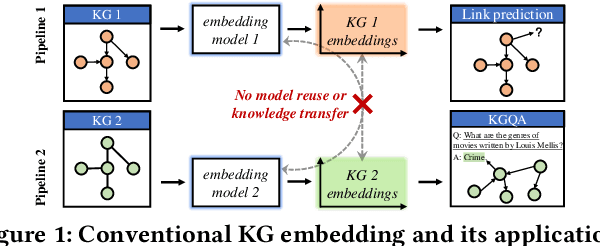


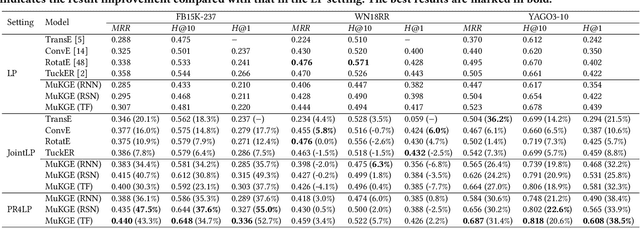
In this paper, we present the ``joint pre-training and local re-training'' framework for learning and applying multi-source knowledge graph (KG) embeddings. We are motivated by the fact that different KGs contain complementary information to improve KG embeddings and downstream tasks. We pre-train a large teacher KG embedding model over linked multi-source KGs and distill knowledge to train a student model for a task-specific KG. To enable knowledge transfer across different KGs, we use entity alignment to build a linked subgraph for connecting the pre-trained KGs and the target KG. The linked subgraph is re-trained for three-level knowledge distillation from the teacher to the student, i.e., feature knowledge distillation, network knowledge distillation, and prediction knowledge distillation, to generate more expressive embeddings. The teacher model can be reused for different target KGs and tasks without having to train from scratch. We conduct extensive experiments to demonstrate the effectiveness and efficiency of our framework.
Deep Active Alignment of Knowledge Graph Entities and Schemata
Apr 19, 2023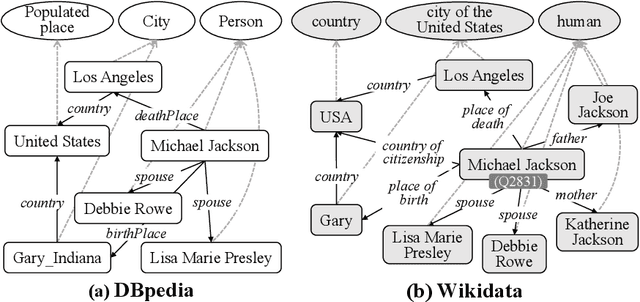
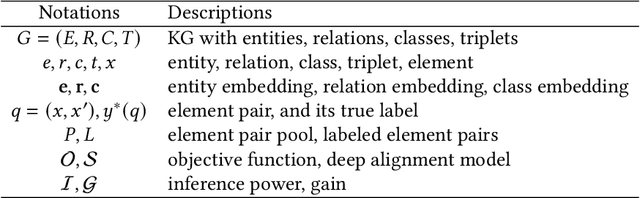
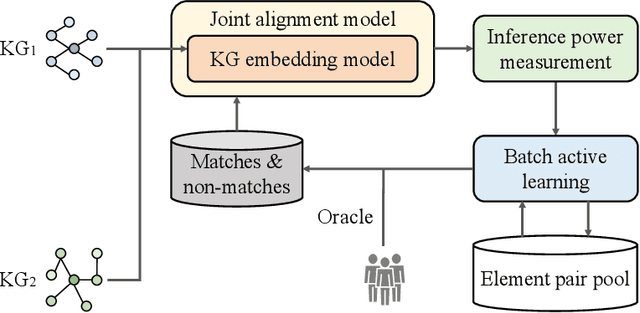
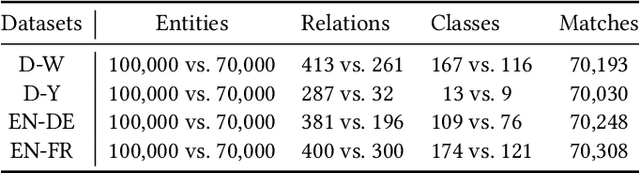
Knowledge graphs (KGs) store rich facts about the real world. In this paper, we study KG alignment, which aims to find alignment between not only entities but also relations and classes in different KGs. Alignment at the entity level can cross-fertilize alignment at the schema level. We propose a new KG alignment approach, called DAAKG, based on deep learning and active learning. With deep learning, it learns the embeddings of entities, relations and classes, and jointly aligns them in a semi-supervised manner. With active learning, it estimates how likely an entity, relation or class pair can be inferred, and selects the best batch for human labeling. We design two approximation algorithms for efficient solution to batch selection. Our experiments on benchmark datasets show the superior accuracy and generalization of DAAKG and validate the effectiveness of all its modules.