 Add to Chrome
 Add to Firefox
 Add to Edge
Pivot-Centric Trajectory Prediction: Bridging Long Horizons via Dynamical Guidance
Aug 04, 2026
Forecasting precise future motion of surrounding agents is essential for reliable autonomous vehicles. However, as the demand for longer prediction horizons increases, existing endpoint-completion or iterative-refine methods increasingly struggle with weak guidance and compounding errors. To tackle the long-horizon prediction challenge, we propose Pivot-Centric Trajectory Prediction (PCTP). By introducing ``pivots'' and focusing on predicting pivot points along extended trajectories, we divide the long-term prediction task into short-term sub-tasks at various scales. Specifically, PCTP decouples the long-term trajectory predicting process into two processes: pivot prediction and pivot-based trajectory refinement. The pivot prediction process aims to utilize global map context and agent-to-agent interactions to identify these ``pivot points'', while the pivot-based trajectory refinement process focuses on local map details and refines the short-term trajectory based on predicted ``pivot points''. Compared with existing methods, PCTP provides more intermediate guidance while reducing compounding errors. Moreover, PCTP is a flexible approach that can be integrated into most state-of-the-art trajectory prediction models. Experimental results show that PCTP improves the prediction accuracy of leading models on both Argoverse I and Argoverse II datasets with minimal impact on model size. Specifically, PCTP combined with QCNet outperforms all published ensemble-free methods on the Argoverse II leaderboard at submission.

TiWeaver: Unified Temporal Dynamics Modeling via Contextual Patching
Jun 02, 2026Multivariate time series forecasting plays a critical role in real-world applications, including weather prediction, stock analysis, and health monitoring. Due to the diversity of data sources, time series exhibit diverse temporal dynamics, often accompanied by various irregularities such as missing values and non-uniform sampling frequencies. Such irregularities lead to complex and asynchronous temporal dependencies across channels. Thus, a single model with a fixed patching scheme often fails to adapt well to diverse multivariate time series, hindering accurate forecasting. In this paper, we propose TiWeaver, a unified framework designed to handle temporal dynamics and fine-grained inter-channel dependencies adaptively. Specifically, we introduce a Graph-Guided Adaptive Tokenizer (G$^2$AT) that divides time series into high contextually coherent patches by jointly considering temporal density and representation consistency. In addition, we propose a Fine-grained Asynchronous Dependency Extractor (FADE), which is designed to model fine-grained asynchronous inter-channel dependencies while incorporating long-term historical dependencies. We evaluate TiWeaver on 12 real-world time series datasets, where it achieves state-of-the-art performance, outperforming existing methods up to 25%. These results demonstrate its robustness and effectiveness across diverse domains and data characteristics.
Air Quality Prediction with Physics-Informed Dual Neural ODEs in Open Systems
Oct 25, 2024

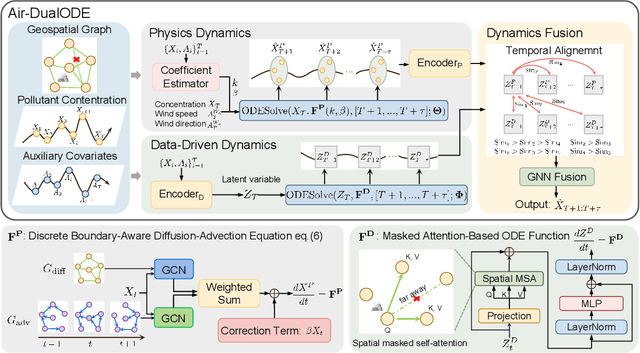

Air pollution significantly threatens human health and ecosystems, necessitating effective air quality prediction to inform public policy. Traditional approaches are generally categorized into physics-based and data-driven models. Physics-based models usually struggle with high computational demands and closed-system assumptions, while data-driven models may overlook essential physical dynamics, confusing the capturing of spatiotemporal correlations. Although some physics-informed approaches combine the strengths of both models, they often face a mismatch between explicit physical equations and implicit learned representations. To address these challenges, we propose Air-DualODE, a novel physics-informed approach that integrates dual branches of Neural ODEs for air quality prediction. The first branch applies open-system physical equations to capture spatiotemporal dependencies for learning physics dynamics, while the second branch identifies the dependencies not addressed by the first in a fully data-driven way. These dual representations are temporally aligned and fused to enhance prediction accuracy. Our experimental results demonstrate that Air-DualODE achieves state-of-the-art performance in predicting pollutant concentrations across various spatial scales, thereby offering a promising solution for real-world air quality challenges.
Single-shot structured illumination microscopy
Jul 13, 2021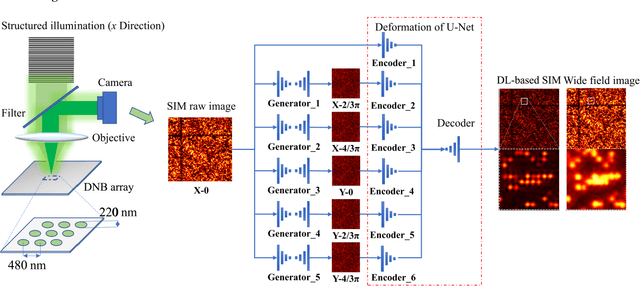
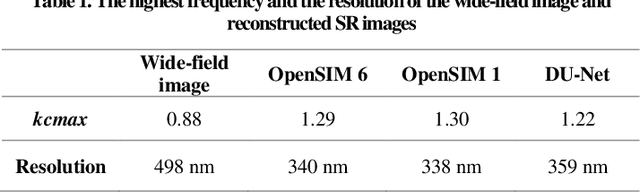

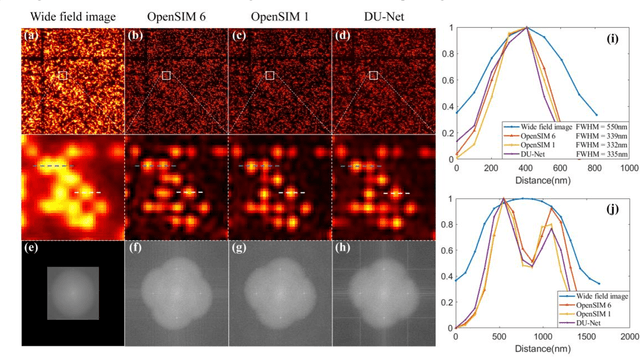
Structured illumination microscopy (SIM) can double the resolution beyond the light diffraction limit, but it comes at the cost of multiple camera exposures and the heavy computation burden of multiple Fourier transforms. In this paper, we report a novel technique termed single-shot SIM, to overcome these limitations. A multi-task joint deep-learning strategy is proposed. Generative adversative networks (GAN) are employed to generate five structured illumination images based on the single-shot structured illumination image. U-Net is employed to reconstruct the super-resolution image from these six generated images without time-consuming Fourier transform. By imaging a self-assembling DNB array, we experimentally verified that this technique could perform single-shot super-resolution reconstruction comparing favorably with conventional SIM. This single-shot SIM technique may ultimately overcome the limitations of multiple exposures and Fourier transforms and is potentially applied for high-throughput gene sequencing.