 Add to Chrome
 Add to Firefox
 Add to Edge
Hystar: Hypernetwork-driven Style-adaptive Retrieval via Dynamic SVD Modulation
May 11, 2026
Query-based image retrieval (QBIR) requires retrieving relevant images given diverse and often stylistically heterogeneous queries, such as sketches, artworks, or low-resolution previews. While large-scale vision--language representation models (VLRMs) like CLIP offer strong zero-shot retrieval performance, they struggle with distribution shifts caused by unseen query styles. In this paper, we propose the Hypernetwork-driven Style-adaptive Retrieval (Hystar), a lightweight framework that dynamically adapts model weights to each query's style. Hystar employs a hypernetwork to generate singular-value perturbations ($ΔS$) for attention layers, enabling flexible per-input adaptation, while static singular-value offsets on MLP layers ensure cross-style stability. To better handle semantic confusions across styles, we design StyleNCE as part of Hystar, an optimal-transport-weighted contrastive loss that emphasizes hard cross-style negatives. Extensive experiments on multi-style retrieval and cross-style classification benchmarks demonstrate that Hystar consistently outperforms strong baselines, achieving state-of-the-art performance while being parameter-efficient and stable across styles.

Revealing and Enhancing Core Visual Regions: Harnessing Internal Attention Dynamics for Hallucination Mitigation in LVLMs
Feb 17, 2026LVLMs have achieved strong multimodal reasoning capabilities but remain prone to hallucinations, producing outputs inconsistent with visual inputs or user instructions. Existing training-free methods, including contrastive decoding and auxiliary expert models, which incur several times more computational overhead and may introduce potential interference, as well as static internal signal enhancement, are often vulnerable to the attention sink phenomenon. We find that internal Positive Attention Dynamics (PAD) in LVLMs naturally reveal semantically core visual regions under the distortions of attention sinks. Based on this, we propose Positive Attention Dynamics Enhancement (PADE), a training-free attention intervention that constructs a PAD map to identify semantically core visual regions, applies per-head Median Absolute Deviation Scaling to adaptively control the intervention strength, and leverages System-Token Compensation to maintain attention to complex user instructions and support long-term output consistency. Experiments on multiple LVLMs and benchmarks show that PADE improves visual grounding and reduces hallucinations, validating the effectiveness of leveraging internal attention dynamics for reliable multimodal reasoning.
Towards Interpretable Hallucination Analysis and Mitigation in LVLMs via Contrastive Neuron Steering
Jan 31, 2026LVLMs achieve remarkable multimodal understanding and generation but remain susceptible to hallucinations. Existing mitigation methods predominantly focus on output-level adjustments, leaving the internal mechanisms that give rise to these hallucinations largely unexplored. To gain a deeper understanding, we adopt a representation-level perspective by introducing sparse autoencoders (SAEs) to decompose dense visual embeddings into sparse, interpretable neurons. Through neuron-level analysis, we identify distinct neuron types, including always-on neurons and image-specific neurons. Our findings reveal that hallucinations often result from disruptions or spurious activations of image-specific neurons, while always-on neurons remain largely stable. Moreover, selectively enhancing or suppressing image-specific neurons enables controllable intervention in LVLM outputs, improving visual grounding and reducing hallucinations. Building on these insights, we propose Contrastive Neuron Steering (CNS), which identifies image-specific neurons via contrastive analysis between clean and noisy inputs. CNS selectively amplifies informative neurons while suppressing perturbation-induced activations, producing more robust and semantically grounded visual representations. This not only enhances visual understanding but also effectively mitigates hallucinations. By operating at the prefilling stage, CNS is fully compatible with existing decoding-stage methods. Extensive experiments on both hallucination-focused and general multimodal benchmarks demonstrate that CNS consistently reduces hallucinations while preserving overall multimodal understanding.
Beyond Global Alignment: Fine-Grained Motion-Language Retrieval via Pyramidal Shapley-Taylor Learning
Jan 29, 2026As a foundational task in human-centric cross-modal intelligence, motion-language retrieval aims to bridge the semantic gap between natural language and human motion, enabling intuitive motion analysis, yet existing approaches predominantly focus on aligning entire motion sequences with global textual representations. This global-centric paradigm overlooks fine-grained interactions between local motion segments and individual body joints and text tokens, inevitably leading to suboptimal retrieval performance. To address this limitation, we draw inspiration from the pyramidal process of human motion perception (from joint dynamics to segment coherence, and finally to holistic comprehension) and propose a novel Pyramidal Shapley-Taylor (PST) learning framework for fine-grained motion-language retrieval. Specifically, the framework decomposes human motion into temporal segments and spatial body joints, and learns cross-modal correspondences through progressive joint-wise and segment-wise alignment in a pyramidal fashion, effectively capturing both local semantic details and hierarchical structural relationships. Extensive experiments on multiple public benchmark datasets demonstrate that our approach significantly outperforms state-of-the-art methods, achieving precise alignment between motion segments and body joints and their corresponding text tokens. The code of this work will be released upon acceptance.
A Turn Toward Better Alignment: Few-Shot Generative Adaptation with Equivariant Feature Rotation
Dec 24, 2025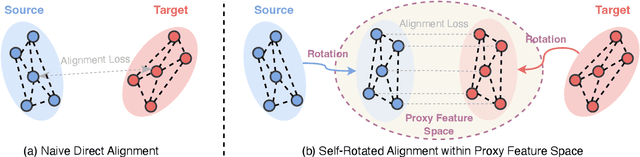
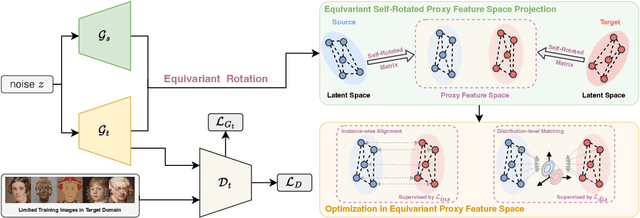
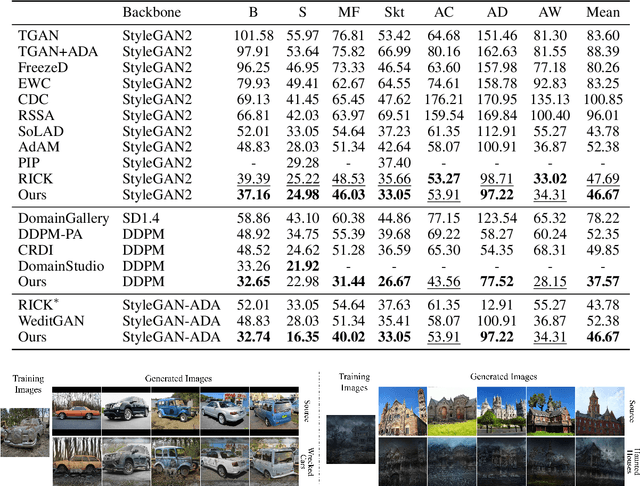
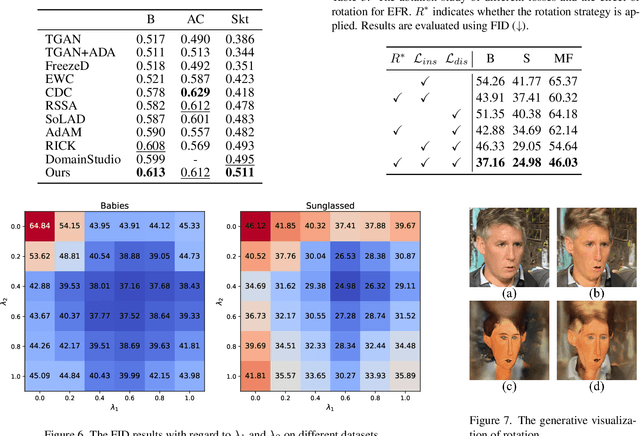
Few-shot image generation aims to effectively adapt a source generative model to a target domain using very few training images. Most existing approaches introduce consistency constraints-typically through instance-level or distribution-level loss functions-to directly align the distribution patterns of source and target domains within their respective latent spaces. However, these strategies often fall short: overly strict constraints can amplify the negative effects of the domain gap, leading to distorted or uninformative content, while overly relaxed constraints may fail to leverage the source domain effectively. This limitation primarily stems from the inherent discrepancy in the underlying distribution structures of the source and target domains. The scarcity of target samples further compounds this issue by hindering accurate estimation of the target domain's distribution. To overcome these limitations, we propose Equivariant Feature Rotation (EFR), a novel adaptation strategy that aligns source and target domains at two complementary levels within a self-rotated proxy feature space. Specifically, we perform adaptive rotations within a parameterized Lie Group to transform both source and target features into an equivariant proxy space, where alignment is conducted. These learnable rotation matrices serve to bridge the domain gap by preserving intra-domain structural information without distortion, while the alignment optimization facilitates effective knowledge transfer from the source to the target domain. Comprehensive experiments on a variety of commonly used datasets demonstrate that our method significantly enhances the generative performance within the targeted domain.
Towards Arbitrary Motion Completing via Hierarchical Continuous Representation
Dec 24, 2025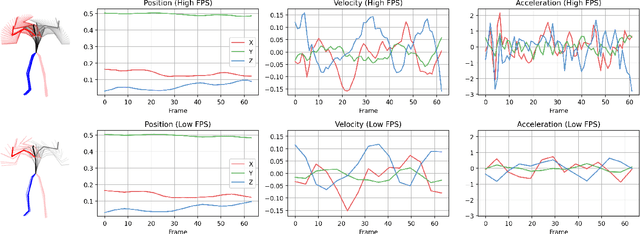
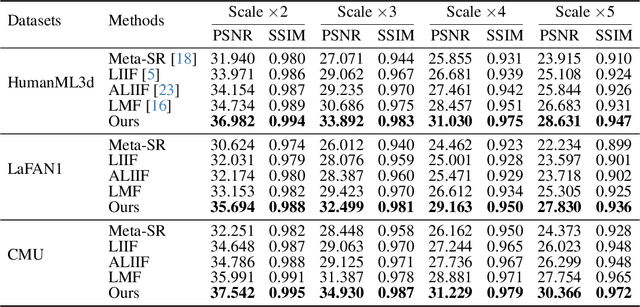
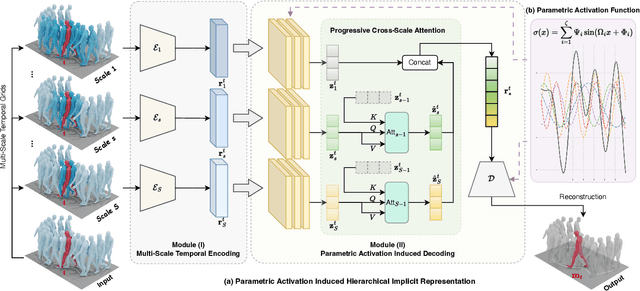
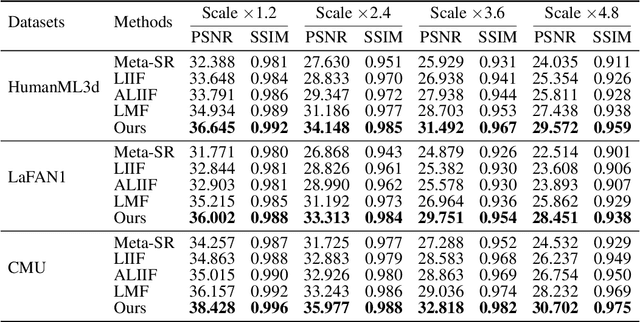
Physical motions are inherently continuous, and higher camera frame rates typically contribute to improved smoothness and temporal coherence. For the first time, we explore continuous representations of human motion sequences, featuring the ability to interpolate, inbetween, and even extrapolate any input motion sequences at arbitrary frame rates. To achieve this, we propose a novel parametric activation-induced hierarchical implicit representation framework, referred to as NAME, based on Implicit Neural Representations (INRs). Our method introduces a hierarchical temporal encoding mechanism that extracts features from motion sequences at multiple temporal scales, enabling effective capture of intricate temporal patterns. Additionally, we integrate a custom parametric activation function, powered by Fourier transformations, into the MLP-based decoder to enhance the expressiveness of the continuous representation. This parametric formulation significantly augments the model's ability to represent complex motion behaviors with high accuracy. Extensive evaluations across several benchmark datasets demonstrate the effectiveness and robustness of our proposed approach.
Revealing Perception and Generation Dynamics in LVLMs: Mitigating Hallucinations via Validated Dominance Correction
Dec 21, 2025Large Vision-Language Models (LVLMs) have shown remarkable capabilities, yet hallucinations remain a persistent challenge. This work presents a systematic analysis of the internal evolution of visual perception and token generation in LVLMs, revealing two key patterns. First, perception follows a three-stage GATE process: early layers perform a Global scan, intermediate layers Approach and Tighten on core content, and later layers Explore supplementary regions. Second, generation exhibits an SAD (Subdominant Accumulation to Dominant) pattern, where hallucinated tokens arise from the repeated accumulation of subdominant tokens lacking support from attention (visual perception) or feed-forward network (internal knowledge). Guided by these findings, we devise the VDC (Validated Dominance Correction) strategy, which detects unsupported tokens and replaces them with validated dominant ones to improve output reliability. Extensive experiments across multiple models and benchmarks confirm that VDC substantially mitigates hallucinations.
Tempo as the Stable Cue: Hierarchical Mixture of Tempo and Beat Experts for Music to 3D Dance Generation
Dec 21, 2025Music to 3D dance generation aims to synthesize realistic and rhythmically synchronized human dance from music. While existing methods often rely on additional genre labels to further improve dance generation, such labels are typically noisy, coarse, unavailable, or insufficient to capture the diversity of real-world music, which can result in rhythm misalignment or stylistic drift. In contrast, we observe that tempo, a core property reflecting musical rhythm and pace, remains relatively consistent across datasets and genres, typically ranging from 60 to 200 BPM. Based on this finding, we propose TempoMoE, a hierarchical tempo-aware Mixture-of-Experts module that enhances the diffusion model and its rhythm perception. TempoMoE organizes motion experts into tempo-structured groups for different tempo ranges, with multi-scale beat experts capturing fine- and long-range rhythmic dynamics. A Hierarchical Rhythm-Adaptive Routing dynamically selects and fuses experts from music features, enabling flexible, rhythm-aligned generation without manual genre labels. Extensive experiments demonstrate that TempoMoE achieves state-of-the-art results in dance quality and rhythm alignment.
AStF: Motion Style Transfer via Adaptive Statistics Fusor
Nov 06, 2025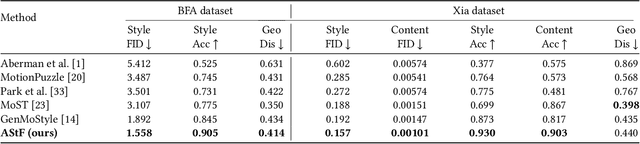
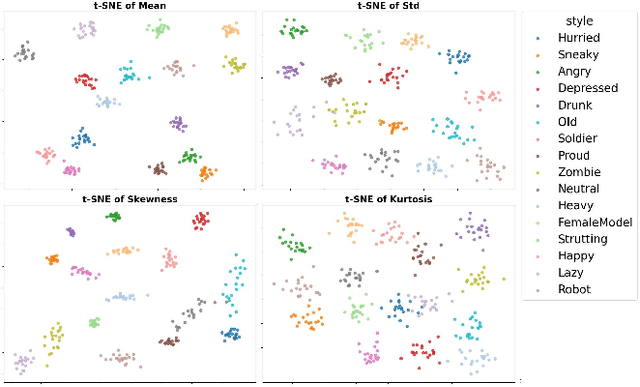
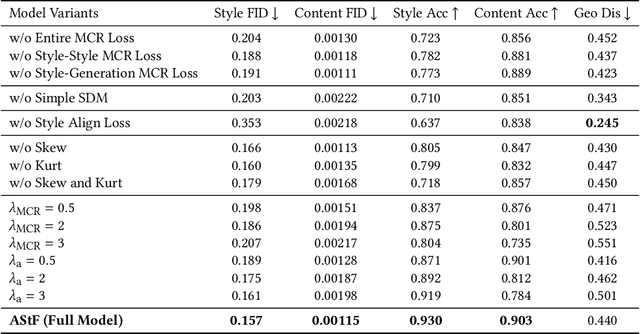
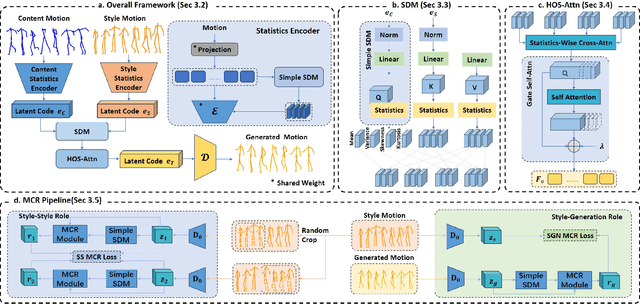
Human motion style transfer allows characters to appear less rigidity and more realism with specific style. Traditional arbitrary image style transfer typically process mean and variance which is proved effective. Meanwhile, similar methods have been adapted for motion style transfer. However, due to the fundamental differences between images and motion, relying on mean and variance is insufficient to fully capture the complex dynamic patterns and spatiotemporal coherence properties of motion data. Building upon this, our key insight is to bring two more coefficient, skewness and kurtosis, into the analysis of motion style. Specifically, we propose a novel Adaptive Statistics Fusor (AStF) which consists of Style Disentanglement Module (SDM) and High-Order Multi-Statistics Attention (HOS-Attn). We trained our AStF in conjunction with a Motion Consistency Regularization (MCR) discriminator. Experimental results show that, by providing a more comprehensive model of the spatiotemporal statistical patterns inherent in dynamic styles, our proposed AStF shows proficiency superiority in motion style transfers over state-of-the-arts. Our code and model are available at https://github.com/CHMimilanlan/AStF.
A Tale of Two Experts: Cooperative Learning for Source-Free Unsupervised Domain Adaptation
Sep 26, 2025Source-Free Unsupervised Domain Adaptation (SFUDA) addresses the realistic challenge of adapting a source-trained model to a target domain without access to the source data, driven by concerns over privacy and cost. Existing SFUDA methods either exploit only the source model's predictions or fine-tune large multimodal models, yet both neglect complementary insights and the latent structure of target data. In this paper, we propose the Experts Cooperative Learning (EXCL). EXCL contains the Dual Experts framework and Retrieval-Augmentation-Interaction optimization pipeline. The Dual Experts framework places a frozen source-domain model (augmented with Conv-Adapter) and a pretrained vision-language model (with a trainable text prompt) on equal footing to mine consensus knowledge from unlabeled target samples. To effectively train these plug-in modules under purely unsupervised conditions, we introduce Retrieval-Augmented-Interaction(RAIN), a three-stage pipeline that (1) collaboratively retrieves pseudo-source and complex target samples, (2) separately fine-tunes each expert on its respective sample set, and (3) enforces learning object consistency via a shared learning result. Extensive experiments on four benchmark datasets demonstrate that our approach matches state-of-the-art performance.