 Add to Chrome
 Add to Firefox
 Add to Edge
KuaiLive-M3: A Multi-Modal, Multi-Domain, and Multi-Feedback Dataset for Live Streaming Recommendation
Jul 26, 2026
Existing public live streaming datasets suffer from three major limitations: they provide limited access to temporally evolving multimodal live content, overlook users' cross-domain interactions between short videos and live streams, and contain only implicit behavioral signals without explicit feedback that captures users' perceived content quality and satisfaction. These limitations prevent existing benchmarks from faithfully reflecting real-world live streaming scenarios and hinder comprehensive research on live streaming recommendation. To address these limitations, we introduce KuaiLive-M3, a multi-modal, multi-domain, and multi-feedback dataset for live streaming recommendation, collected from Kuaishou, a leading live streaming and short video platform in China. KuaiLive-M3 covers 21,938 users and contains 35 million live streaming interactions and 111 million short video interactions, with fine-grained timestamps and diverse user behaviors. It further provides approximately 88 million timestamped segment-level multi-modal embeddings that capture the temporal evolution of live streaming content, as well as 25,403 questionnaire-based feedback records that bridge implicit user behaviors and explicit user preferences. Based on these unique signals, we establish benchmarks for cross-domain recommendation, live stream highlight prediction, and questionnaire-enhanced recommendation. Extensive experiments with representative baselines demonstrate that KuaiLive-M3 provides a challenging and realistic benchmark for future live streaming recommendation research. The results further highlight the importance of modeling temporally evolving content, transferring user preferences across domains, and bridging the gap between implicit behaviors and explicit user feedback. The dataset and benchmark code are publicly available at https://imgkkk574.github.io/KuaiLive-M3/.

Local-Global History-aware Contrastive Learning for Temporal Knowledge Graph Reasoning
Dec 04, 2023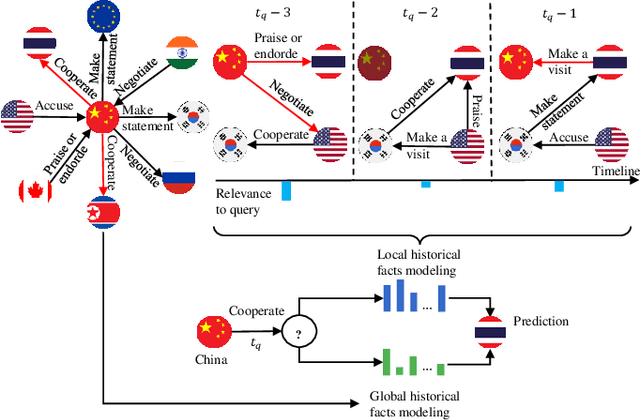
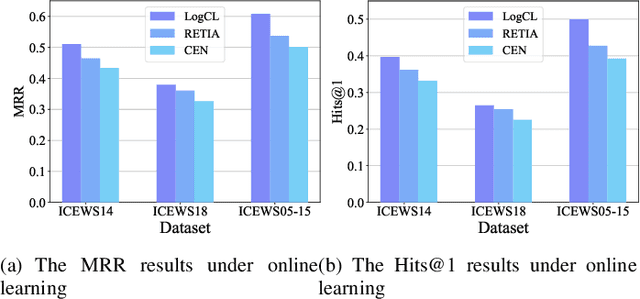
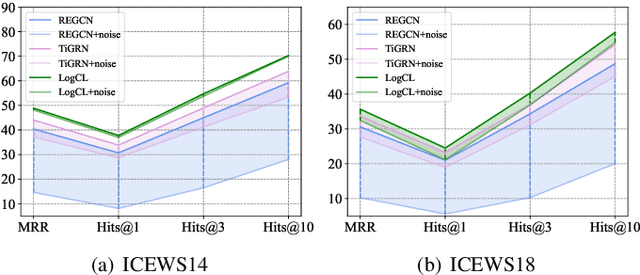
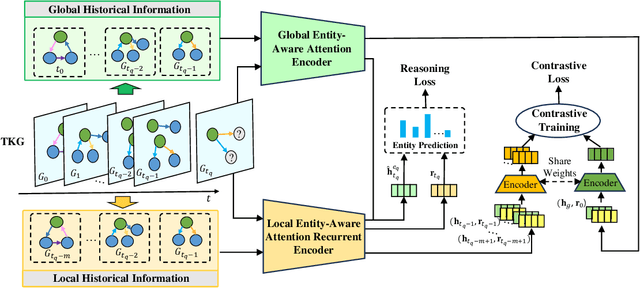
Temporal knowledge graphs (TKGs) have been identified as a promising approach to represent the dynamics of facts along the timeline. The extrapolation of TKG is to predict unknowable facts happening in the future, holding significant practical value across diverse fields. Most extrapolation studies in TKGs focus on modeling global historical fact repeating and cyclic patterns, as well as local historical adjacent fact evolution patterns, showing promising performance in predicting future unknown facts. Yet, existing methods still face two major challenges: (1) They usually neglect the importance of historical information in KG snapshots related to the queries when encoding the local and global historical information; (2) They exhibit weak anti-noise capabilities, which hinders their performance when the inputs are contaminated with noise.To this end, we propose a novel \blue{Lo}cal-\blue{g}lobal history-aware \blue{C}ontrastive \blue{L}earning model (\blue{LogCL}) for TKG reasoning, which adopts contrastive learning to better guide the fusion of local and global historical information and enhance the ability to resist interference. Specifically, for the first challenge, LogCL proposes an entity-aware attention mechanism applied to the local and global historical facts encoder, which captures the key historical information related to queries. For the latter issue, LogCL designs four historical query contrast patterns, effectively improving the robustness of the model. The experimental results on four benchmark datasets demonstrate that LogCL delivers better and more robust performance than the state-of-the-art baselines.