 Add to Chrome
 Add to Firefox
 Add to Edge
DiT-IC: Aligned Diffusion Transformer for Efficient Image Compression
Mar 13, 2026
Diffusion-based image compression has recently shown outstanding perceptual fidelity, yet its practicality is hindered by prohibitive sampling overhead and high memory usage. Most existing diffusion codecs employ U-Net architectures, where hierarchical downsampling forces diffusion to operate in shallow latent spaces (typically with only 8x spatial downscaling), resulting in excessive computation. In contrast, conventional VAE-based codecs work in much deeper latent domains (16x - 64x downscaled), motivating a key question: Can diffusion operate effectively in such compact latent spaces without compromising reconstruction quality? To address this, we introduce DiT-IC, an Aligned Diffusion Transformer for Image Compression, which replaces the U-Net with a Diffusion Transformer capable of performing diffusion in latent space entirely at 32x downscaled resolution. DiT-IC adapts a pretrained text-to-image multi-step DiT into a single-step reconstruction model through three key alignment mechanisms: (1) a variance-guided reconstruction flow that adapts denoising strength to latent uncertainty for efficient reconstruction; (2) a self-distillation alignment that enforces consistency with encoder-defined latent geometry to enable one-step diffusion; and (3) a latent-conditioned guidance that replaces text prompts with semantically aligned latent conditions, enabling text-free inference. With these designs, DiT-IC achieves state-of-the-art perceptual quality while offering up to 30x faster decoding and drastically lower memory usage than existing diffusion-based codecs. Remarkably, it can reconstruct 2048x2048 images on a 16 GB laptop GPU.

Ultra Lowrate Image Compression with Semantic Residual Coding and Compression-aware Diffusion
May 13, 2025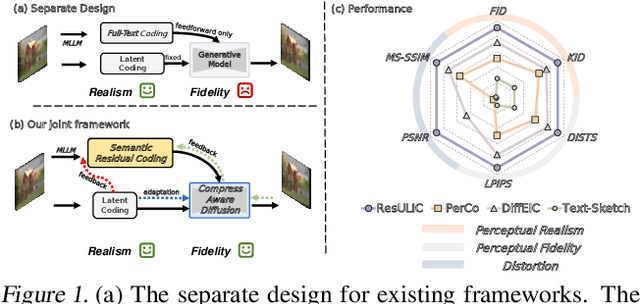
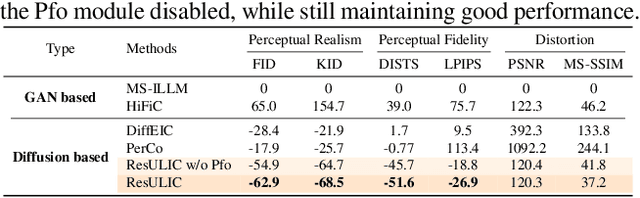
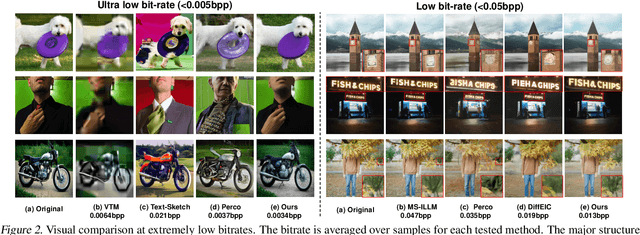
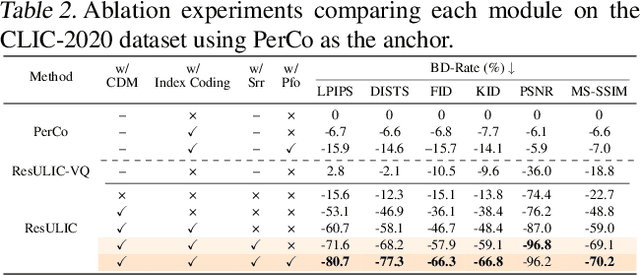
Existing multimodal large model-based image compression frameworks often rely on a fragmented integration of semantic retrieval, latent compression, and generative models, resulting in suboptimal performance in both reconstruction fidelity and coding efficiency. To address these challenges, we propose a residual-guided ultra lowrate image compression named ResULIC, which incorporates residual signals into both semantic retrieval and the diffusion-based generation process. Specifically, we introduce Semantic Residual Coding (SRC) to capture the semantic disparity between the original image and its compressed latent representation. A perceptual fidelity optimizer is further applied for superior reconstruction quality. Additionally, we present the Compression-aware Diffusion Model (CDM), which establishes an optimal alignment between bitrates and diffusion time steps, improving compression-reconstruction synergy. Extensive experiments demonstrate the effectiveness of ResULIC, achieving superior objective and subjective performance compared to state-of-the-art diffusion-based methods with - 80.7%, -66.3% BD-rate saving in terms of LPIPS and FID. Project page is available at https: //njuvision.github.io/ResULIC/.