 Add to Chrome
 Add to Firefox
 Add to Edge
SPECTRA: Band-Routed Embedding and Stage-Wise LoRA for Cross-Sensor Fine-Tuning of Geospatial Foundation Models
Aug 03, 2026
Geospatial foundation models (GeoFMs), pretrained on large-scale geospatial data such as Earth observation (EO), climate, and weather data, have shown promising performance when fine-tuned on diverse downstream tasks. However, there are two challenges of adapting EO-pretrained GeoFMs to practical downstream datasets. The first challenge is how to handle spectral mismatch: pretrained patch embeddings expect a fixed set of input bands, whereas downstream sensors may provide different channels. The second challenge is how to reduce fine-tuning cost and make it efficient. While existing work has made efforts on these challenges individually, jointly improving fine-tuning performance under spectral mismatch while reducing adaptation cost remains underexplored. We propose SPECTRA, a parameter-efficient fine-tuning framework that addresses both spectral mismatch and adaptation cost. To handle spectral mismatch, SPECTRA introduces Band-Routed Embedding (BRE), which maps all available downstream bands into the band space expected by the pretrained GeoFM. By using BRE, all available bands in the downstream dataset are utilized to improve the selected-band input without changing the pretrained patch embedding interface. To reduce adaptation cost, SPECTRA further introduces a Stage-wise Transferability-aware LoRA (ST-LoRA) fine-tuning. ST-LoRA estimates stage-wise transferability before fine-tuning and assigns stage-specific LoRA ranks, concentrating trainable parameters on the stages with high transferability for the target task. Across three EO-pretrained GeoFMs and four downstream segmentation datasets, experiments show that BRE improves performance by utilizing all spectral bands, while ST-LoRA reduces trainable parameters compared with full fine-tuning and standard LoRA. Code is available at https://github.com/big-data-lab-umbc/SPECTRA.

Spatiotemporal Proximal Causal Inference under Hidden Confounding and Interference
Aug 02, 2026Estimating causal effects from real-world spatiotemporal data is challenging due to hidden confounders and interference. Standard causal identification methods assume conditional exchangeability given observed covariates, which fails whenever hidden confounders affect both treatment and outcomes - a common setting in domains such as climate, environmental policy, epidemiology, and regional economics. In this paper, we propose a novel spatiotemporal proximal causal inference framework that extends proximal identification theory to spatiotemporal settings. The proposed method jointly captures local and neighborhood-level confounding information by introducing treatment- and outcome-inducing proxies, and we derive a spatiotemporal outcome confounding bridge function that identifies the potential outcome without requiring direct recovery of the hidden confounder. We establish the identifiability of this bridge function under proxy exclusion restrictions and a spatiotemporal completeness condition, and show that the resulting estimator recovers the outcome through a proximal generalization of the g-computation formula. To operationalize this identification result, we propose a neural architecture that learns proxies via transformer-based spatiotemporal encoders - coupled with a conditional mutual information critic to enforce exclusion restrictions and a moment-matching network to guarantee that the learned bridge function satisfies the underlying identifying equation. We further introduce a stabilized weighting scheme to address treatment support imbalance. Experiments on synthetic datasets demonstrate that our approach achieves comparable performance to baseline causal inference methods, while providing, to our knowledge, the first theoretically grounded outcomes for the hidden confounding in the presence of spatiotemporal interference through a proximal causal inference framework.
CASC: Causal Adversarial Subspace Clustering for Multivariate Spatiotemporal Data
Jul 23, 2026Deep subspace clustering plays a critical role in applications involving multivariate spatiotemporal data, such as sea ice monitoring, disease spread analysis, and tracking neuro-degeneration over time. Despite recent advances, existing methods primarily rely on geometric self-expressiveness, assume static subspace structures, and often fail to capture causal dependencies, local spatial interactions, and long-range temporal dynamics inherent in complex spatiotemporal systems. To address these limitations, we propose a novel Causal Adversarial Subspace Clustering (CASC) framework for discovering evolving latent regimes in high-dimensional spatiotemporal data. CASC integrates a U-Net-inspired deep adversarial clustering architecture with stacked FAConvLSTM layers to preserve spatial and temporal structure while learning robust latent representations. A graph attention transformer-based self-expressive network is introduced to jointly model local spatial relationships, global dependencies, and long-range temporal interactions. Furthermore, we propose two new learning objectives: (1) a Causal Subspace Preservation Loss that aligns self-expression coefficients with latent causal relationships, encouraging clusters to reflect underlying causal processes rather than simple feature similarity, and (2) a Dynamic Temporal Subspace Evolution Loss that captures evolving subspace structures and temporal regime transitions in nonstationary environments. Together, these components transform deep subspace clustering from a correlation-driven paradigm into a causal-temporal regime discovery framework.
* 10 pages
Time-Varying Causal Treatment for Quantifying the Causal Effect of Short-Term Variations on Arctic Sea Ice Dynamics
Jan 25, 2026Quantifying the causal relationship between ice melt and freshwater distribution is critical, as these complex interactions manifest as regional fluctuations in sea surface height (SSH). Leveraging SSH as a proxy for sea ice dynamics enables improved understanding of the feedback mechanisms driving polar climate change and global sea-level rise. However, conventional deep learning models often struggle with reliable treatment effect estimation in spatiotemporal settings due to unobserved confounders and the absence of physical constraints. To address these challenges, we propose the Knowledge-Guided Causal Model Variational Autoencoder (KGCM-VAE) to quantify causal mechanisms between sea ice thickness and SSH. The proposed framework integrates a velocity modulation scheme in which smoothed velocity signals are dynamically amplified via a sigmoid function governed by SSH transitions to generate physically grounded causal treatments. In addition, the model incorporates Maximum Mean Discrepancy (MMD) to balance treated and control covariate distributions in the latent space, along with a causal adjacency-constrained decoder to ensure alignment with established physical structures. Experimental results on both synthetic and real-world Arctic datasets demonstrate that KGCM-VAE achieves superior PEHE compared to state-of-the-art benchmarks. Ablation studies further confirm the effectiveness of the approach, showing that the joint application of MMD and causal adjacency constraints yields a 1.88\% reduction in estimation error.
PhysE-Inv: A Physics-Encoded Inverse Modeling approach for Arctic Snow Depth Prediction
Jan 23, 2026The accurate estimation of Arctic snow depth ($h_s$) remains a critical time-varying inverse problem due to the extreme scarcity and noise inherent in associated sea ice parameters. Existing process-based and data-driven models are either highly sensitive to sparse data or lack the physical interpretability required for climate-critical applications. To address this gap, we introduce PhysE-Inv, a novel framework that integrates a sophisticated sequential architecture, an LSTM Encoder-Decoder with Multi-head Attention and physics-guided contrastive learning, with physics-guided inference.Our core innovation lies in a surjective, physics-constrained inversion methodology. This methodology first leverages the hydrostatic balance forward model as a target-formulation proxy, enabling effective learning in the absence of direct $h_s$ ground truth; second, it uses reconstruction physics regularization over a latent space to dynamically discover hidden physical parameters from noisy, incomplete time-series input. Evaluated against state-of-the-art baselines, PhysE-Inv significantly improves prediction performance, reducing error by 20\% while demonstrating superior physical consistency and resilience to data sparsity compared to empirical methods. This approach pioneers a path for noise-tolerant, interpretable inverse modeling, with wide applicability in geospatial and cryospheric domains.
FAConvLSTM: Factorized-Attention ConvLSTM for Efficient Feature Extraction in Multivariate Climate Data
Jan 16, 2026Learning physically meaningful spatiotemporal representations from high-resolution multivariate Earth observation data is challenging due to strong local dynamics, long-range teleconnections, multi-scale interactions, and nonstationarity. While ConvLSTM2D is a commonly used baseline, its dense convolutional gating incurs high computational cost and its strictly local receptive fields limit the modeling of long-range spatial structure and disentangled climate dynamics. To address these limitations, we propose FAConvLSTM, a Factorized-Attention ConvLSTM layer designed as a drop-in replacement for ConvLSTM2D that simultaneously improves efficiency, spatial expressiveness, and physical interpretability. FAConvLSTM factorizes recurrent gate computations using lightweight [1 times 1] bottlenecks and shared depthwise spatial mixing, substantially reducing channel complexity while preserving recurrent dynamics. Multi-scale dilated depthwise branches and squeeze-and-excitation recalibration enable efficient modeling of interacting physical processes across spatial scales, while peephole connections enhance temporal precision. To capture teleconnection-scale dependencies without incurring global attention cost, FAConvLSTM incorporates a lightweight axial spatial attention mechanism applied sparsely in time. A dedicated subspace head further produces compact per timestep embeddings refined through temporal self-attention with fixed seasonal positional encoding. Experiments on multivariate spatiotemporal climate data shows superiority demonstrating that FAConvLSTM yields more stable, interpretable, and robust latent representations than standard ConvLSTM, while significantly reducing computational overhead.
Learning Subglacial Bed Topography from Sparse Radar with Physics-Guided Residuals
Nov 18, 2025Accurate subglacial bed topography is essential for ice sheet modeling, yet radar observations are sparse and uneven. We propose a physics-guided residual learning framework that predicts bed thickness residuals over a BedMachine prior and reconstructs bed from the observed surface. A DeepLabV3+ decoder over a standard encoder (e.g.,ResNet-50) is trained with lightweight physics and data terms: multi-scale mass conservation, flow-aligned total variation, Laplacian damping, non-negativity of thickness, a ramped prior-consistency term, and a masked Huber fit to radar picks modulated by a confidence map. To measure real-world generalization, we adopt leakage-safe blockwise hold-outs (vertical/horizontal) with safety buffers and report metrics only on held-out cores. Across two Greenland sub-regions, our approach achieves strong test-core accuracy and high structural fidelity, outperforming U-Net, Attention U-Net, FPN, and a plain CNN. The residual-over-prior design, combined with physics, yields spatially coherent, physically plausible beds suitable for operational mapping under domain shift.
B-TGAT: A Bi-directional Temporal Graph Attention Transformer for Clustering Multivariate Spatiotemporal Data
Sep 16, 2025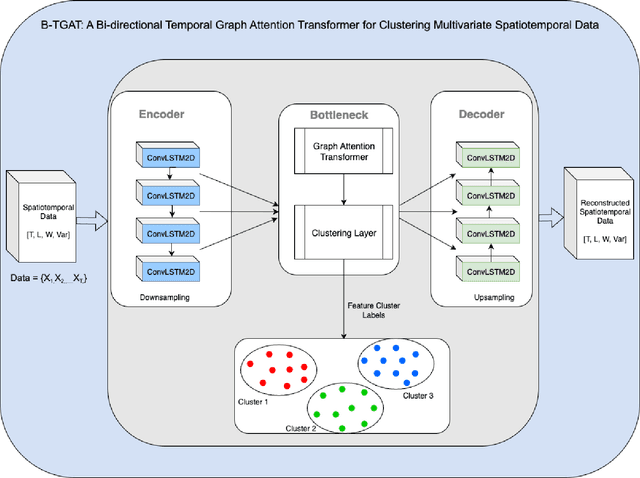
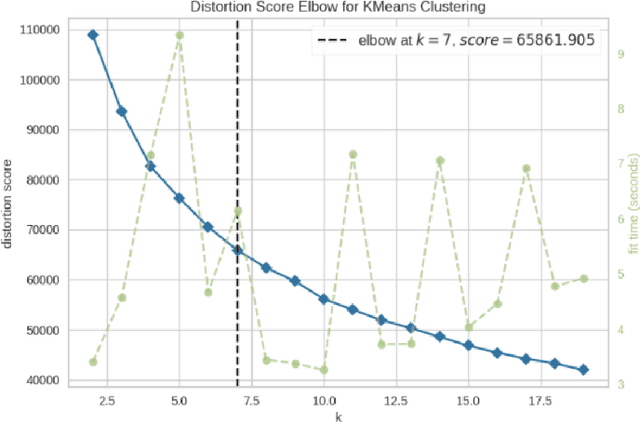
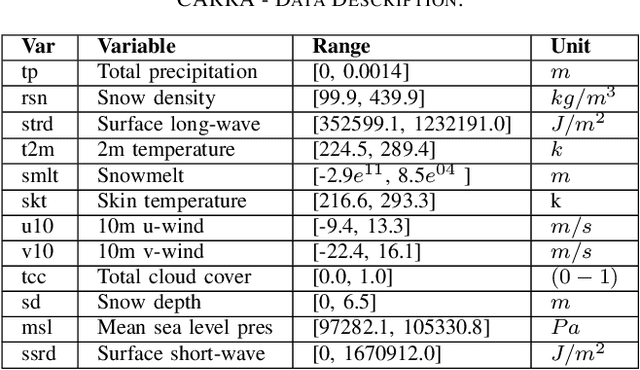
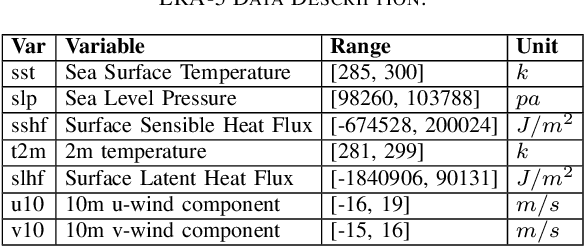
Clustering high-dimensional multivariate spatiotemporal climate data is challenging due to complex temporal dependencies, evolving spatial interactions, and non-stationary dynamics. Conventional clustering methods, including recurrent and convolutional models, often struggle to capture both local and global temporal relationships while preserving spatial context. We present a time-distributed hybrid U-Net autoencoder that integrates a Bi-directional Temporal Graph Attention Transformer (B-TGAT) to guide efficient temporal clustering of multidimensional spatiotemporal climate datasets. The encoder and decoder are equipped with ConvLSTM2D modules that extract joint spatial--temporal features by modeling localized dynamics and spatial correlations over time, and skip connections that preserve multiscale spatial details during feature compression and reconstruction. At the bottleneck, B-TGAT integrates graph-based spatial modeling with attention-driven temporal encoding, enabling adaptive weighting of temporal neighbors and capturing both short and long-range dependencies across regions. This architecture produces discriminative latent embeddings optimized for clustering. Experiments on three distinct spatiotemporal climate datasets demonstrate superior cluster separability, temporal stability, and alignment with known climate transitions compared to state-of-the-art baselines. The integration of ConvLSTM2D, U-Net skip connections, and B-TGAT enhances temporal clustering performance while providing interpretable insights into complex spatiotemporal variability, advancing both methodological development and climate science applications.
Improving Greenland Bed Topography Mapping with Uncertainty-Aware Graph Learning on Sparse Radar Data
Sep 10, 2025Accurate maps of Greenland's subglacial bed are essential for sea-level projections, but radar observations are sparse and uneven. We introduce GraphTopoNet, a graph-learning framework that fuses heterogeneous supervision and explicitly models uncertainty via Monte Carlo dropout. Spatial graphs built from surface observables (elevation, velocity, mass balance) are augmented with gradient features and polynomial trends to capture both local variability and broad structure. To handle data gaps, we employ a hybrid loss that combines confidence-weighted radar supervision with dynamically balanced regularization. Applied to three Greenland subregions, GraphTopoNet outperforms interpolation, convolutional, and graph-based baselines, reducing error by up to 60 percent while preserving fine-scale glacial features. The resulting bed maps improve reliability for operational modeling, supporting agencies engaged in climate forecasting and policy. More broadly, GraphTopoNet shows how graph machine learning can convert sparse, uncertain geophysical observations into actionable knowledge at continental scale.
Cloud Optical Thickness Retrievals Using Angle Invariant Attention Based Deep Learning Models
May 30, 2025Cloud Optical Thickness (COT) is a critical cloud property influencing Earth's climate, weather, and radiation budget. Satellite radiance measurements enable global COT retrieval, but challenges like 3D cloud effects, viewing angles, and atmospheric interference must be addressed to ensure accurate estimation. Traditionally, the Independent Pixel Approximation (IPA) method, which treats individual pixels independently, has been used for COT estimation. However, IPA introduces significant bias due to its simplified assumptions. Recently, deep learning-based models have shown improved performance over IPA but lack robustness, as they are sensitive to variations in radiance intensity, distortions, and cloud shadows. These models also introduce substantial errors in COT estimation under different solar and viewing zenith angles. To address these challenges, we propose a novel angle-invariant, attention-based deep model called Cloud-Attention-Net with Angle Coding (CAAC). Our model leverages attention mechanisms and angle embeddings to account for satellite viewing geometry and 3D radiative transfer effects, enabling more accurate retrieval of COT. Additionally, our multi-angle training strategy ensures angle invariance. Through comprehensive experiments, we demonstrate that CAAC significantly outperforms existing state-of-the-art deep learning models, reducing cloud property retrieval errors by at least a factor of nine.