 Add to Chrome
 Add to Firefox
 Add to Edge
HyperFM: An Efficient Hyperspectral Foundation Model with Spectral Grouping
Apr 22, 2026
The NASA PACE mission provides unprecedented hyperspectral observations of ocean color, aerosols, and clouds, offering new insights into how these components interact and influence Earth's climate and air quality. Its Ocean Color Instrument measures light across hundreds of finely spaced wavelength bands, enabling detailed characterization of features such as phytoplankton composition, aerosol properties, and cloud microphysics. However, hyperspectral data of this scale is large, complex, and difficult to label, requiring specialized processing and analysis techniques. Existing foundation models, which have transformed computer vision and natural language processing, are generally trained on standard RGB imagery and therefore struggle to interpret the continuous spectral signatures captured by PACE. While recent advances have introduced hyperspectral foundation models, they are typically trained on cloud-free observations and often remain limited to single-sensor datasets due to spectral inconsistencies across instruments. Moreover, existing models tend to be parameter-heavy and computationally expensive, limiting scalability and adoption in operational settings. To address these challenges, we introduce HyperFM, a parameter-efficient hyperspectral foundation model that leverages intra-group and inter-group spectral attention along with hybrid parameter decomposition to better capture spectral spatial relationships while reducing computational cost. HyperFM demonstrates consistent performance improvements over existing hyperspectral foundation models and task-specific state-of-the-art methods across four benchmark downstream atmospheric cloud property retrieval tasks. To support further research, we additionally release HyperFM250K, a large-scale hyperspectral dataset from the PACE mission that includes both clear and cloudy scenes.

Cloud Optical Thickness Retrievals Using Angle Invariant Attention Based Deep Learning Models
May 30, 2025Cloud Optical Thickness (COT) is a critical cloud property influencing Earth's climate, weather, and radiation budget. Satellite radiance measurements enable global COT retrieval, but challenges like 3D cloud effects, viewing angles, and atmospheric interference must be addressed to ensure accurate estimation. Traditionally, the Independent Pixel Approximation (IPA) method, which treats individual pixels independently, has been used for COT estimation. However, IPA introduces significant bias due to its simplified assumptions. Recently, deep learning-based models have shown improved performance over IPA but lack robustness, as they are sensitive to variations in radiance intensity, distortions, and cloud shadows. These models also introduce substantial errors in COT estimation under different solar and viewing zenith angles. To address these challenges, we propose a novel angle-invariant, attention-based deep model called Cloud-Attention-Net with Angle Coding (CAAC). Our model leverages attention mechanisms and angle embeddings to account for satellite viewing geometry and 3D radiative transfer effects, enabling more accurate retrieval of COT. Additionally, our multi-angle training strategy ensures angle invariance. Through comprehensive experiments, we demonstrate that CAAC significantly outperforms existing state-of-the-art deep learning models, reducing cloud property retrieval errors by at least a factor of nine.
Joint Retrieval of Cloud properties using Attention-based Deep Learning Models
Apr 09, 2025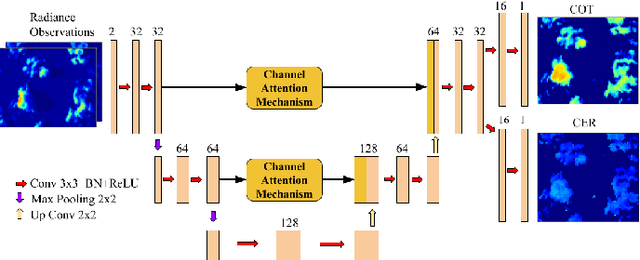
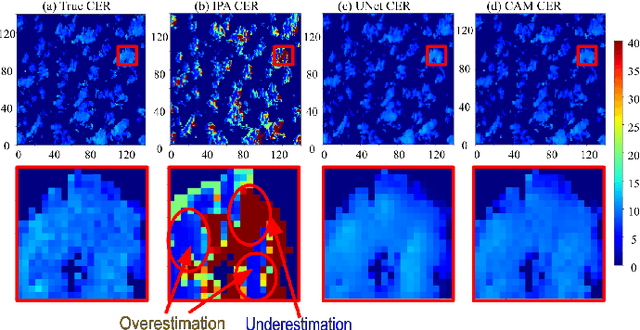
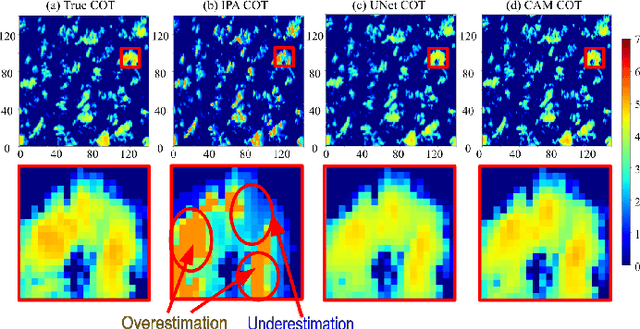
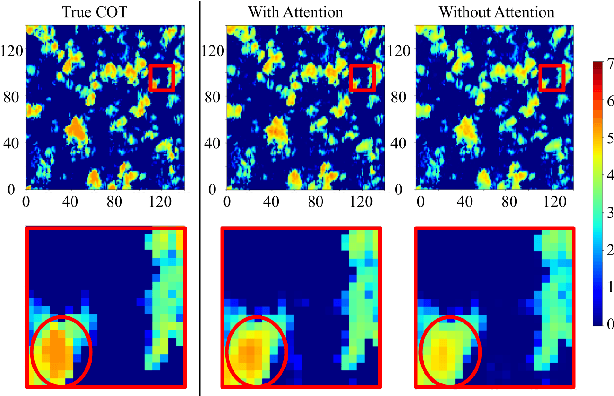
Accurate cloud property retrieval is vital for understanding cloud behavior and its impact on climate, including applications in weather forecasting, climate modeling, and estimating Earth's radiation balance. The Independent Pixel Approximation (IPA), a widely used physics-based approach, simplifies radiative transfer calculations by assuming each pixel is independent of its neighbors. While computationally efficient, IPA has significant limitations, such as inaccuracies from 3D radiative effects, errors at cloud edges, and ineffectiveness for overlapping or heterogeneous cloud fields. Recent AI/ML-based deep learning models have improved retrieval accuracy by leveraging spatial relationships across pixels. However, these models are often memory-intensive, retrieve only a single cloud property, or struggle with joint property retrievals. To overcome these challenges, we introduce CloudUNet with Attention Module (CAM), a compact UNet-based model that employs attention mechanisms to reduce errors in thick, overlapping cloud regions and a specialized loss function for joint retrieval of Cloud Optical Thickness (COT) and Cloud Effective Radius (CER). Experiments on a Large Eddy Simulation (LES) dataset show that our CAM model outperforms state-of-the-art deep learning methods, reducing mean absolute errors (MAE) by 34% for COT and 42% for CER, and achieving 76% and 86% lower MAE for COT and CER retrievals compared to the IPA method.