 Add to Chrome
 Add to Firefox
 Add to Edge
Multi-Speaker Conversational Audio Deepfake: Taxonomy, Dataset and Pilot Study
Jan 30, 2026
The rapid advances in text-to-speech (TTS) technologies have made audio deepfakes increasingly realistic and accessible, raising significant security and trust concerns. While existing research has largely focused on detecting single-speaker audio deepfakes, real-world malicious applications with multi-speaker conversational settings is also emerging as a major underexplored threat. To address this gap, we propose a conceptual taxonomy of multi-speaker conversational audio deepfakes, distinguishing between partial manipulations (one or multiple speakers altered) and full manipulations (entire conversations synthesized). As a first step, we introduce a new Multi-speaker Conversational Audio Deepfakes Dataset (MsCADD) of 2,830 audio clips containing real and fully synthetic two-speaker conversations, generated using VITS and SoundStorm-based NotebookLM models to simulate natural dialogue with variations in speaker gender, and conversational spontaneity. MsCADD is limited to text-to-speech (TTS) types of deepfake. We benchmark three neural baseline models; LFCC-LCNN, RawNet2, and Wav2Vec 2.0 on this dataset and report performance in terms of F1 score, accuracy, true positive rate (TPR), and true negative rate (TNR). Results show that these baseline models provided a useful benchmark, however, the results also highlight that there is a significant gap in multi-speaker deepfake research in reliably detecting synthetic voices under varied conversational dynamics. Our dataset and benchmarks provide a foundation for future research on deepfake detection in conversational scenarios, which is a highly underexplored area of research but also a major area of threat to trustworthy information in audio settings. The MsCADD dataset is publicly available to support reproducibility and benchmarking by the research community.

Time-Varying Causal Treatment for Quantifying the Causal Effect of Short-Term Variations on Arctic Sea Ice Dynamics
Jan 25, 2026Quantifying the causal relationship between ice melt and freshwater distribution is critical, as these complex interactions manifest as regional fluctuations in sea surface height (SSH). Leveraging SSH as a proxy for sea ice dynamics enables improved understanding of the feedback mechanisms driving polar climate change and global sea-level rise. However, conventional deep learning models often struggle with reliable treatment effect estimation in spatiotemporal settings due to unobserved confounders and the absence of physical constraints. To address these challenges, we propose the Knowledge-Guided Causal Model Variational Autoencoder (KGCM-VAE) to quantify causal mechanisms between sea ice thickness and SSH. The proposed framework integrates a velocity modulation scheme in which smoothed velocity signals are dynamically amplified via a sigmoid function governed by SSH transitions to generate physically grounded causal treatments. In addition, the model incorporates Maximum Mean Discrepancy (MMD) to balance treated and control covariate distributions in the latent space, along with a causal adjacency-constrained decoder to ensure alignment with established physical structures. Experimental results on both synthetic and real-world Arctic datasets demonstrate that KGCM-VAE achieves superior PEHE compared to state-of-the-art benchmarks. Ablation studies further confirm the effectiveness of the approach, showing that the joint application of MMD and causal adjacency constraints yields a 1.88\% reduction in estimation error.
PhysE-Inv: A Physics-Encoded Inverse Modeling approach for Arctic Snow Depth Prediction
Jan 23, 2026The accurate estimation of Arctic snow depth ($h_s$) remains a critical time-varying inverse problem due to the extreme scarcity and noise inherent in associated sea ice parameters. Existing process-based and data-driven models are either highly sensitive to sparse data or lack the physical interpretability required for climate-critical applications. To address this gap, we introduce PhysE-Inv, a novel framework that integrates a sophisticated sequential architecture, an LSTM Encoder-Decoder with Multi-head Attention and physics-guided contrastive learning, with physics-guided inference.Our core innovation lies in a surjective, physics-constrained inversion methodology. This methodology first leverages the hydrostatic balance forward model as a target-formulation proxy, enabling effective learning in the absence of direct $h_s$ ground truth; second, it uses reconstruction physics regularization over a latent space to dynamically discover hidden physical parameters from noisy, incomplete time-series input. Evaluated against state-of-the-art baselines, PhysE-Inv significantly improves prediction performance, reducing error by 20\% while demonstrating superior physical consistency and resilience to data sparsity compared to empirical methods. This approach pioneers a path for noise-tolerant, interpretable inverse modeling, with wide applicability in geospatial and cryospheric domains.
Learning Subglacial Bed Topography from Sparse Radar with Physics-Guided Residuals
Nov 18, 2025Accurate subglacial bed topography is essential for ice sheet modeling, yet radar observations are sparse and uneven. We propose a physics-guided residual learning framework that predicts bed thickness residuals over a BedMachine prior and reconstructs bed from the observed surface. A DeepLabV3+ decoder over a standard encoder (e.g.,ResNet-50) is trained with lightweight physics and data terms: multi-scale mass conservation, flow-aligned total variation, Laplacian damping, non-negativity of thickness, a ramped prior-consistency term, and a masked Huber fit to radar picks modulated by a confidence map. To measure real-world generalization, we adopt leakage-safe blockwise hold-outs (vertical/horizontal) with safety buffers and report metrics only on held-out cores. Across two Greenland sub-regions, our approach achieves strong test-core accuracy and high structural fidelity, outperforming U-Net, Attention U-Net, FPN, and a plain CNN. The residual-over-prior design, combined with physics, yields spatially coherent, physically plausible beds suitable for operational mapping under domain shift.
Improving Greenland Bed Topography Mapping with Uncertainty-Aware Graph Learning on Sparse Radar Data
Sep 10, 2025Accurate maps of Greenland's subglacial bed are essential for sea-level projections, but radar observations are sparse and uneven. We introduce GraphTopoNet, a graph-learning framework that fuses heterogeneous supervision and explicitly models uncertainty via Monte Carlo dropout. Spatial graphs built from surface observables (elevation, velocity, mass balance) are augmented with gradient features and polynomial trends to capture both local variability and broad structure. To handle data gaps, we employ a hybrid loss that combines confidence-weighted radar supervision with dynamically balanced regularization. Applied to three Greenland subregions, GraphTopoNet outperforms interpolation, convolutional, and graph-based baselines, reducing error by up to 60 percent while preserving fine-scale glacial features. The resulting bed maps improve reliability for operational modeling, supporting agencies engaged in climate forecasting and policy. More broadly, GraphTopoNet shows how graph machine learning can convert sparse, uncertain geophysical observations into actionable knowledge at continental scale.
DeepTopoNet: A Framework for Subglacial Topography Estimation on the Greenland Ice Sheets
May 29, 2025Understanding Greenland's subglacial topography is critical for projecting the future mass loss of the ice sheet and its contribution to global sea-level rise. However, the complex and sparse nature of observational data, particularly information about the bed topography under the ice sheet, significantly increases the uncertainty in model projections. Bed topography is traditionally measured by airborne ice-penetrating radar that measures the ice thickness directly underneath the aircraft, leaving data gap of tens of kilometers in between flight lines. This study introduces a deep learning framework, which we call as DeepTopoNet, that integrates radar-derived ice thickness observations and BedMachine Greenland data through a novel dynamic loss-balancing mechanism. Among all efforts to reconstruct bed topography, BedMachine has emerged as one of the most widely used datasets, combining mass conservation principles and ice thickness measurements to generate high-resolution bed elevation estimates. The proposed loss function adaptively adjusts the weighting between radar and BedMachine data, ensuring robustness in areas with limited radar coverage while leveraging the high spatial resolution of BedMachine predictions i.e. bed estimates. Our approach incorporates gradient-based and trend surface features to enhance model performance and utilizes a CNN architecture designed for subgrid-scale predictions. By systematically testing on the Upernavik Isstr{\o}m) region, the model achieves high accuracy, outperforming baseline methods in reconstructing subglacial terrain. This work demonstrates the potential of deep learning in bridging observational gaps, providing a scalable and efficient solution to inferring subglacial topography.
Building Machine Learning Challenges for Anomaly Detection in Science
Mar 03, 2025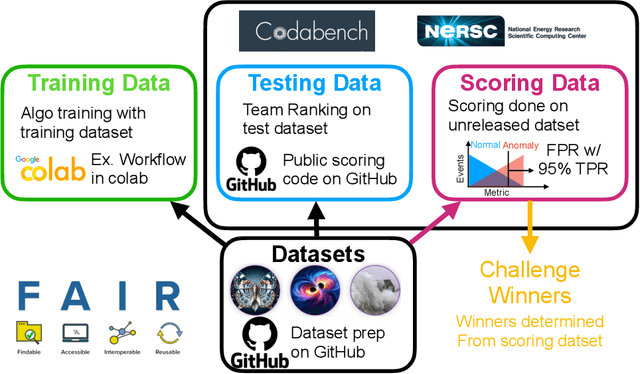
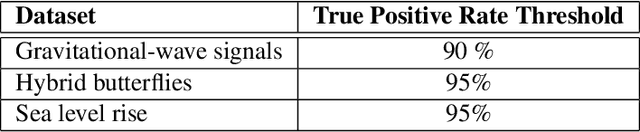
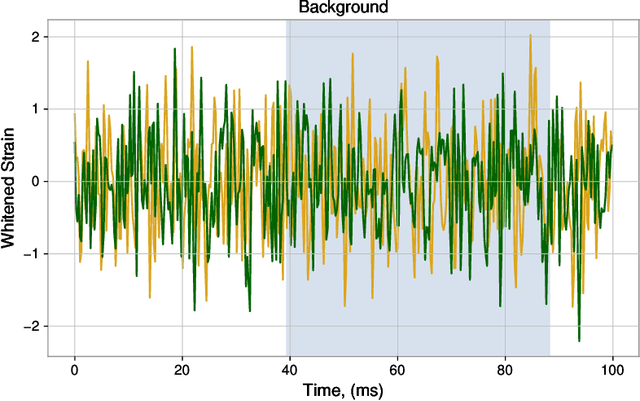
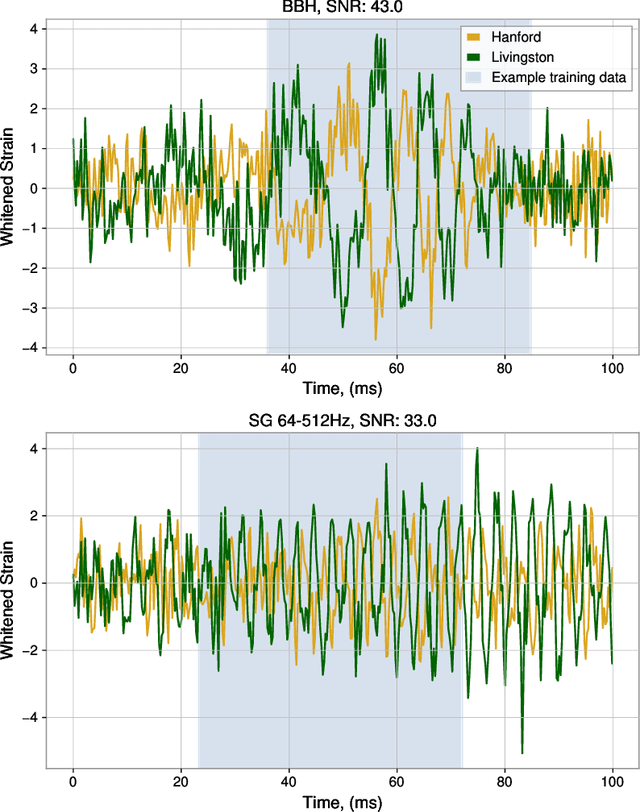
Scientific discoveries are often made by finding a pattern or object that was not predicted by the known rules of science. Oftentimes, these anomalous events or objects that do not conform to the norms are an indication that the rules of science governing the data are incomplete, and something new needs to be present to explain these unexpected outliers. The challenge of finding anomalies can be confounding since it requires codifying a complete knowledge of the known scientific behaviors and then projecting these known behaviors on the data to look for deviations. When utilizing machine learning, this presents a particular challenge since we require that the model not only understands scientific data perfectly but also recognizes when the data is inconsistent and out of the scope of its trained behavior. In this paper, we present three datasets aimed at developing machine learning-based anomaly detection for disparate scientific domains covering astrophysics, genomics, and polar science. We present the different datasets along with a scheme to make machine learning challenges around the three datasets findable, accessible, interoperable, and reusable (FAIR). Furthermore, we present an approach that generalizes to future machine learning challenges, enabling the possibility of large, more compute-intensive challenges that can ultimately lead to scientific discovery.